




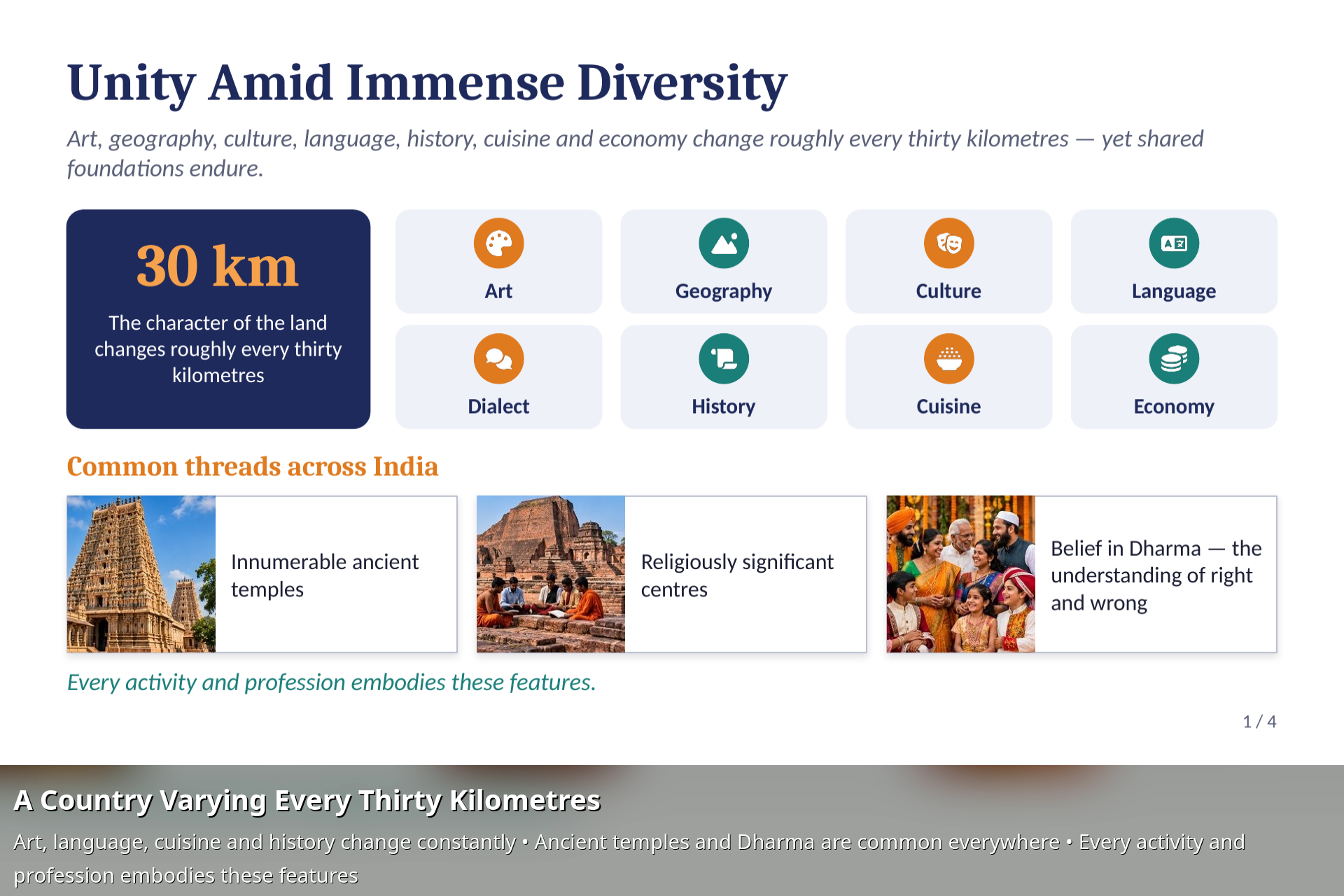
India is a vast, diverse country where the art, geography, culture, language, dialect, history, cuisine, and economic characteristics vary considerably every thirty kilometres. Innumerable ancient temples, religiously significant centres, and the belief in Dharma (understanding of right and wrong) are common features across India. Every activity and profession embodies these features.
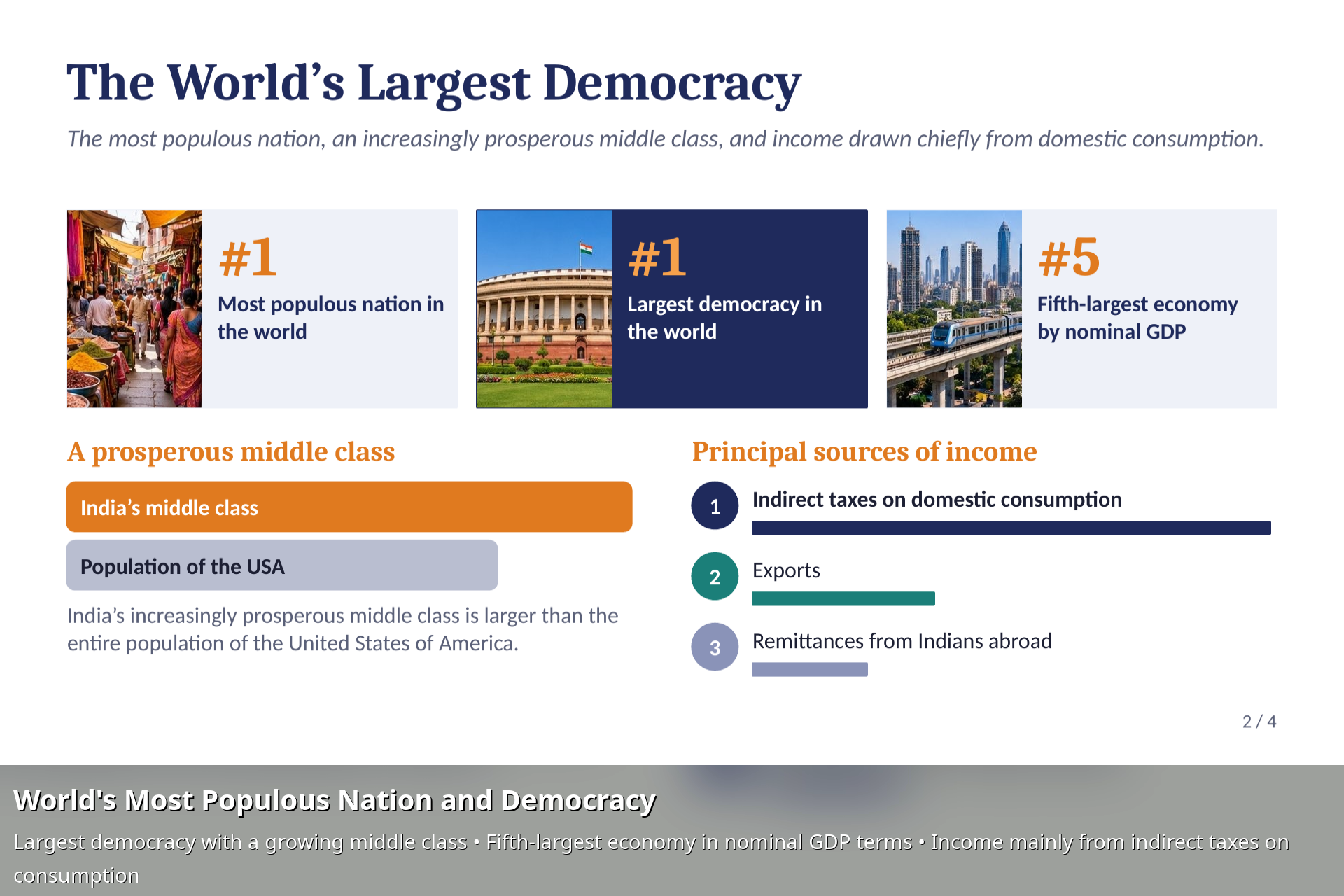
India is the world’s most populous nation with the largest democracy. With an increasingly prosperous middle class larger than the population of the United States of America, India is the world’s fifth-largest economy in nominal Gross Domestic Product (GDP) terms. Most of its income comes from indirect taxation on domestic consumption; exports and repatriation of money from Indian expatriates are distant second and third sources.
Featuring:




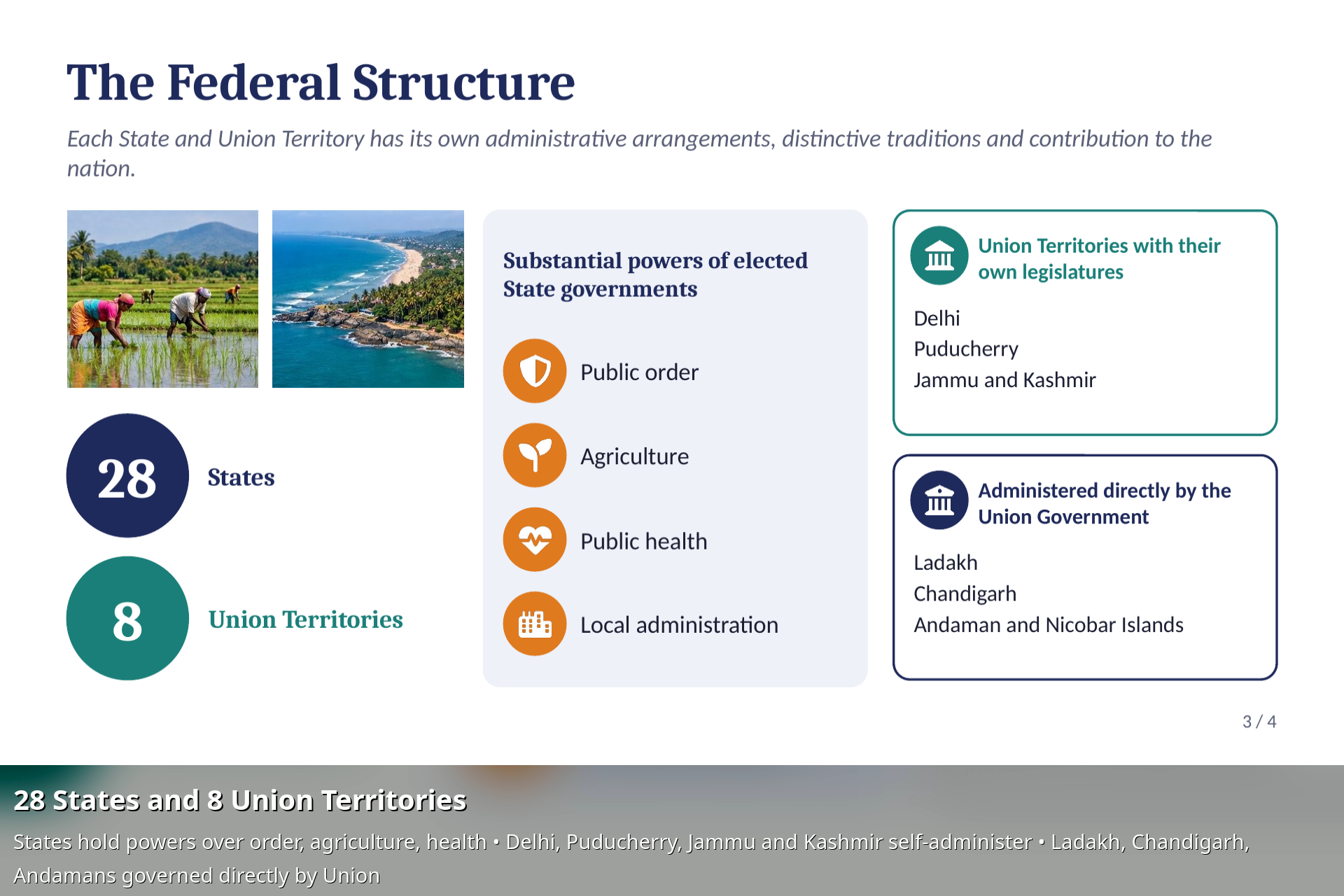
Its federal system divides the country into 28 States and 8 Union Territories, each with…
Its federal system divides the country into 28 States and 8 Union Territories, each with its own administrative arrangements, distinctive traditions and contribution to the nation. Elected governments in each state generally possess substantial powers over subjects such as public order, agriculture, public health and local administration. The Union (Federal) Government administers Union Territories directly through different arrangements. Union Territories like Delhi, Puducherry, and Jammu and Kashmir have their own legislatures and administer themselves. However, the Federal Government administers Ladakh, Chandigarh, and the Andaman and Nicobar Islands directly.
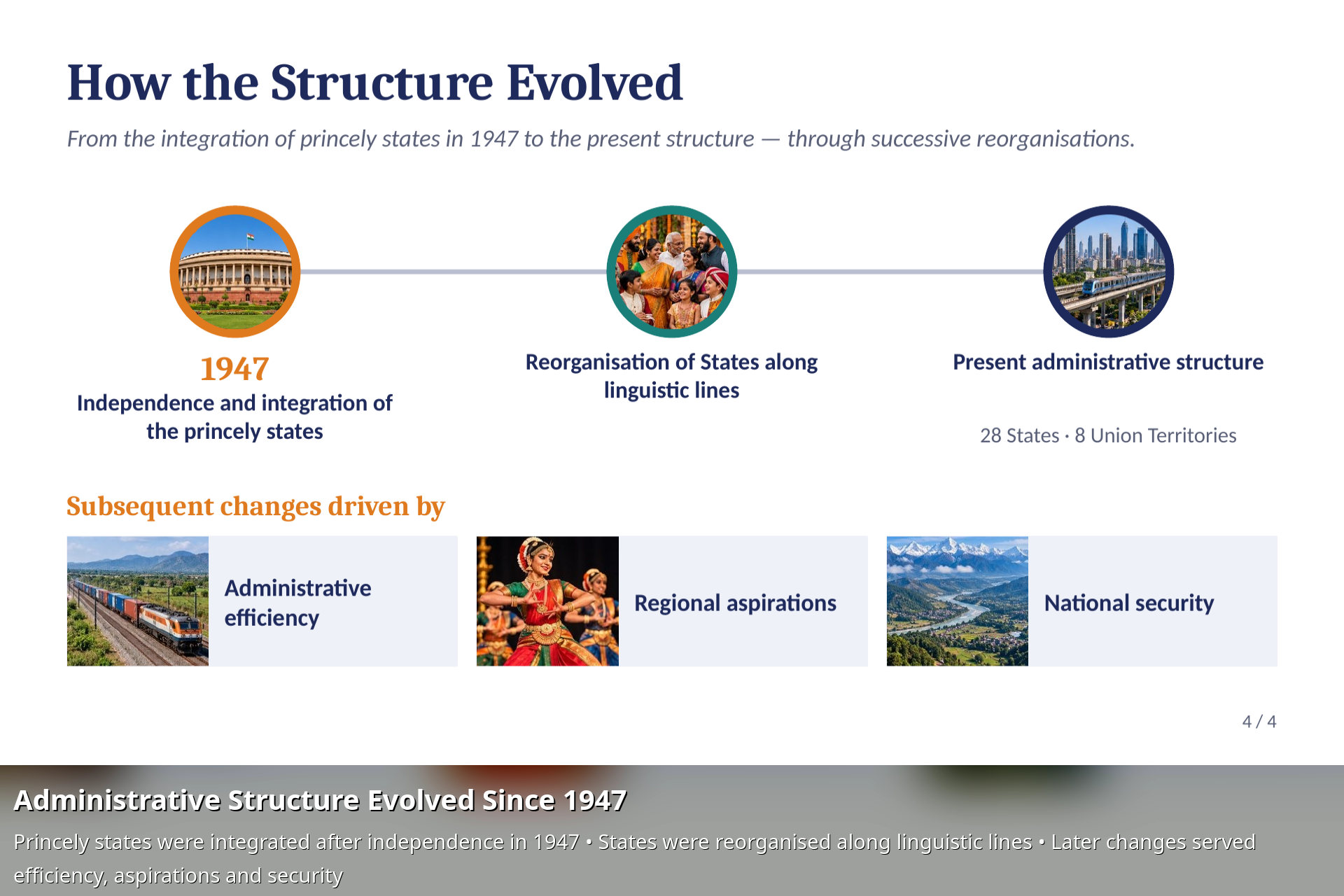
After the integration of princely states after independence in 1947, India’s present administrative structure has evolved through many changes. Notable changes include the reorganisation of States along linguistic lines and subsequent changes for administrative efficiency, regional aspirations, and national security.
The Northern RegionNorthern India encompasses the Himalayan mountain ranges, fertile river plains, historic cities and…
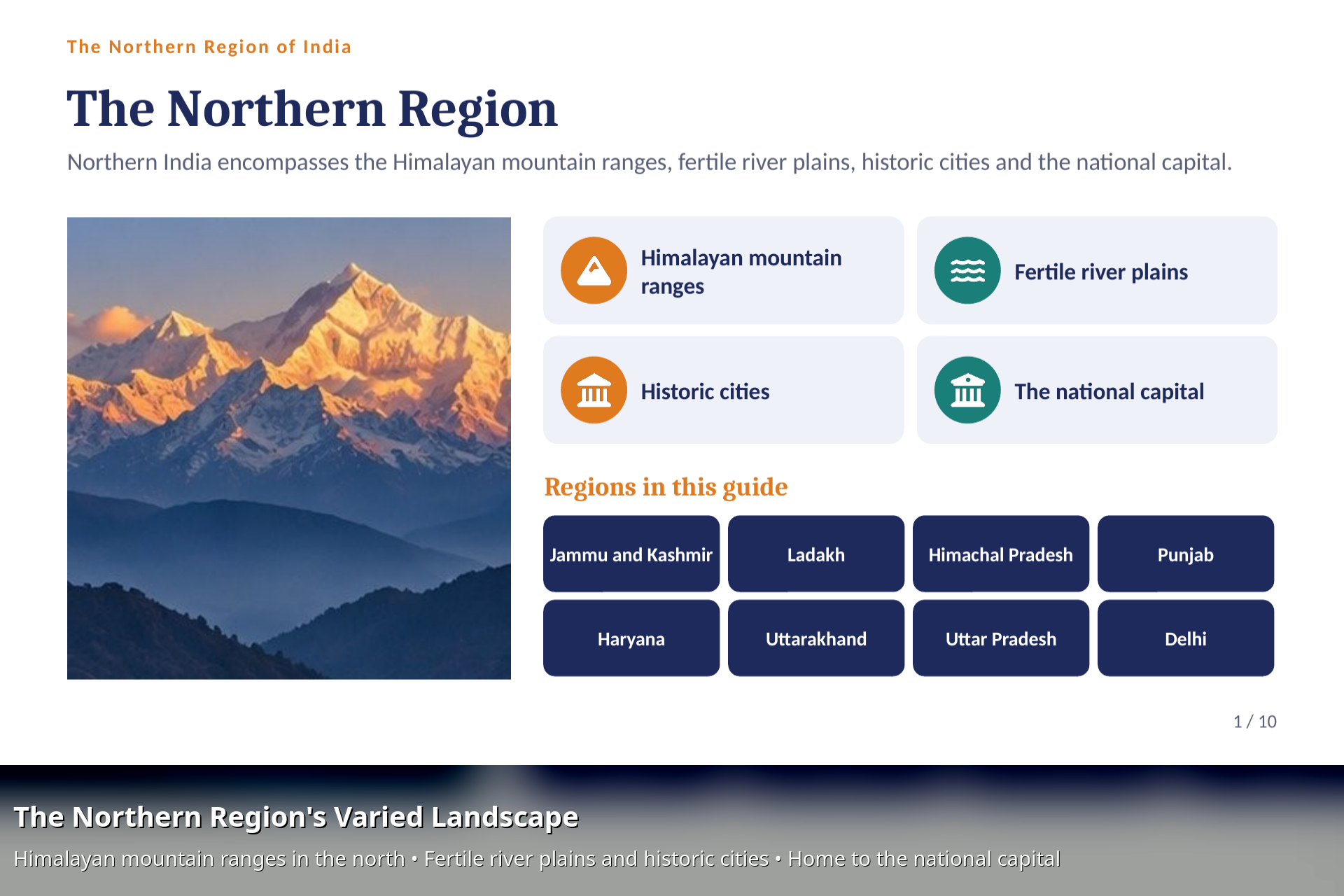
The Northern Region
Northern India encompasses the Himalayan mountain ranges, fertile river plains, historic cities and the national capital.
Featuring:




Jammu and KashmirA Union Territory known for its Himalayan landscapes, Kashmir Valley, horticulture, handicrafts and…
Jammu and Kashmir
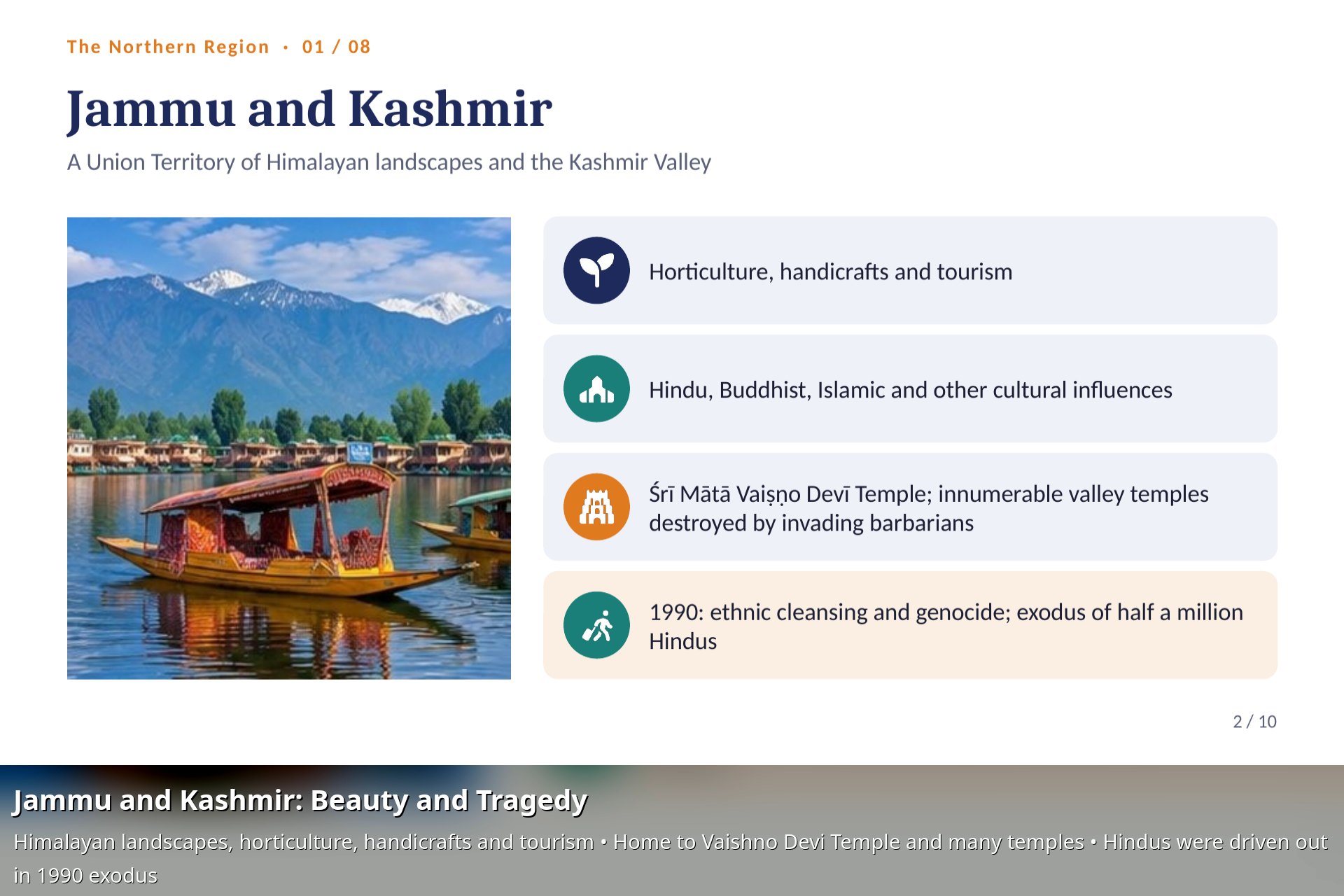
A Union Territory known for its Himalayan landscapes, Kashmir Valley, horticulture, handicrafts and tourism. Its history reflects Hindu, Buddhist, Islamic and other cultural influences. It is the proud home of the Śrī Mātā Vaiṣṇo Devī Temple and innumerable Hindu temples in the Kashmir Valley destroyed by invading barbarians. The Kashmir Valley experienced ethnic cleansing and genocide in 1990, when Islamists systematically raped Hindu women, killed Hindu men, and caused the exodus of half a million Hindus who continue to live outside the state.
LadakhA high-altitude Union Territory characterised by cold deserts, dramatic mountains, Buddhist monasteries and distinctive Tibetan…
Ladakh
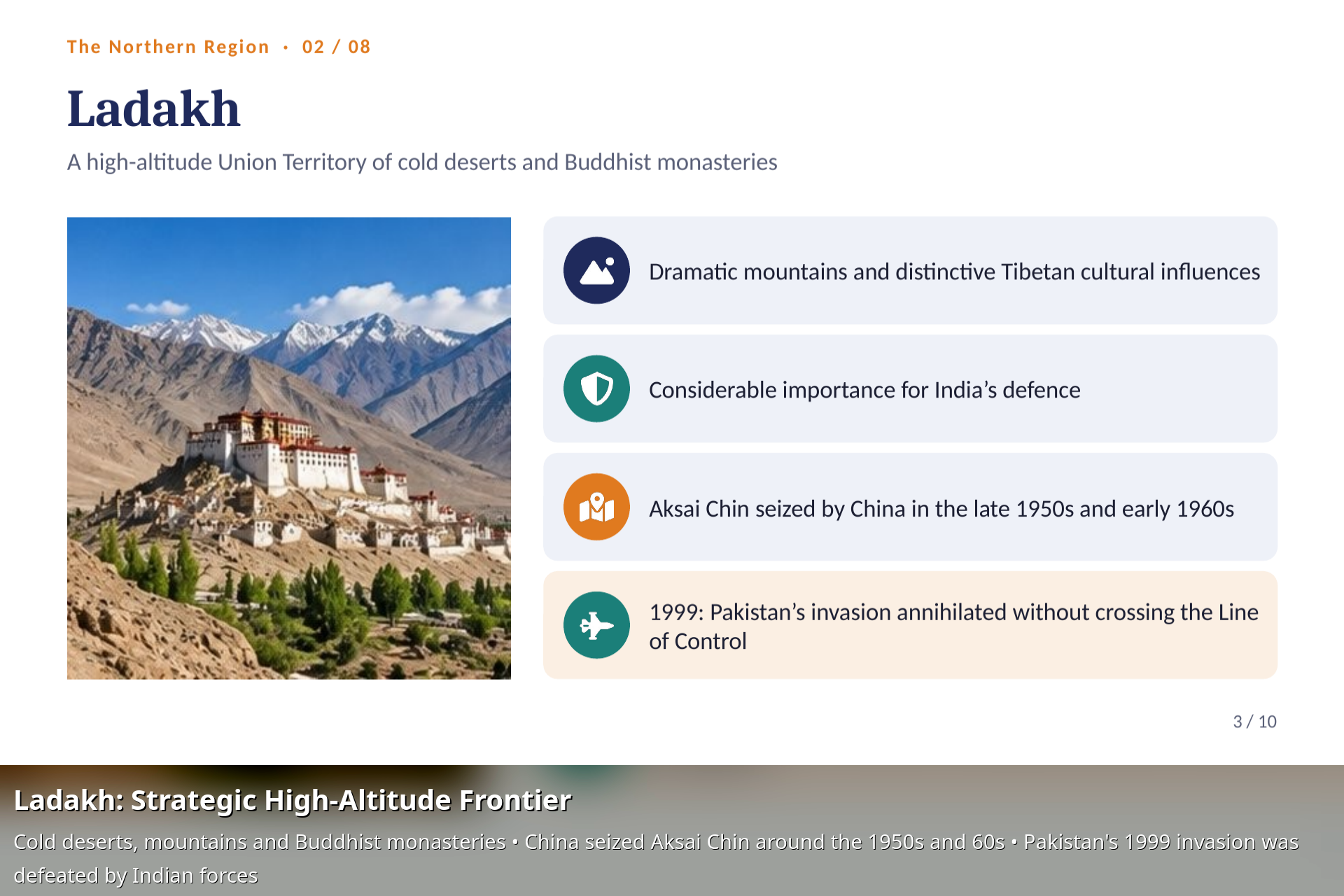
A high-altitude Union Territory characterised by cold deserts, dramatic mountains, Buddhist monasteries and distinctive Tibetan cultural influences. Its strategic location gives it considerable importance for India’s defence. China seized a piece of this region in the late 50s and early 60s called Aksai Chin. Pakistan invaded the heights over Ladakh in 1999, trying to cut off this region completely from India. However, the Indian Defence innovatively deployed artillery, the air force, and raw courage to annihilate the enemy without crossing the Line of Control.
Himachal PradeshA Himalayan State renowned for apple cultivation, forests, hill stations, hydroelectric power and mountain…
Himachal Pradesh
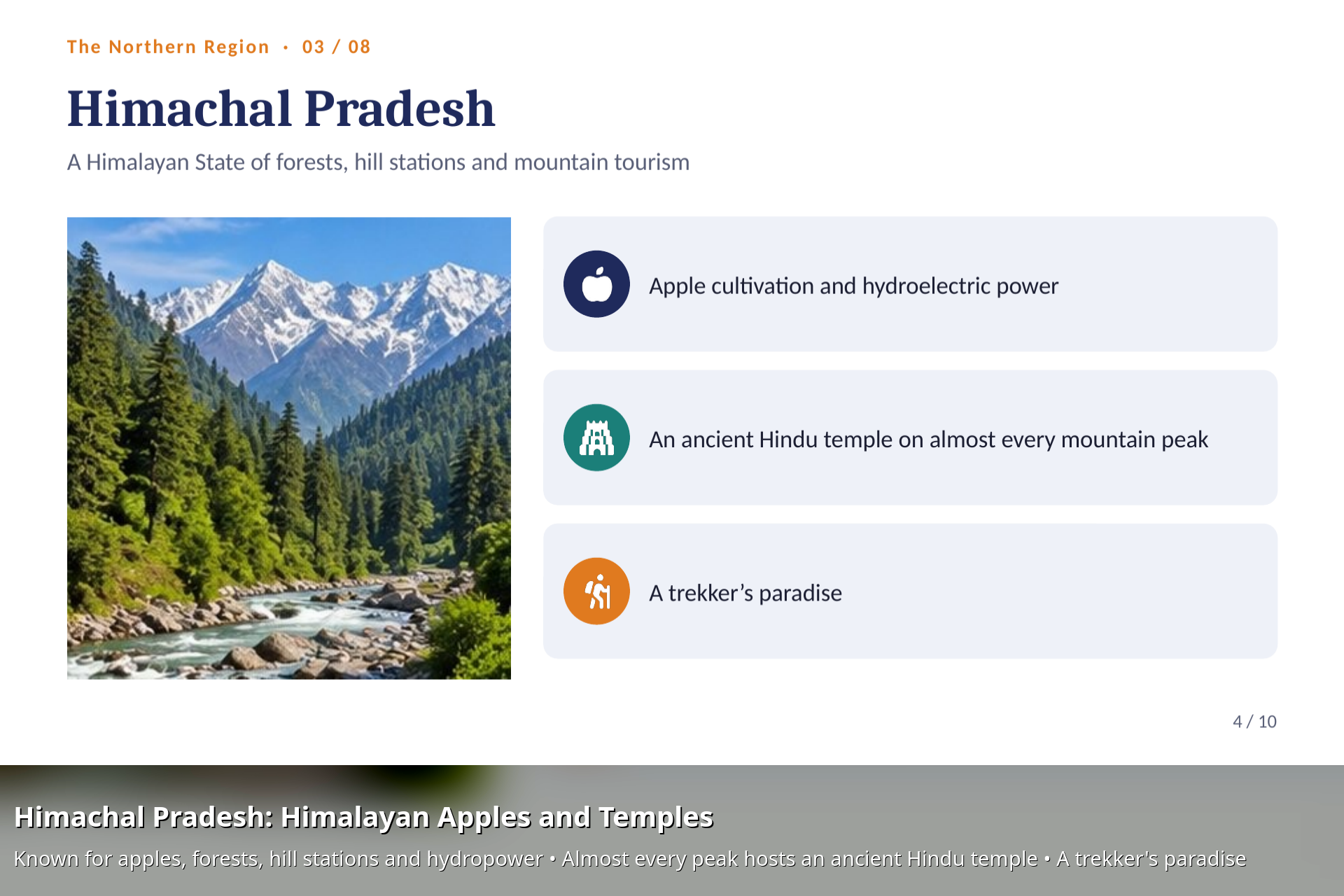
A Himalayan State renowned for apple cultivation, forests, hill stations, hydroelectric power and mountain tourism. Almost every mountain peak hosts an ancient Hindu temple. It is also a trekker’s paradise.
Featuring:


PunjabA fertile agricultural State associated with the Green Revolution, when wheat and rice production became…
Punjab
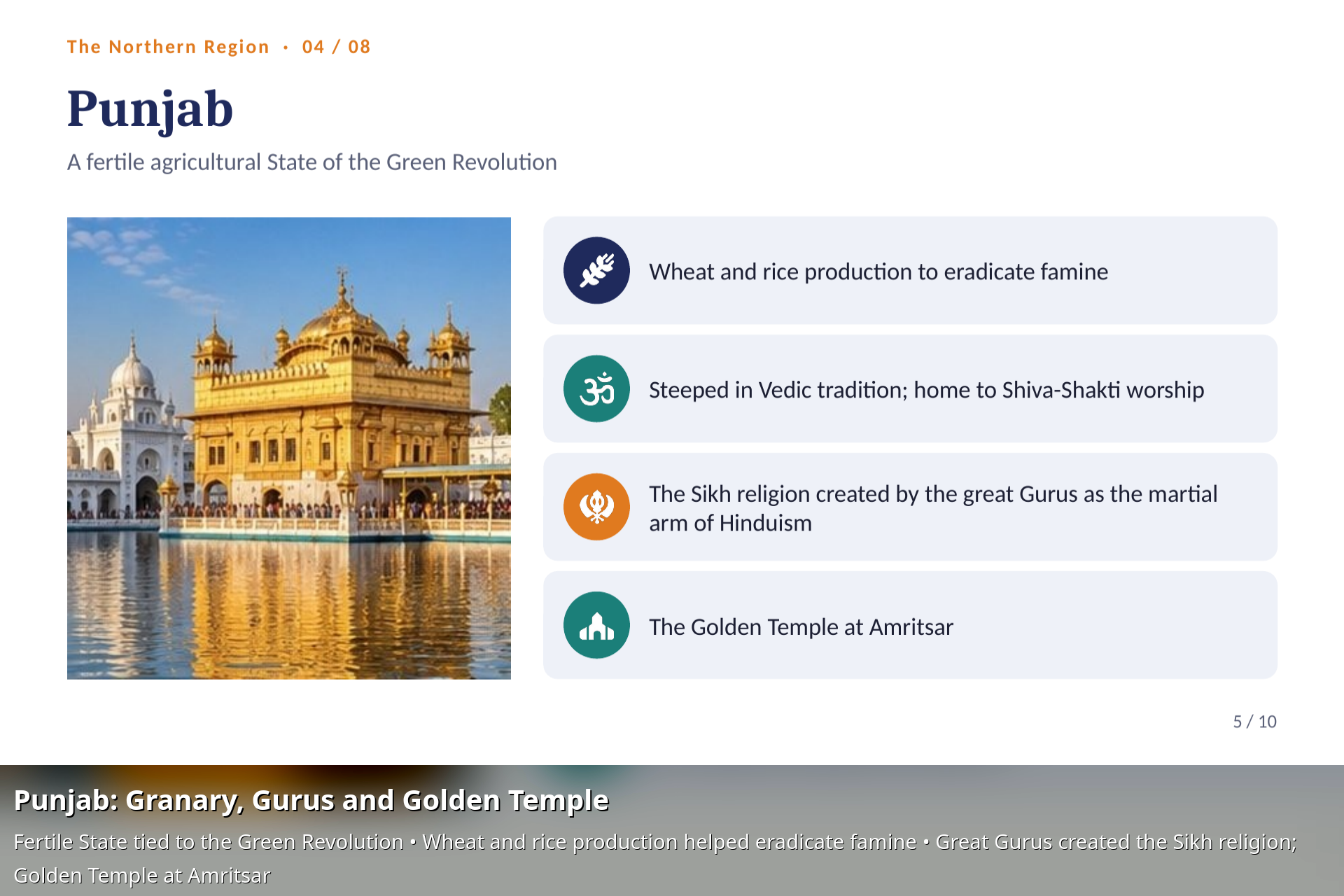
A fertile agricultural State associated with the Green Revolution, when wheat and rice production became a popular method to eradicate famine in India. Steeped in Vedic tradition, the state is home to the Shiva-Shakti tradition of worship. Being a frontline state against invading barbarians, great Gurus created the Sikh religion as the martial arm of Hinduism. It proudly hosts the Golden Temple at Amritsar.
HaryanaAn important agricultural, industrial and commercial State surrounding much of Delhi. Gurugram has evolved into…
Haryana
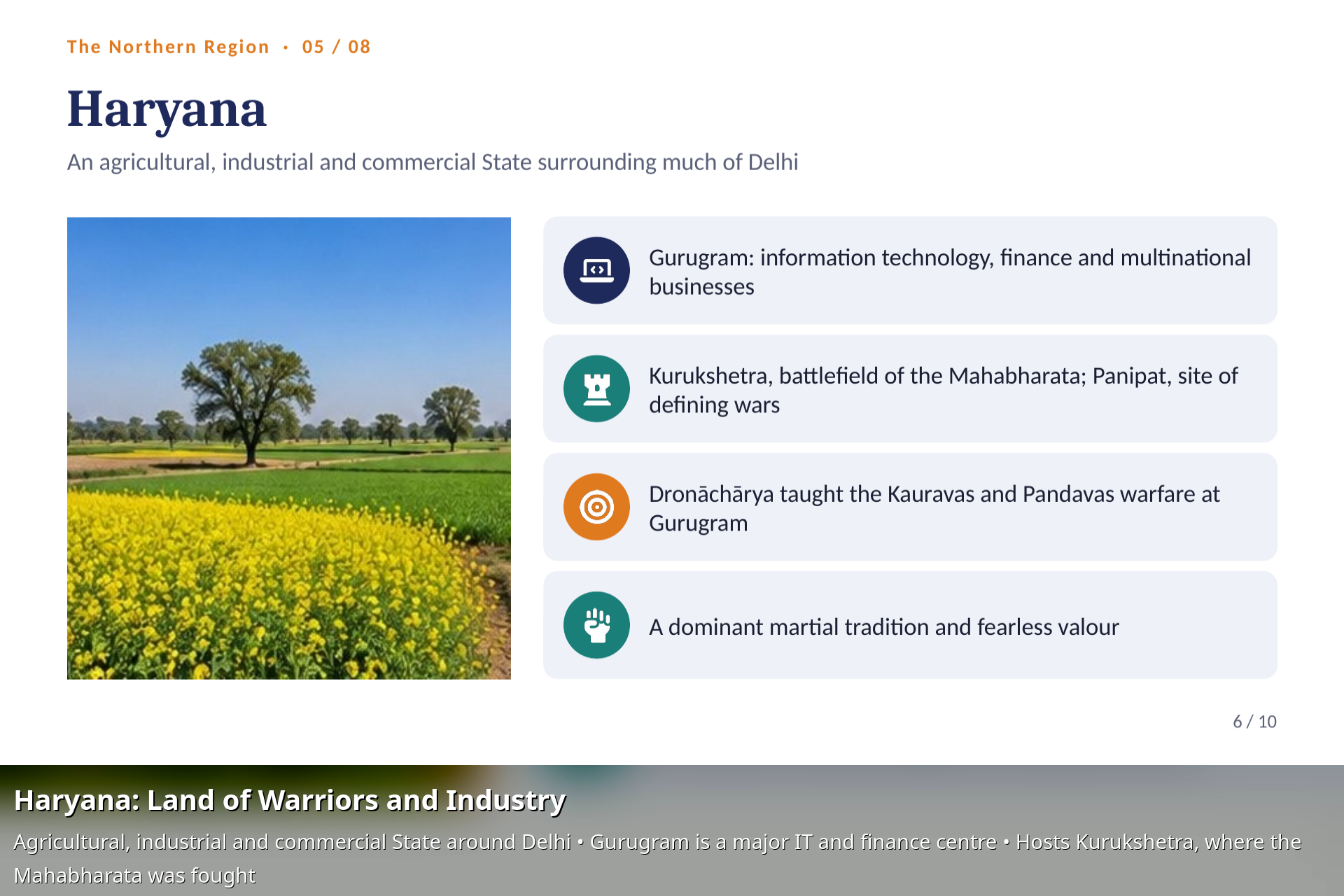
An important agricultural, industrial and commercial State surrounding much of Delhi. Gurugram has evolved into a major centre for information technology, finance and multinational businesses. Haryana was the epicentre of Indian history. With a dominant martial tradition, it hosts Kurukshetra, where the famous Mahabharata was fought. Panipat is another location that witnessed many defining wars. The Kauravas and Pandavas learnt warfare from Dronāchārya at Gurugram. Haryana natives are known for their fearless valour.
UttarakhandA Himalayan State known for its sacred pilgrimage centres, including Yamunotri, Gangotri, Badrinath, and Kedarnath.…
Uttarakhand
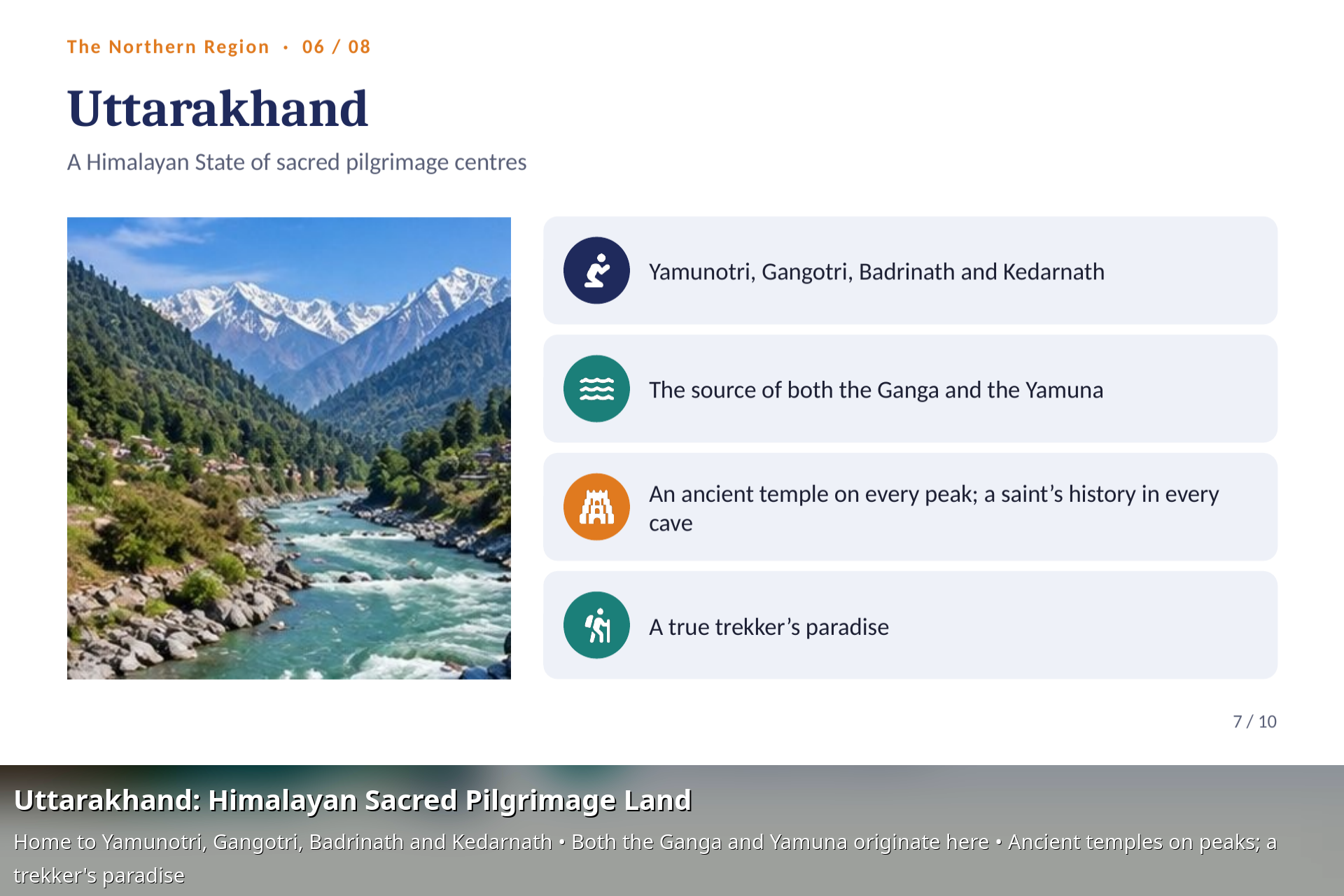
A Himalayan State known for its sacred pilgrimage centres, including Yamunotri, Gangotri, Badrinath, and Kedarnath. Both the Ganga and Yamuna originate here. Every peak has an ancient temple. Every cave has a history of an ancient saint. It is a true trekker’s paradise.
Featuring:


Uttar PradeshIndia’s most populous State, with major centres including Lucknow, Varanasi, Prayagraj, Agra, and Ayodhya.…
Uttar Pradesh
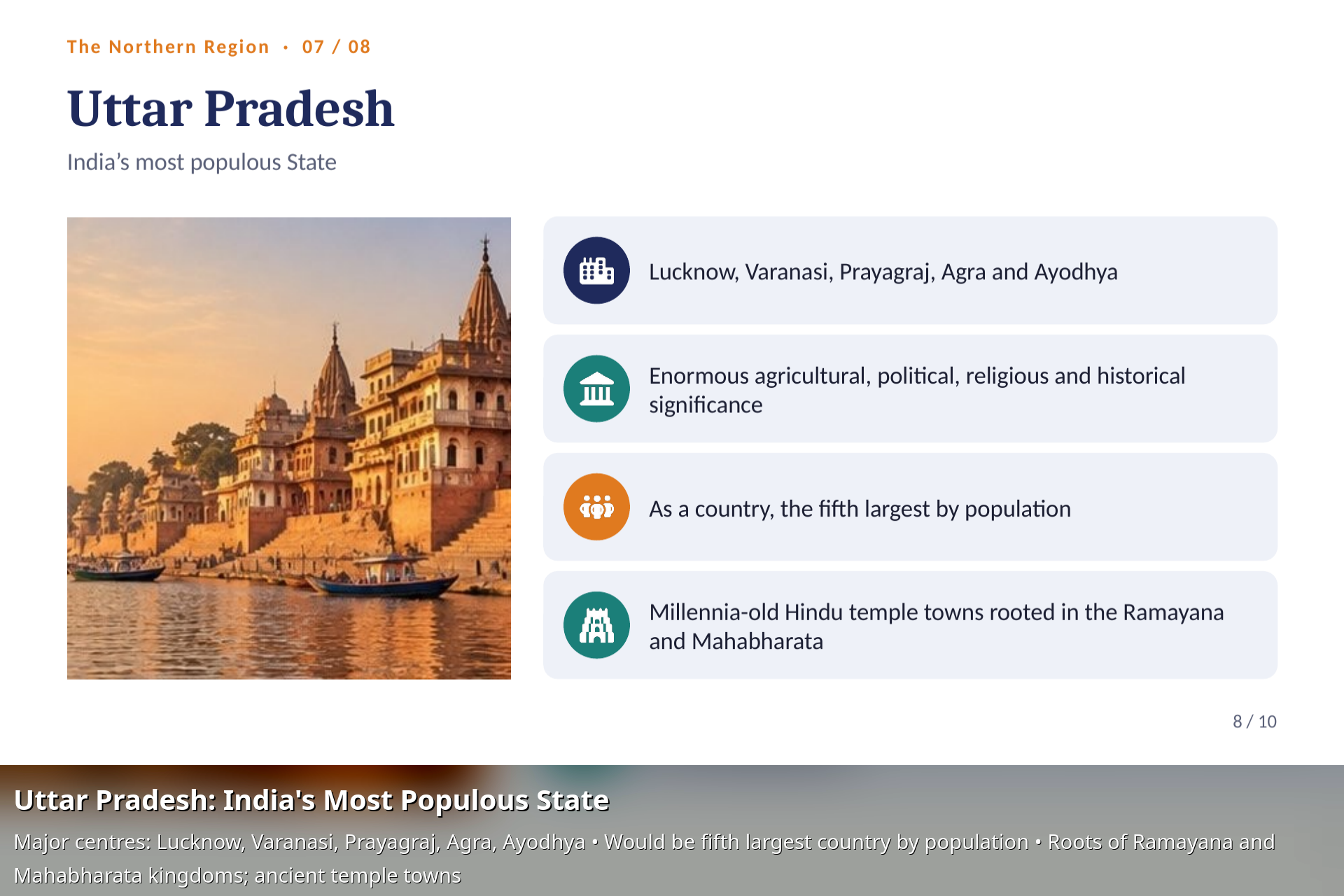
India’s most populous State, with major centres including Lucknow, Varanasi, Prayagraj, Agra, and Ayodhya. It has enormous agricultural, political, religious and historical significance. If it were a separate country, it would be the fifth largest by population. Since the great Ramayana and Mahabharata kingdoms had roots in this state, it is not surprising that several millennia-old Hindu temple towns fill this state.
DelhiThe National Capital Territory houses the Union Government’s principal institutions, Parliament, the Supreme Court and…
Delhi
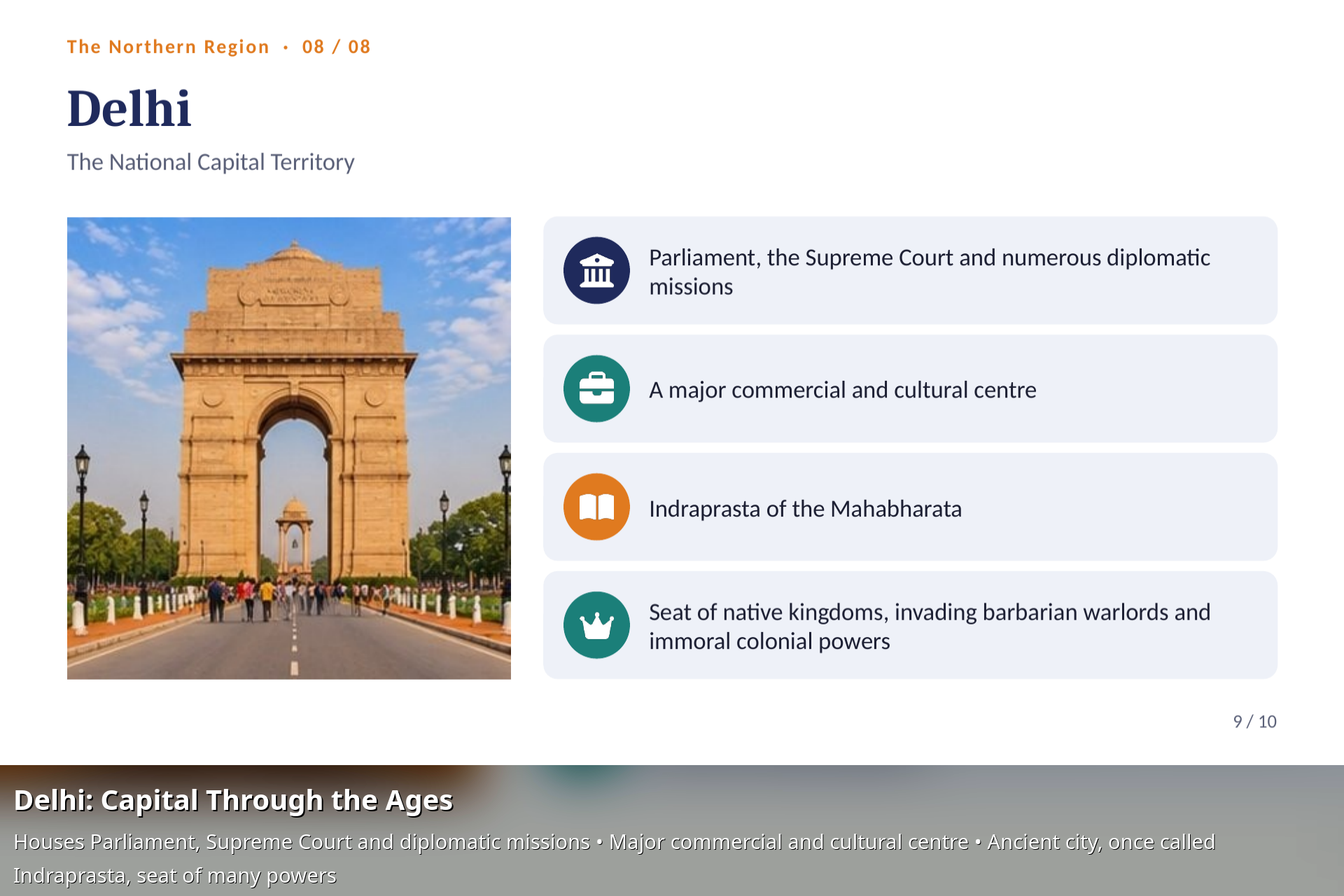
The National Capital Territory houses the Union Government’s principal institutions, Parliament, the Supreme Court and numerous diplomatic missions. It is also a major commercial and cultural centre. As an ancient city dating back to the Mahabharata, when it was called Indraprasta, the city has been the seat of power for many native kingdoms, invading barbarian warlords, and immoral colonial powers.
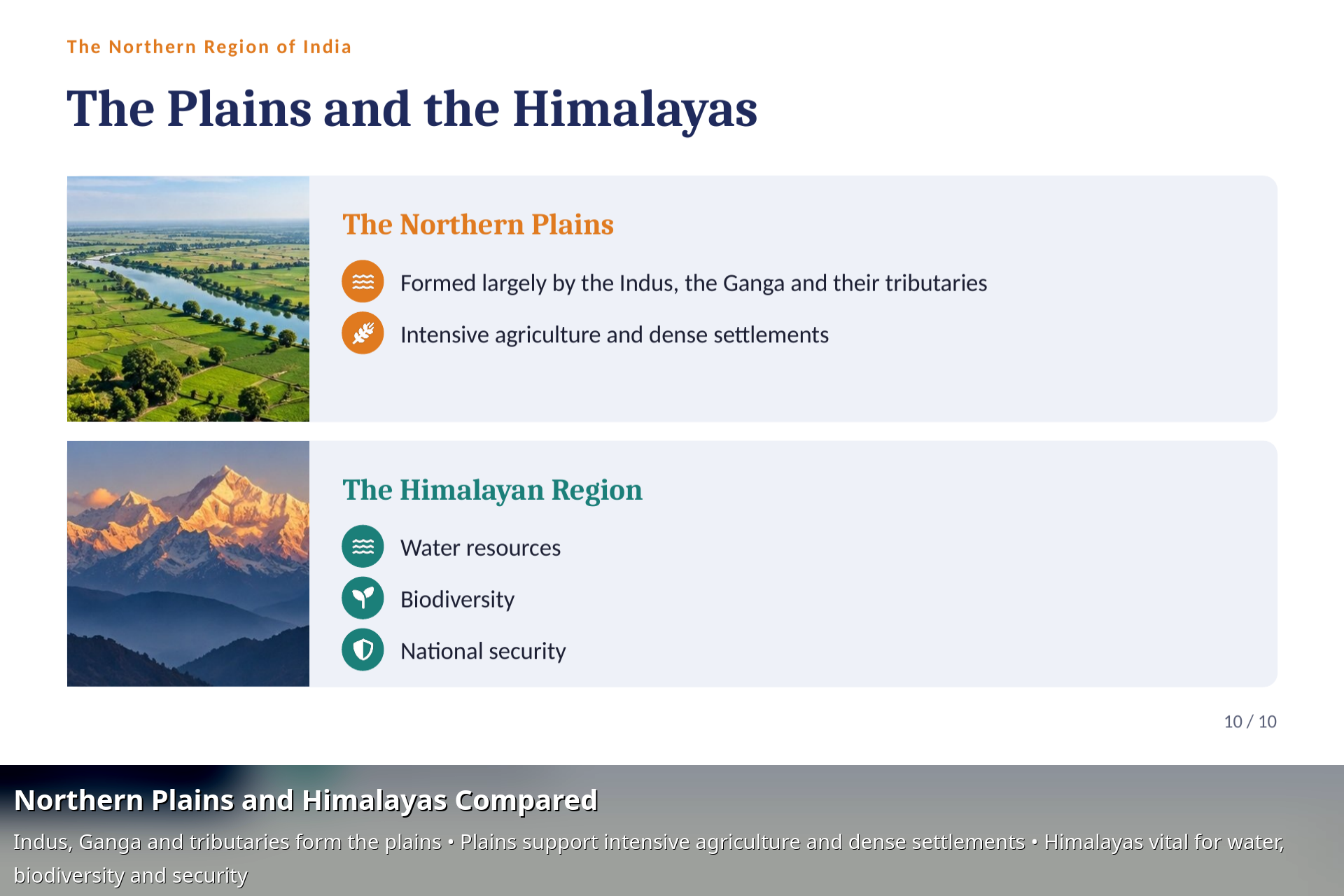
The northern plains, formed largely by the Indus, Ganga and their tributaries, support intensive agriculture and dense settlements. The Himalayan region, meanwhile, is vital for water resources, biodiversity and national security.
Featuring:
The Western RegionWestern India combines desert landscapes, fertile plateaus, long coastlines, historic trading centres and…
The Western Region
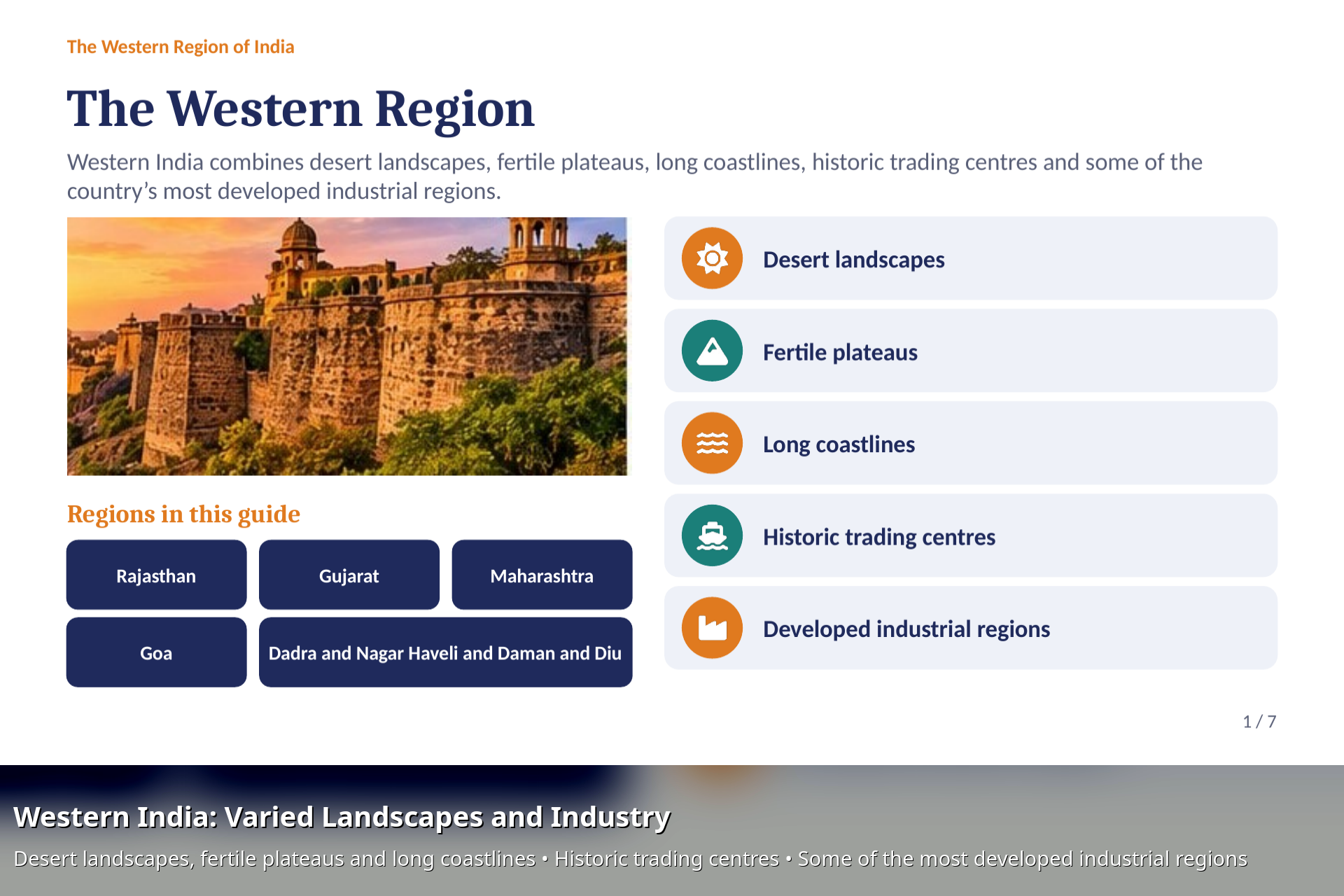
Western India combines desert landscapes, fertile plateaus, long coastlines, historic trading centres and some of the country’s most developed industrial regions.
RajasthanIndia’s largest State by area, Rajasthan features the Thar Desert, the Aravalli Range, magnificent forts,…
Rajasthan
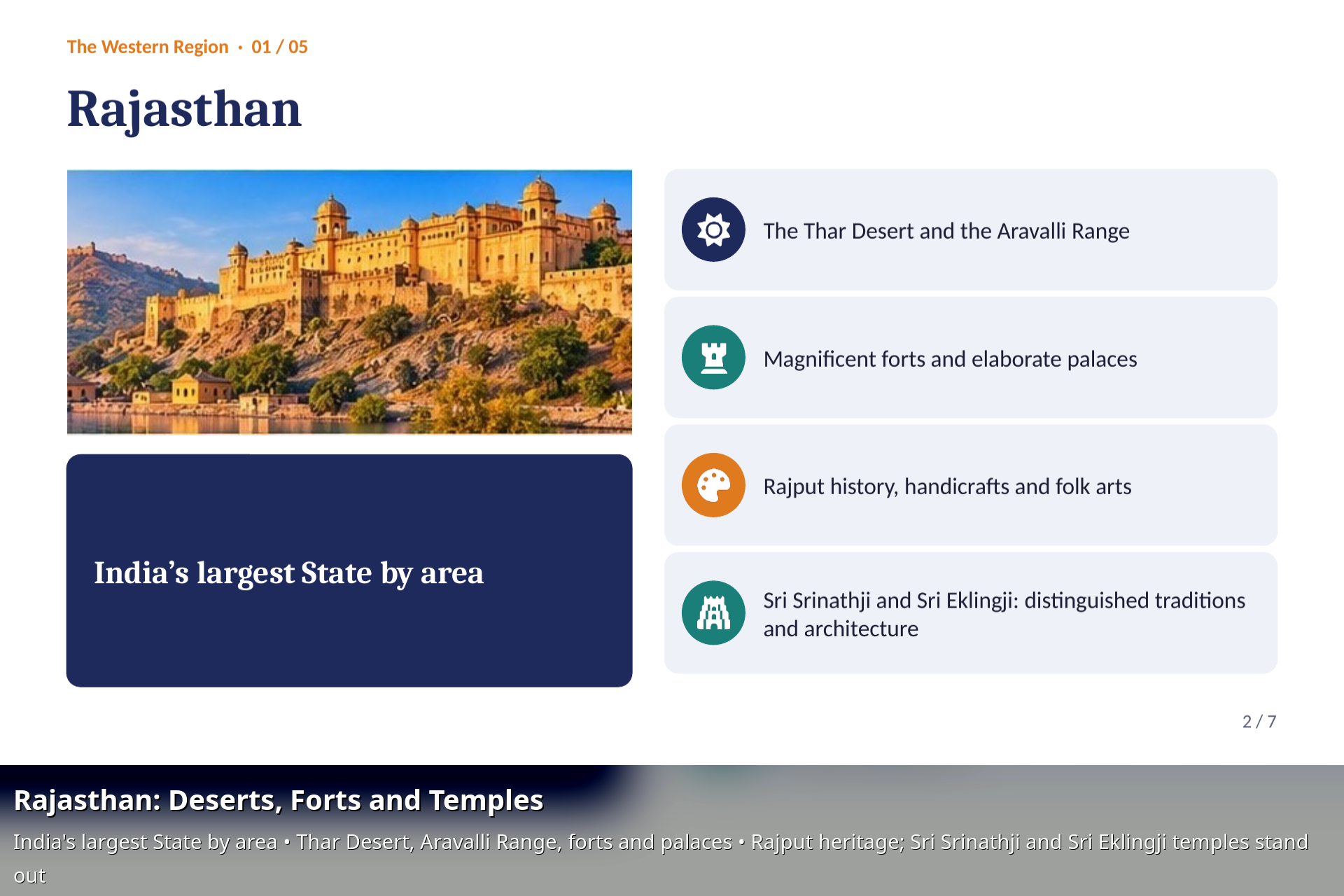
India’s largest State by area, Rajasthan features the Thar Desert, the Aravalli Range, magnificent forts, elaborate palaces, and a rich tradition of Rajput history, handicrafts and folk arts. While it has many famous temples, the Sri Srinathji and Sri Eklingji stand out for their traditions and architecture.
GujaratA major industrial and commercial State with a long Sindhu Sagar (Arabian Sea) coast. Its…
Gujarat
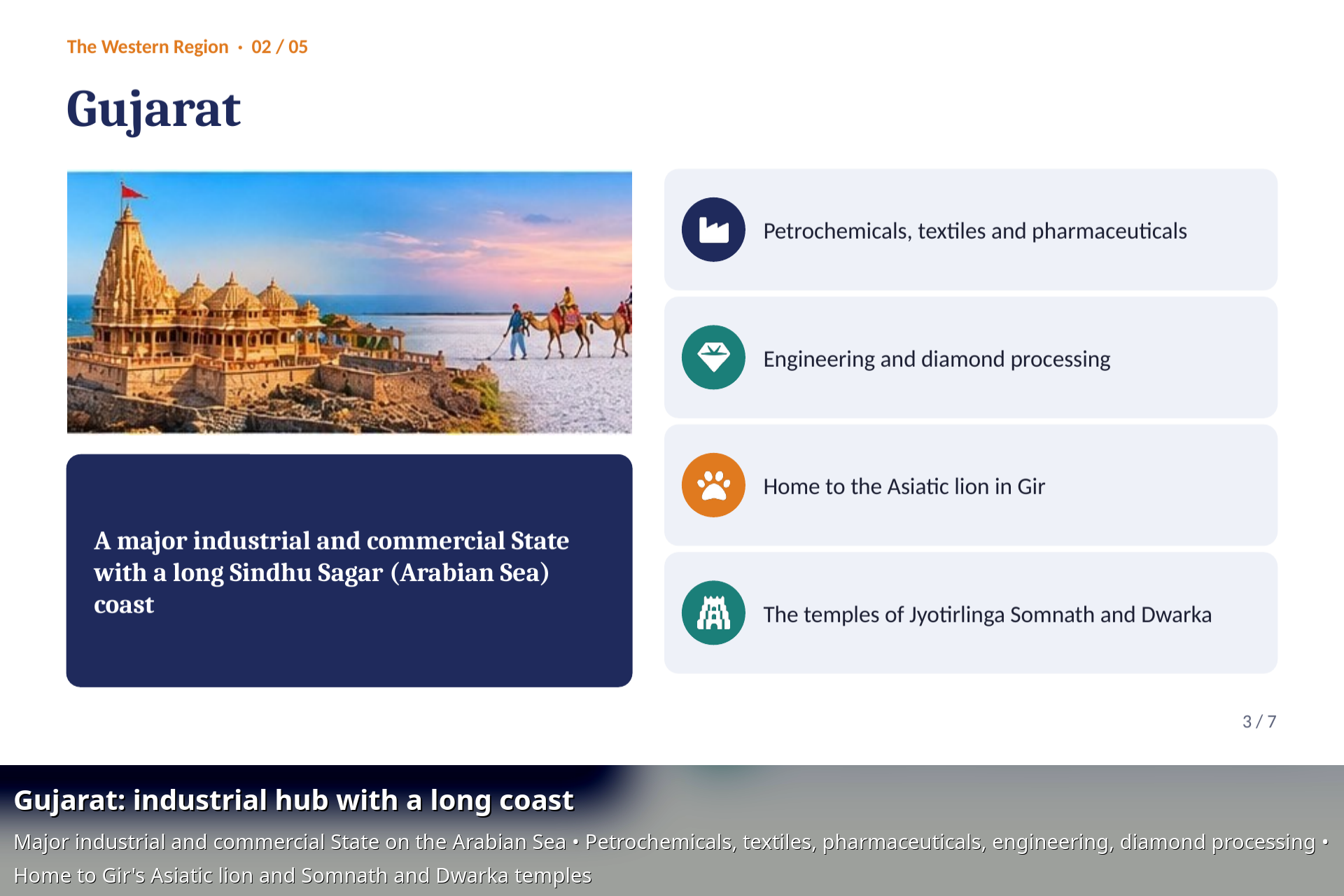
A major industrial and commercial State with a long Sindhu Sagar (Arabian Sea) coast. Its industries include petrochemicals, textiles, pharmaceuticals, engineering, and diamond processing. It is also home to the Asiatic lion in Gir. While the state has numerous temples, it proudly hosts the temples of Jyotirlinga Somnath and Dwarka.
Featuring:


MaharashtraOne of India’s leading economic centres, with Mumbai as its financial capital. Pune is an…
Maharashtra
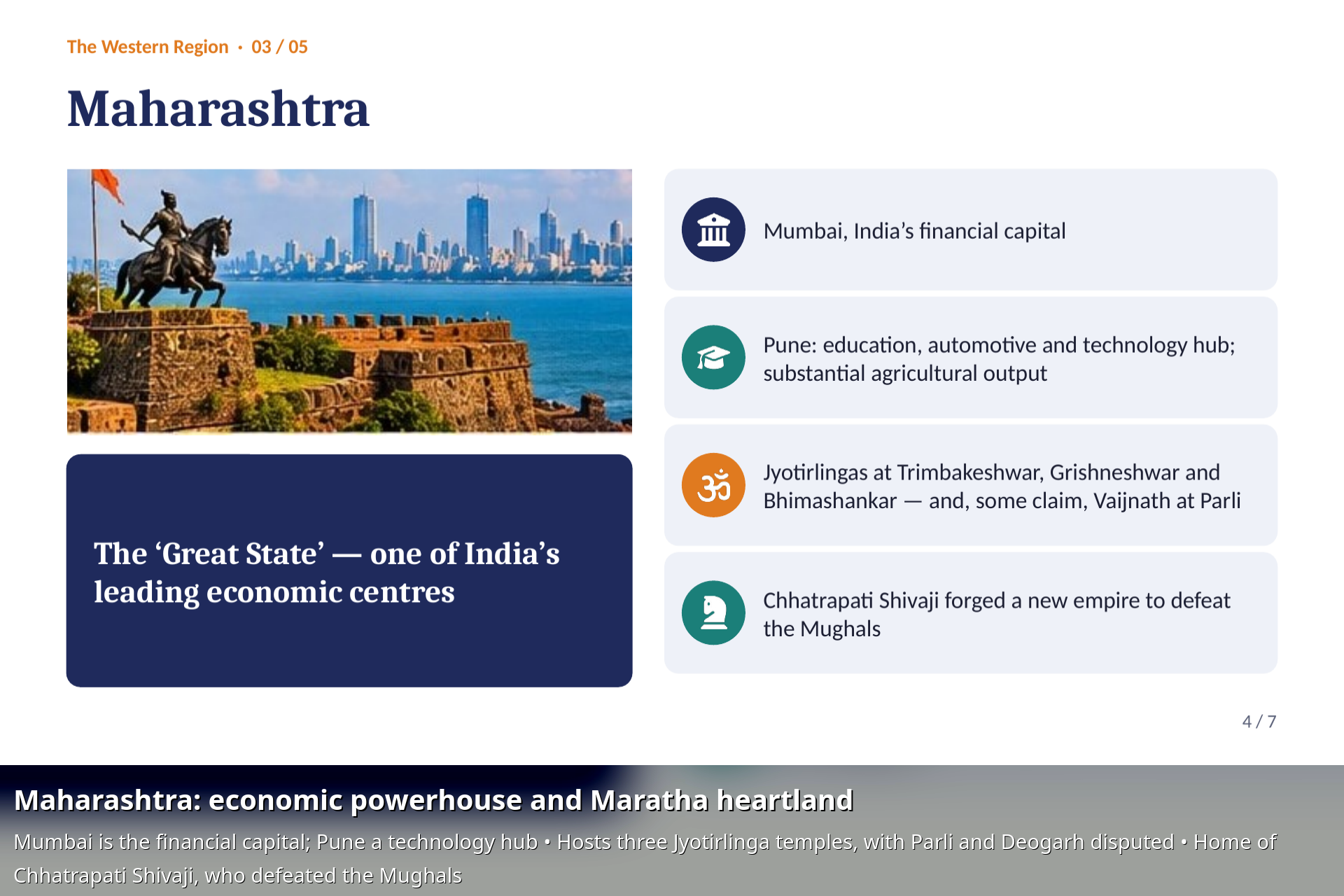
One of India’s leading economic centres, with Mumbai as its financial capital. Pune is an important educational, automotive and technology hub, while the State also produces substantial agricultural output. This great state (the literal translation of its name) proudly hosts three Jyotirlinga temples at Trimbakeshwar (near Nashik), Grishneshwar (near Ellora), and Bhimashankar (near Pune). Some claim that the Vaijnath temple at Parli is another, but others argue that the real one is near Deogarh. This is the state of Chhatrapati Shivaji, who forged a new empire to defeat the Mughals.
GoaIndia’s smallest State by area, celebrated for its beaches and biodiversity. Traditionally, Hindu temples provided…
Goa
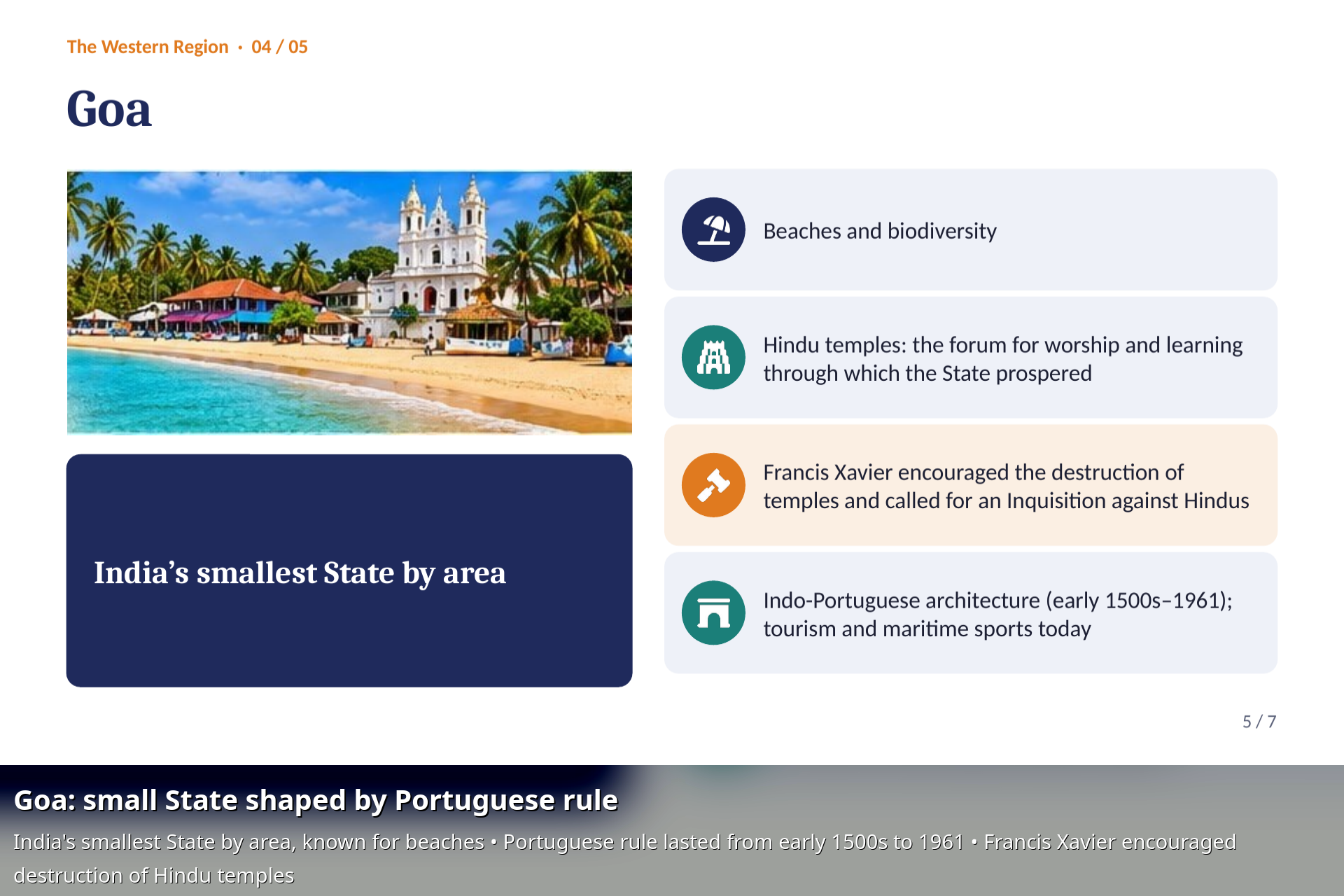
India’s smallest State by area, celebrated for its beaches and biodiversity. Traditionally, Hindu temples provided the forum for worship and learning through which the state prospered. This suffered under Portuguese colonisation. Francis Xavier, known for his maniacal religious zeal, encouraged the destruction of Hindu temples and called for an Inquisition against Hindus. He also proudly documented his dastardly deeds in his own words. During the Portuguese occupation from the early 1500s to 1961, they built several distinctive Indo-Portuguese architectural buildings. Today, tourism and maritime sports are the major attractions.
Dadra and Nagar Haveli and Daman and DiuA Union Territory comprising geographically separated areas on…
Dadra and Nagar Haveli and Daman and Diu
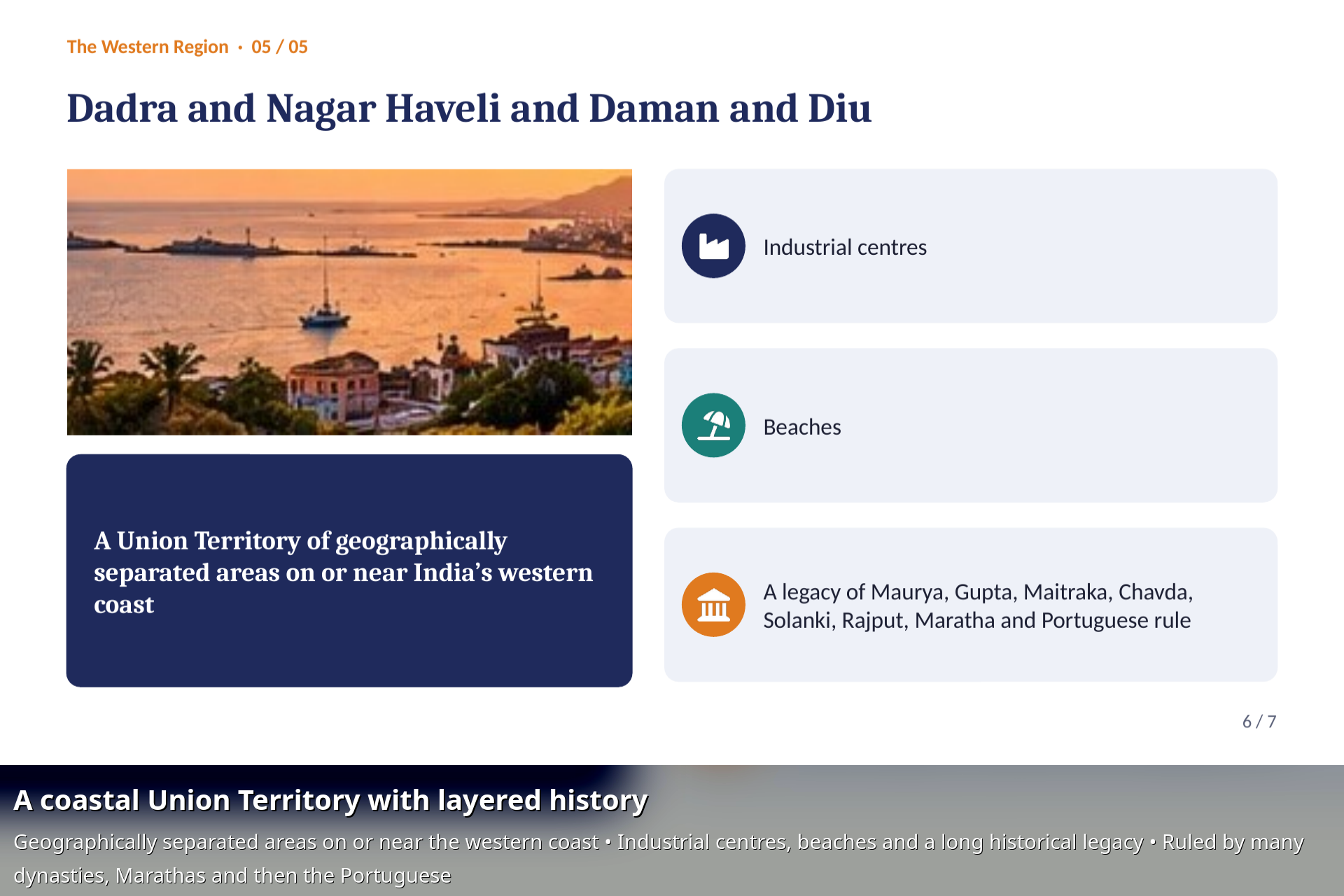
A Union Territory comprising geographically separated areas on or near India’s western coast. It has industrial centres, beaches and a long historical legacy: Diu was ruled by the Mauryas, Kshatrapas, Guptas, Maitrakas, Chavdas, Chaulukyas (Solankis) and the Vaja dynasty; Dadra and Nagar Haveli by the Rajput kings of Ramnagar and Jawhar and then the Marathas; and all three by the Portuguese.
Featuring:
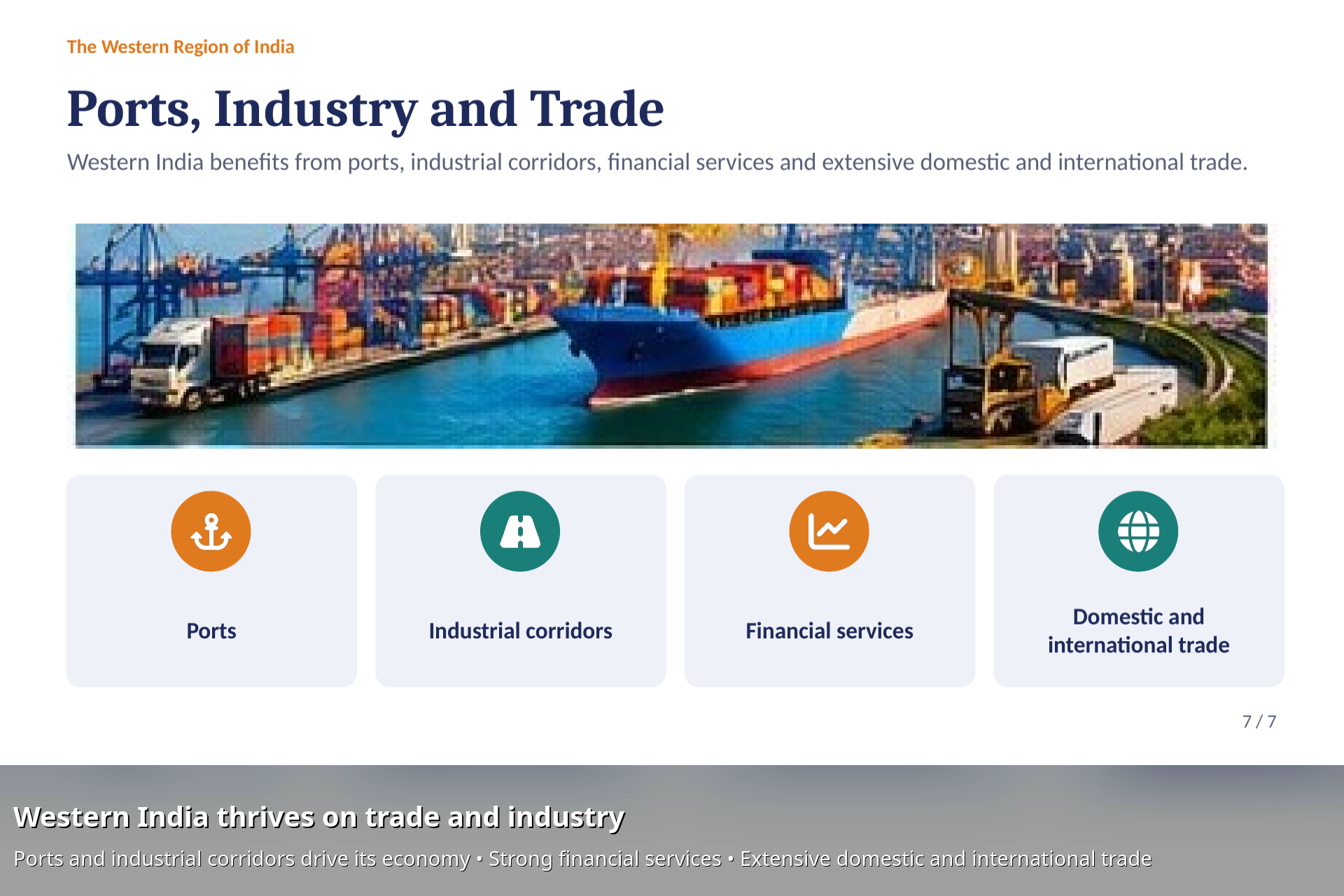
Western India benefits from ports, industrial corridors, financial services and extensive domestic and international trade.
The Central RegionRugged plateaus, dense forests, immense mineral resources, and ancient archaeological sites define Central…
The Central Region
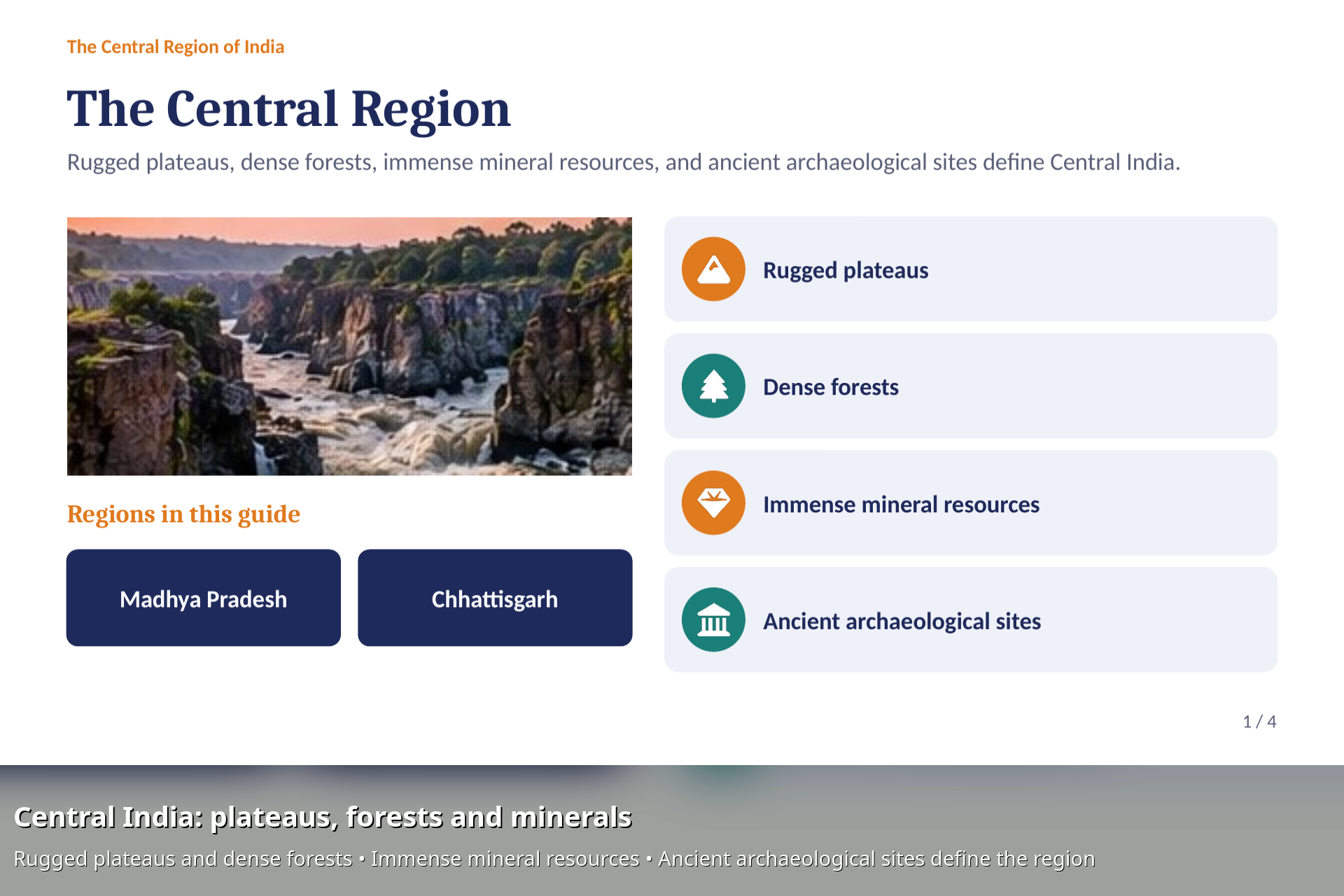
Rugged plateaus, dense forests, immense mineral resources, and ancient archaeological sites define Central India.
Madhya PradeshLocated at the geographical centre, it is renowned for its forests, tiger reserves, the…
Madhya Pradesh
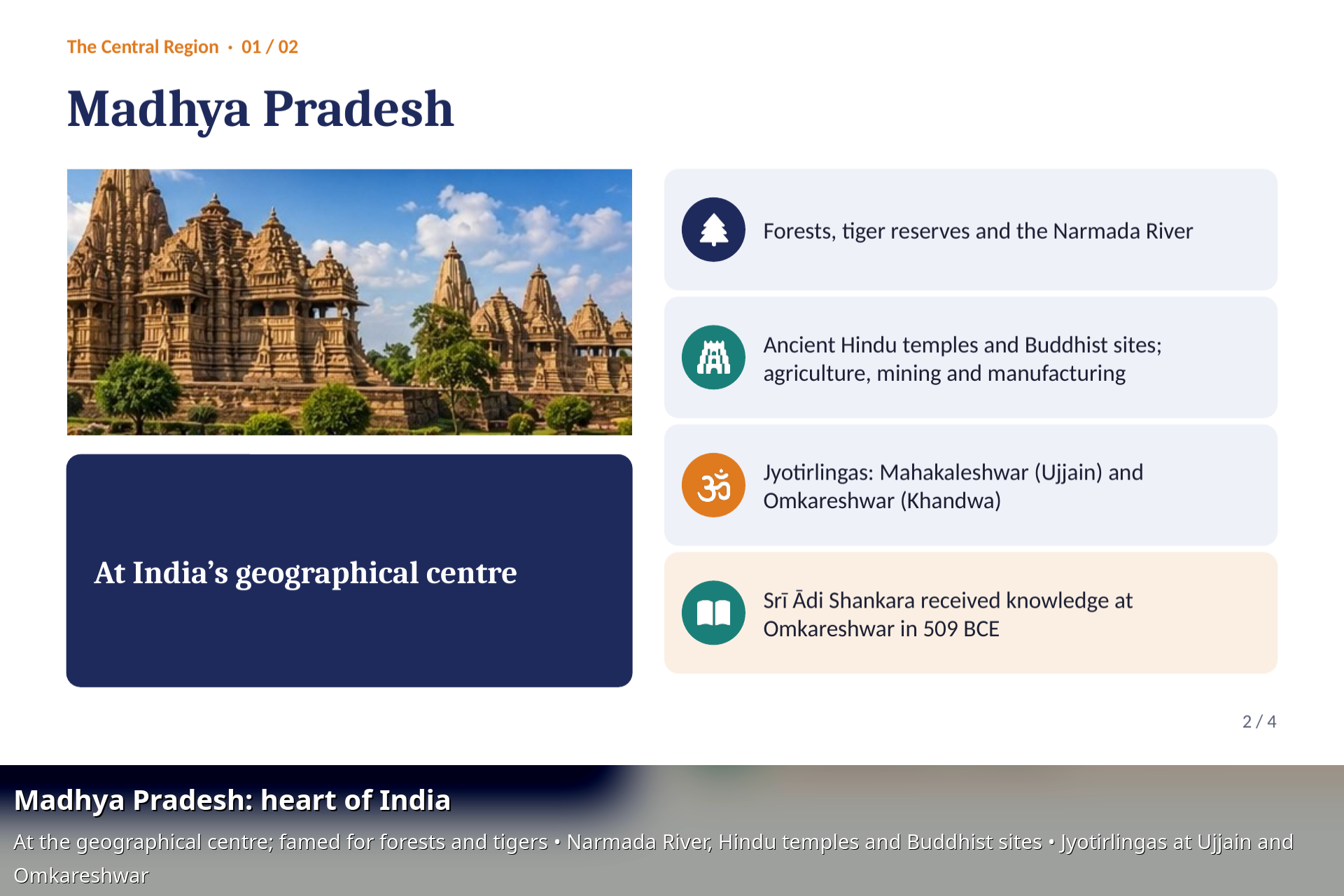
Located at the geographical centre, it is renowned for its forests, tiger reserves, the Narmada River, ancient Hindu temples, and Buddhist sites. Agriculture, mining, and manufacturing are important economic activities. The state proudly hosts two Jyotirlinga shrines at Ujjain (Mahakaleshwar) and Khandwa (Omkareshwar). Srī Ādi Shankara received knowledge at the Omkareshwar temple in 509 BCE.
Featuring:
ChhattisgarhRich in coal, iron ore, forests, and other mineral resources, Chhattisgarh is an important centre…
Chhattisgarh
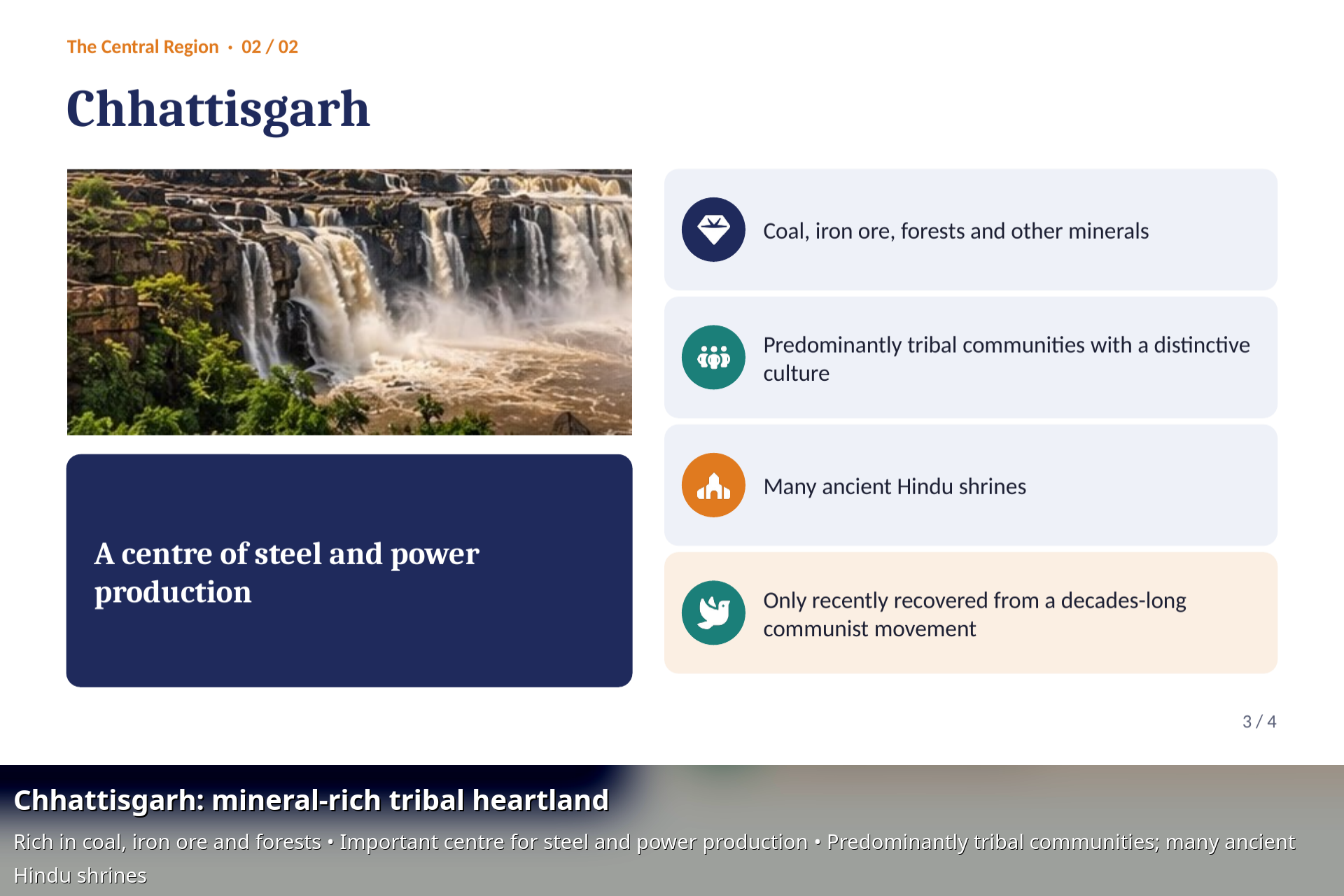
Rich in coal, iron ore, forests, and other mineral resources, Chhattisgarh is an important centre for steel and power production. Its predominantly tribal communities give it a distinctive cultural character. The state has many ancient Hindu shrines. It only recently recovered from a decades-long communist movement.
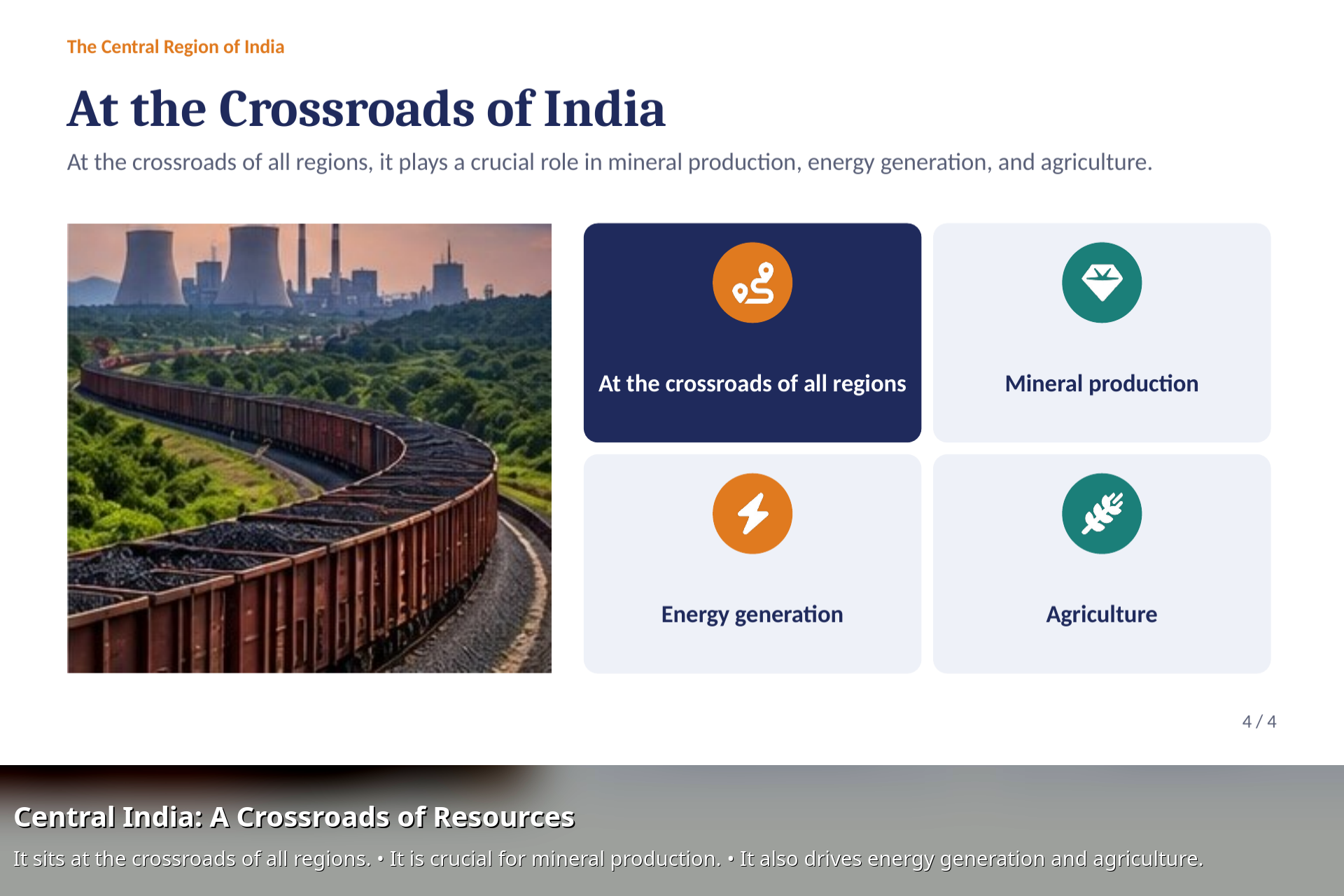
At the crossroads of all regions, it plays a crucial role in mineral production, energy generation, and agriculture.
The Eastern RegionEastern India combines fertile river plains, mineral-rich plateaus, major ports and ancient centres…
The Eastern Region
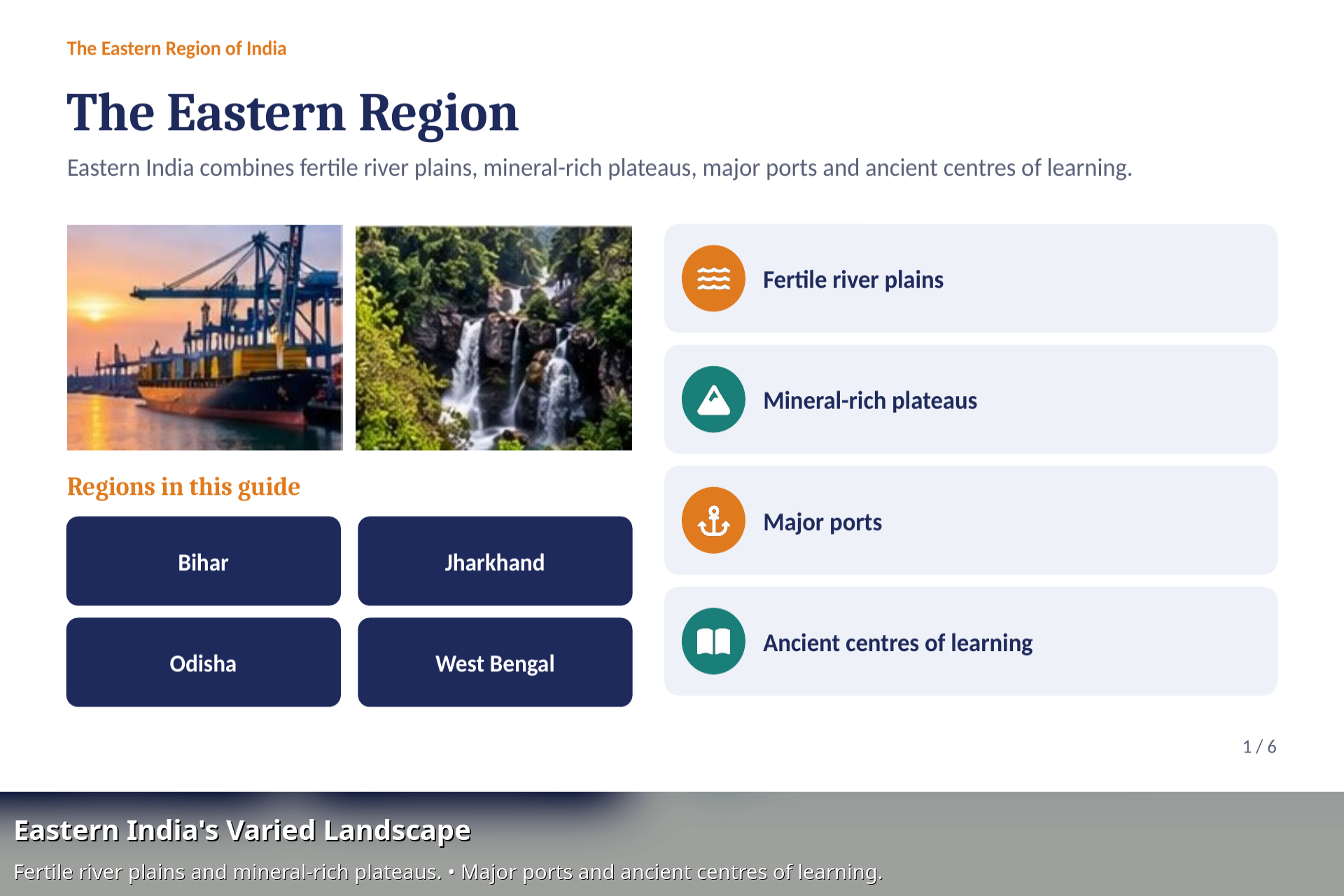
Eastern India combines fertile river plains, mineral-rich plateaus, major ports and ancient centres of learning.
Featuring:
BiharAs the historic heartland of many ancient Hindu kingdoms, this Magadha region, now called Bihar,…
Bihar
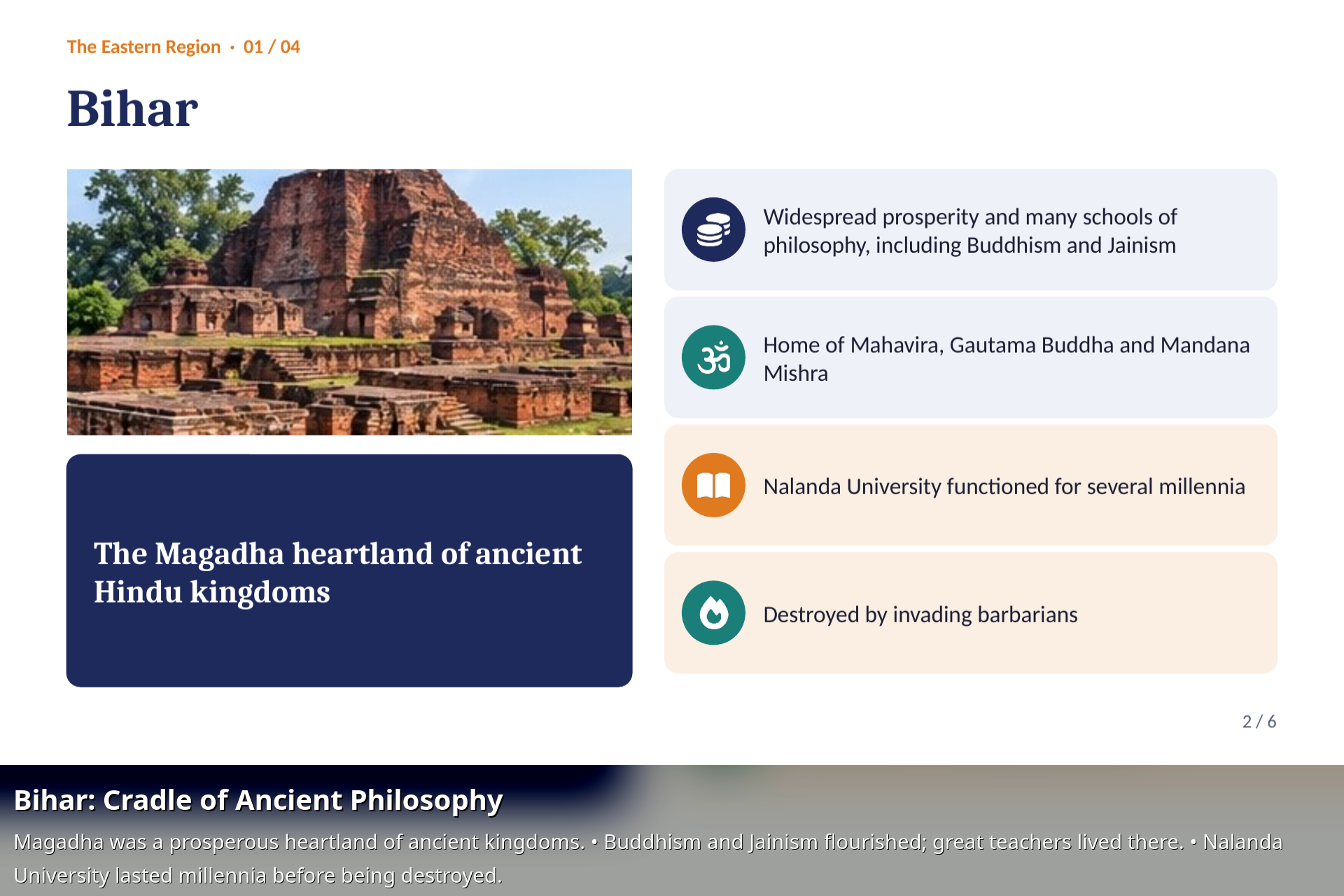
As the historic heartland of many ancient Hindu kingdoms, this Magadha region, now called Bihar, had widespread prosperity and encouraged philosophy in many forms, including Buddhism and Jainism. Mahavira, Gautama Buddha, and Mandana Mishra lived there. The famous Nalanda University functioned here for several millennia and was destroyed by invading barbarians.
JharkhandA mineral-rich State with extensive forests, tribal traditions and major coal, iron ore and steel…
Jharkhand
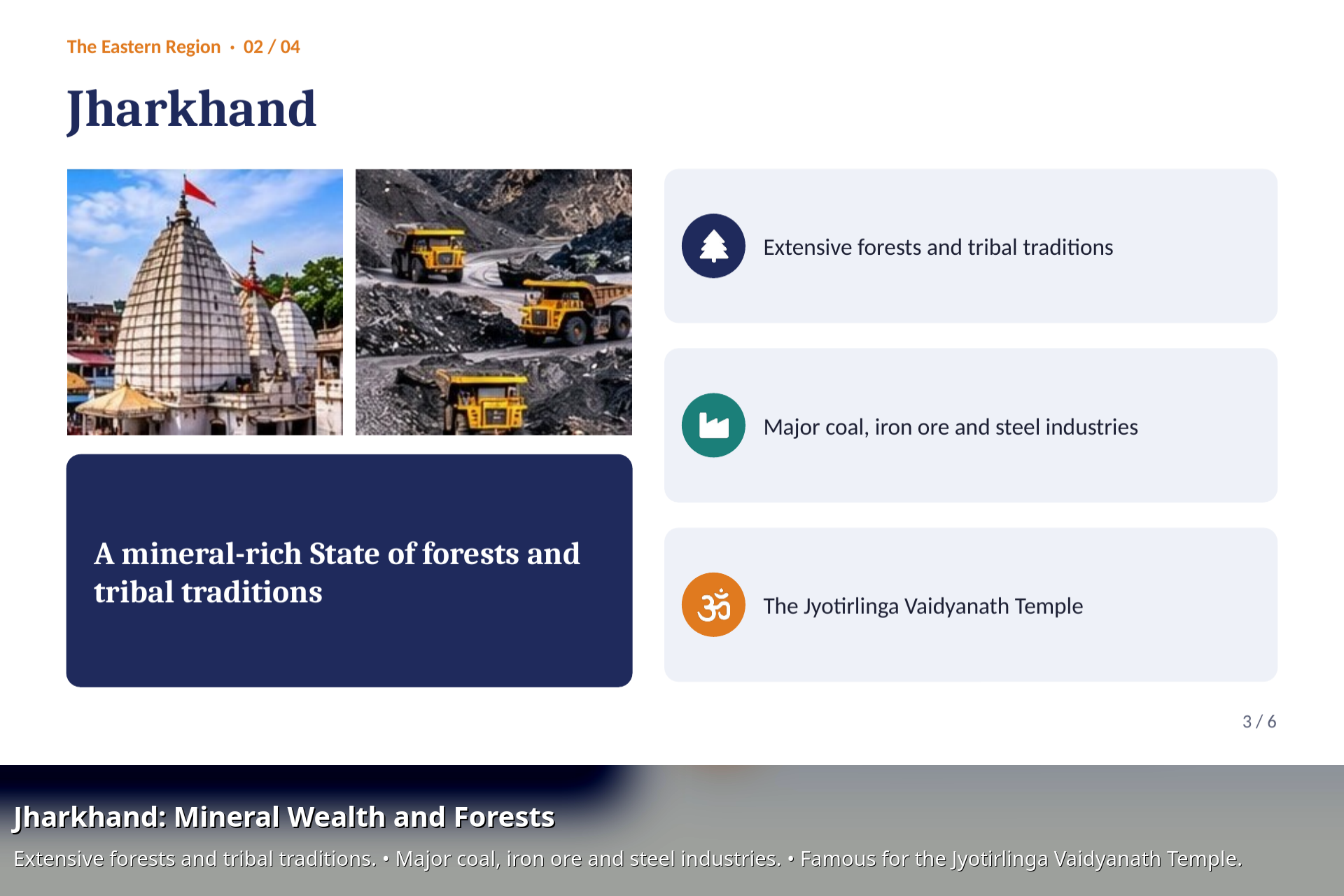
A mineral-rich State with extensive forests, tribal traditions and major coal, iron ore and steel industries. The state is famous for its Jyotirlinga Vaidyanath Temple.
OdishaFamous for its seafaring economy and fierce warriors, the state is home to the Jagannath…
Odisha
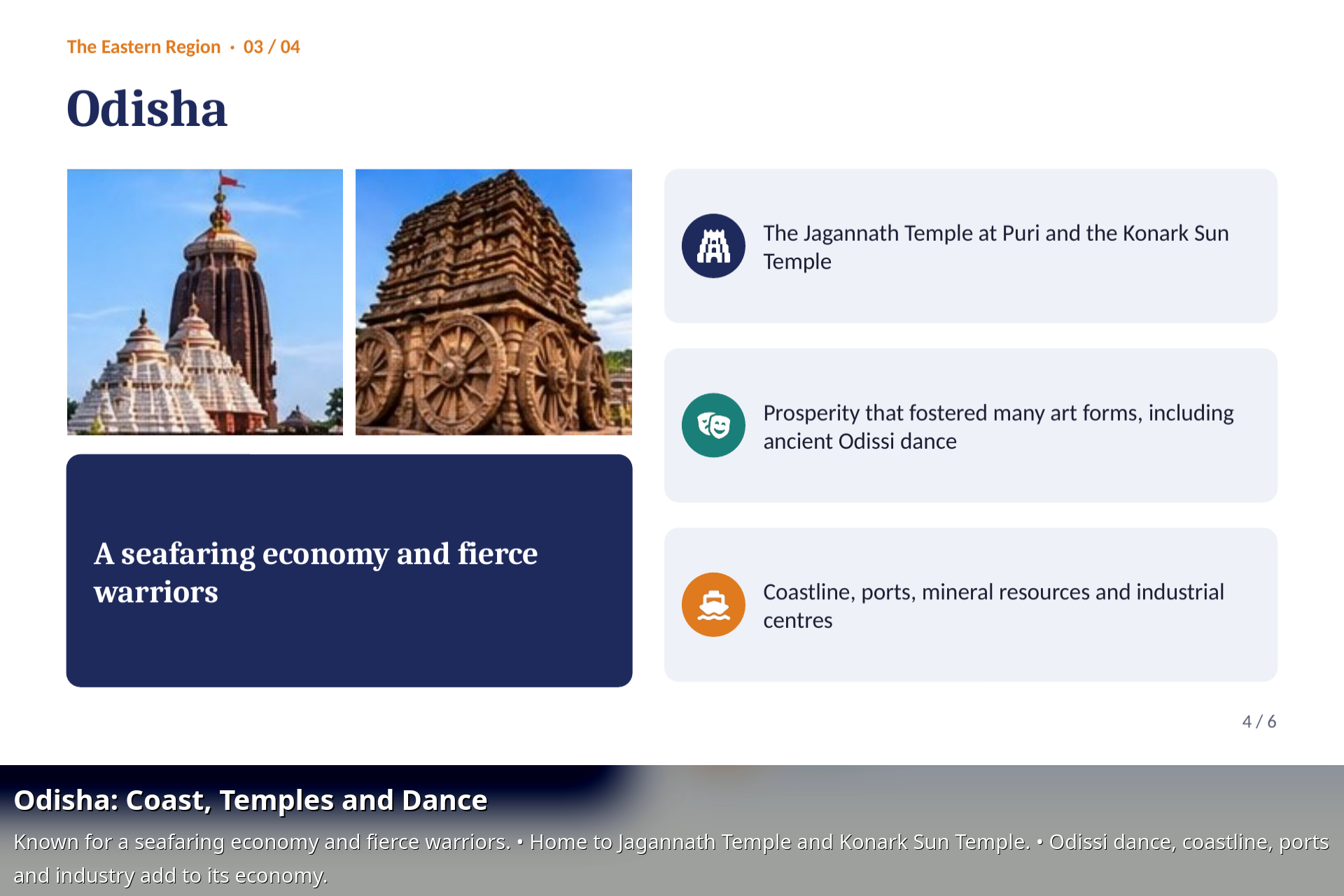
Famous for its seafaring economy and fierce warriors, the state is home to the Jagannath Temple at Puri and the Konark Sun Temple. Prosperity fostered many art forms, including the ancient Odissi dance form. Its coastline, ports, mineral resources, and industrial centres contribute to the economy.
Featuring:


West BengalStretching from the Himalaya to the Bay of Bengal, West Bengal includes Darjeeling’s tea-growing…
West Bengal
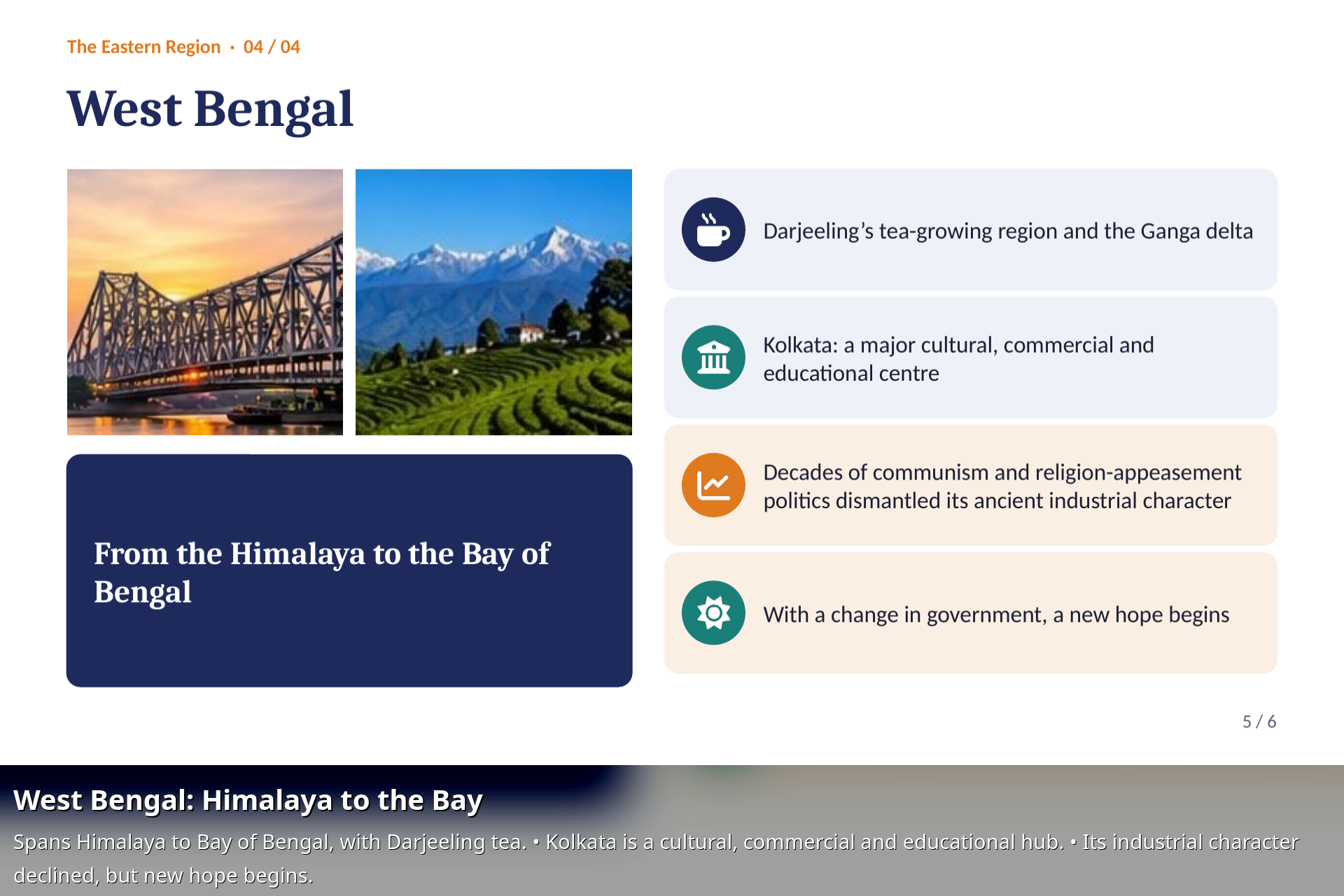
Stretching from the Himalaya to the Bay of Bengal, West Bengal includes Darjeeling’s tea-growing region and the Ganga delta. Kolkata, the capital, is a major cultural, commercial and educational centre. Decades of communism and religion-appeasement politics have dismantled its ancient industrial character. However, with a change in the government, a new hope begins.
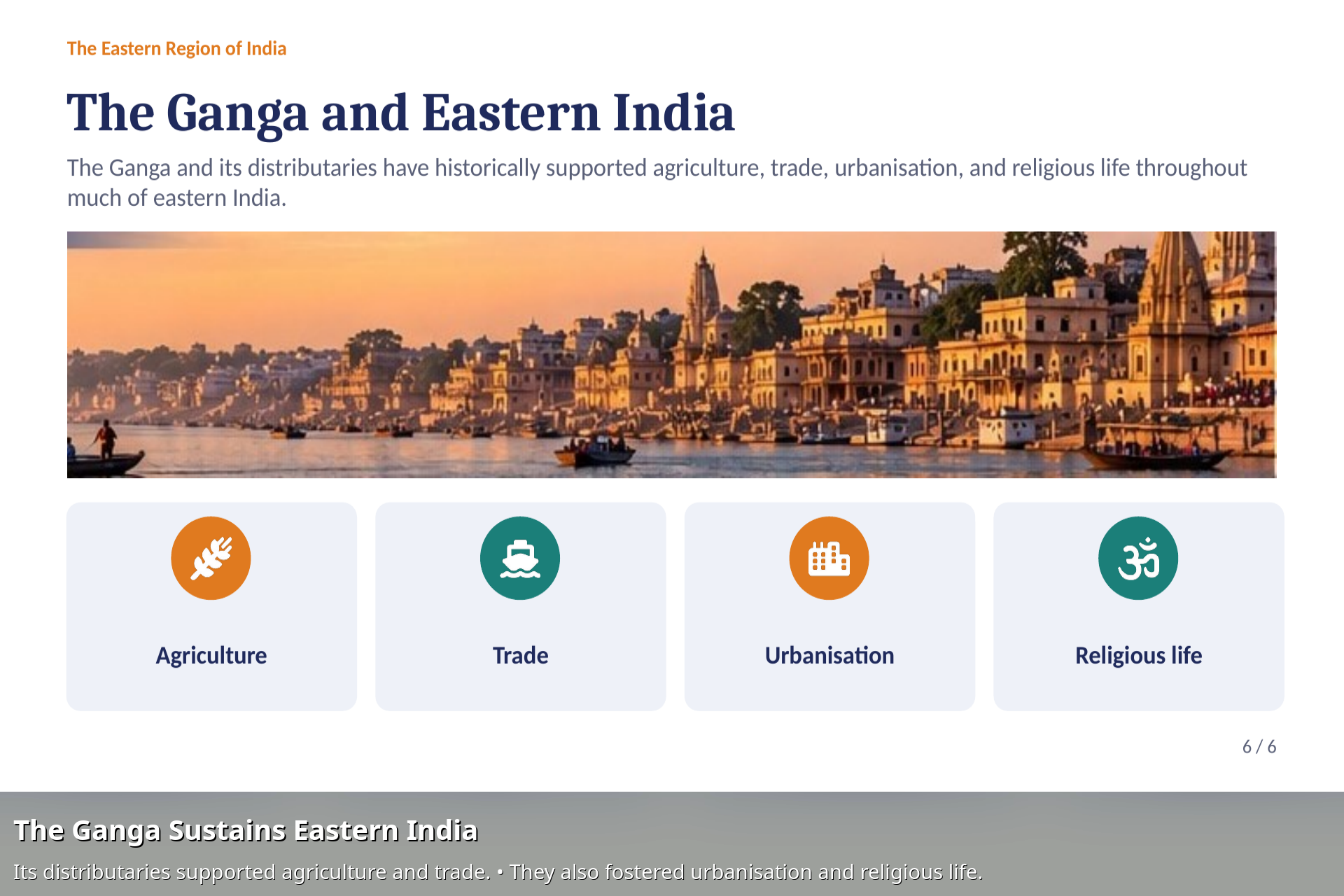
The Ganga and its distributaries have historically supported agriculture, trade, urbanisation, and religious life throughout much of eastern India.
The Southern RegionSouthern India is distinguished by its ancient Dravidian (the land of the peninsula)…
The Southern Region
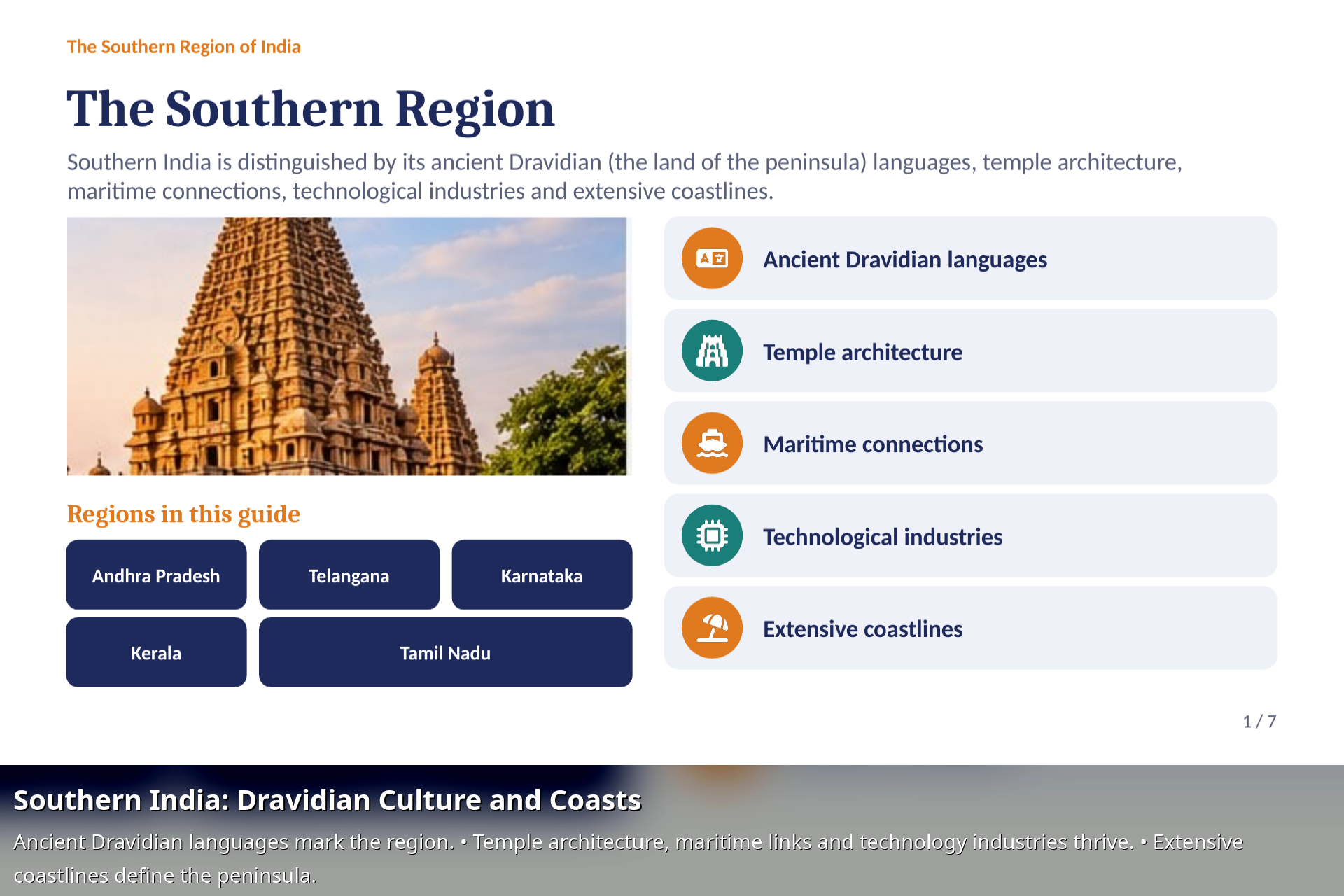
Southern India is distinguished by its ancient Dravidian (the land of the peninsula) languages, temple architecture, maritime connections, technological industries and extensive coastlines.
Featuring:
Andhra PradeshKnown for its long coastline, agriculture, aquaculture, Telugu literary traditions and the renowned pilgrimage…
Andhra Pradesh
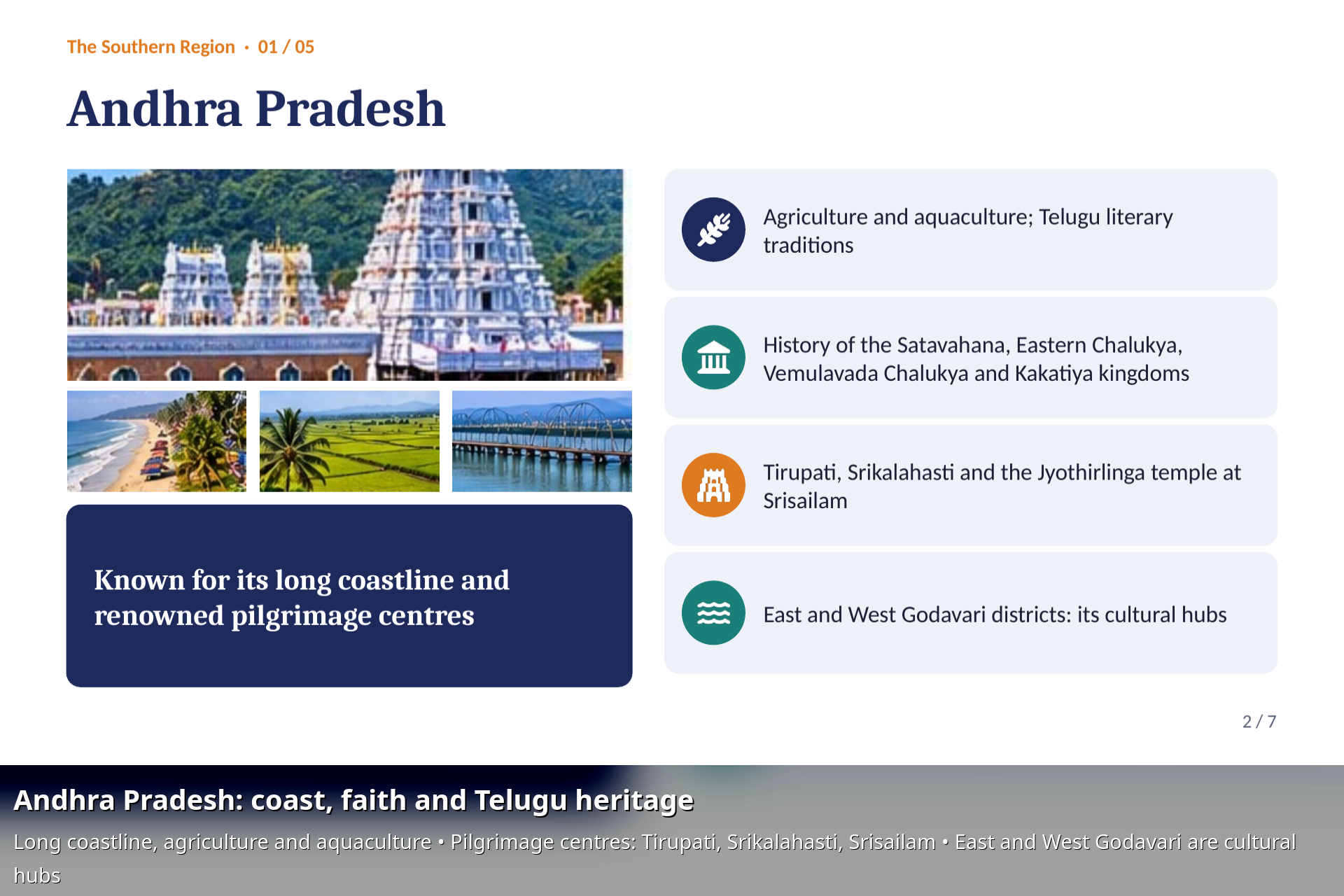
Known for its long coastline, agriculture, aquaculture, Telugu literary traditions and the renowned pilgrimage centre of Tirupati, Srikalahasti, and the Jyothir Linga temple at Srisailam. Its history reflects the Satavahana, Eastern Chalukya, Vemulavada Chalukya and Kakatiya kingdoms. The East and West Godavari districts are its cultural hubs.
TelanganaWith Hyderabad as its capital, Telangana is a major centre for information technology, pharmaceuticals and…
Telangana
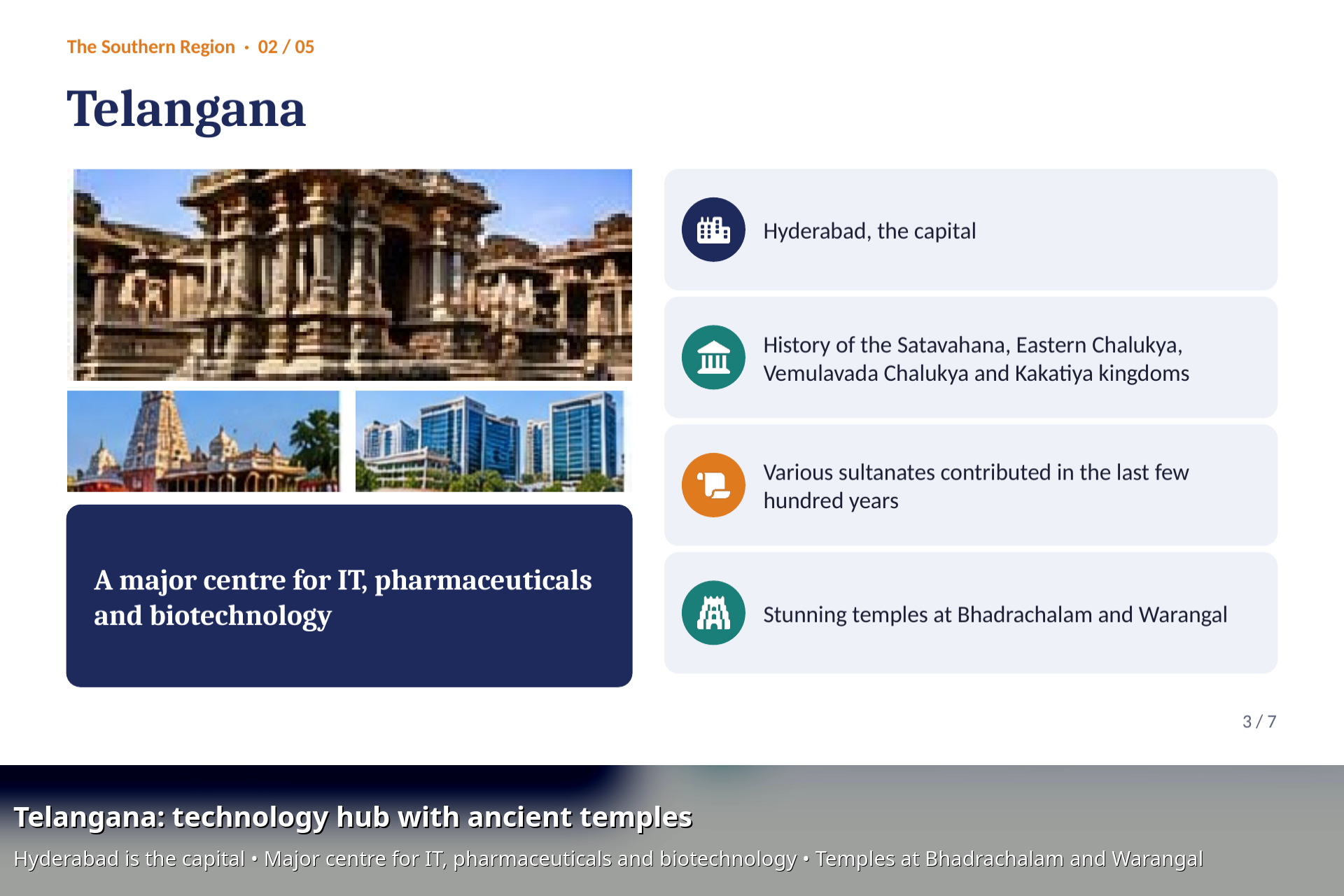
With Hyderabad as its capital, Telangana is a major centre for information technology, pharmaceuticals and biotechnology. Its history reflects the Satavahana, Eastern Chalukya, Vemulavada Chalukya and Kakatiya kingdoms. In the last few hundred years, various sultanates contributed. It has stunning temples at Bhadrachalam and Warangal.
KarnatakaWith Bengaluru, the world-renowned technology and innovation hub, Karnataka has a rich heritage inherited from…
Karnataka
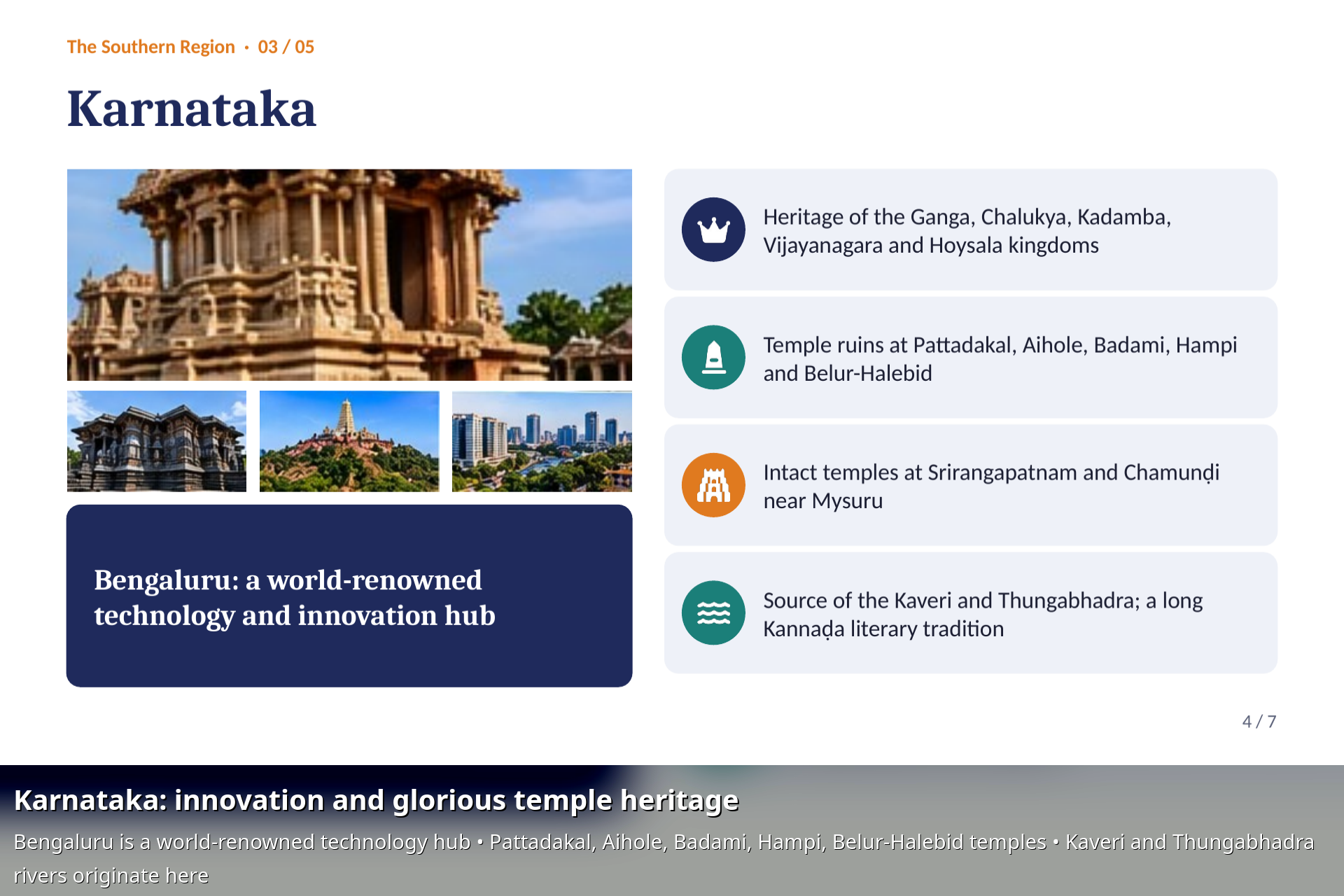
With Bengaluru, the world-renowned technology and innovation hub, Karnataka has a rich heritage inherited from the Ganga, Chalukya, Kadamba, Vijayanagara, and Hoysala kingdoms. Each had distinctive architecture and art forms. The temple ruins at Pattadakal, Aihole, Badami, Hampi, and Belur-Halebid remind us of a glorious past. Several ancient temples remain intact, including the famous Srirangapatnam and Chamunḍi temples near Mysuru. The Kaveri and Thungabhadra Rivers originate in this state. The language Kannaḍan also has a long literary tradition.
Featuring:
KeralaHome to the richest temple in the world (the Padmanabhaswamy temple) in its capital, Thiruvananthapuram,…
Kerala
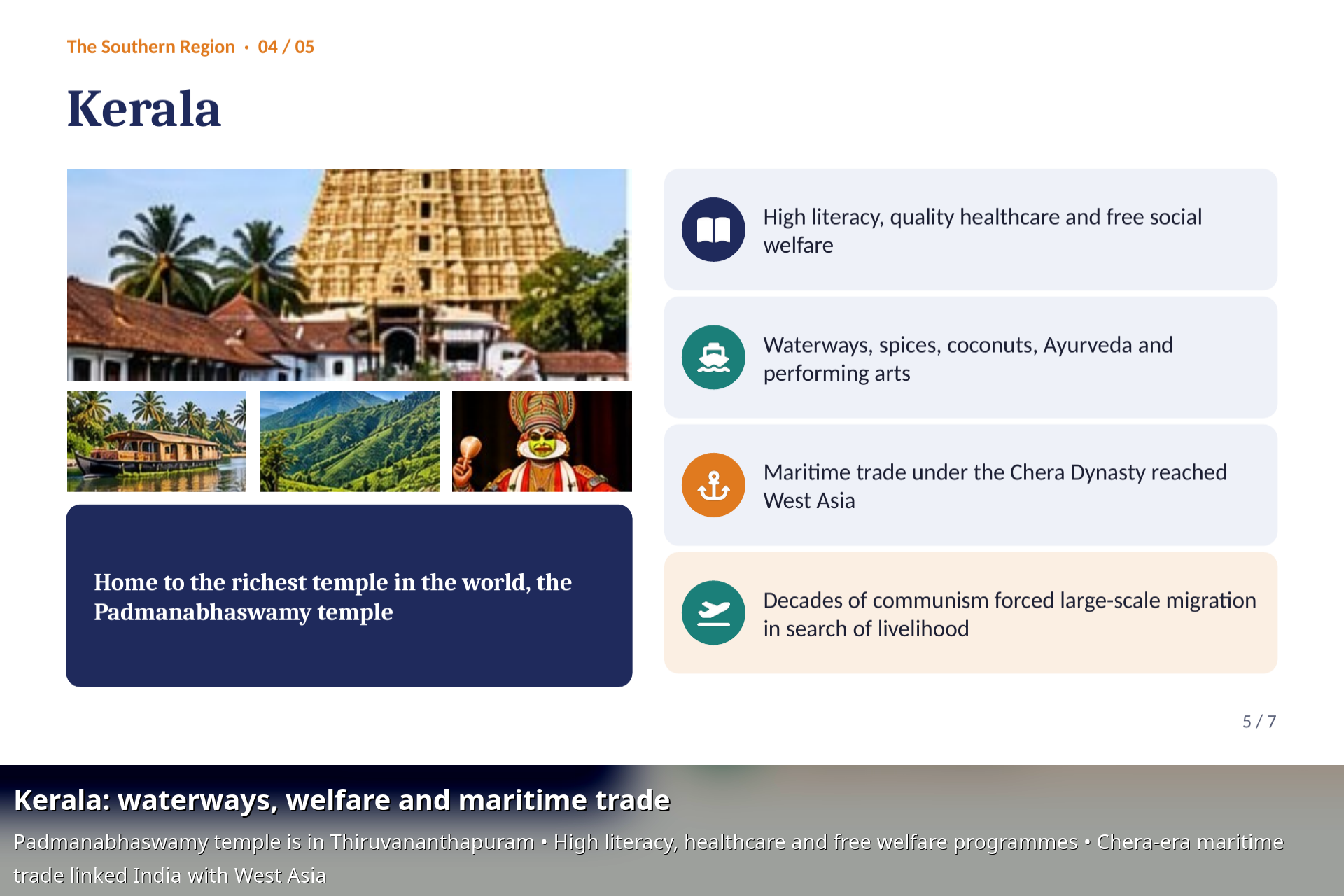
Home to the richest temple in the world (the Padmanabhaswamy temple) in its capital, Thiruvananthapuram, Kerala attains distinction for high literacy, quality healthcare, and free social welfare programmes. It is known for its extensive internal waterways, spices, coconuts, Ayurveda, and captivating performing arts. Its long history of maritime trade under the ancient Chera Dynasty connected India with West Asia and other regions. Decades of communism denied business opportunities, forcing large-scale migration of its citizens to every corner of the world in search of livelihood.
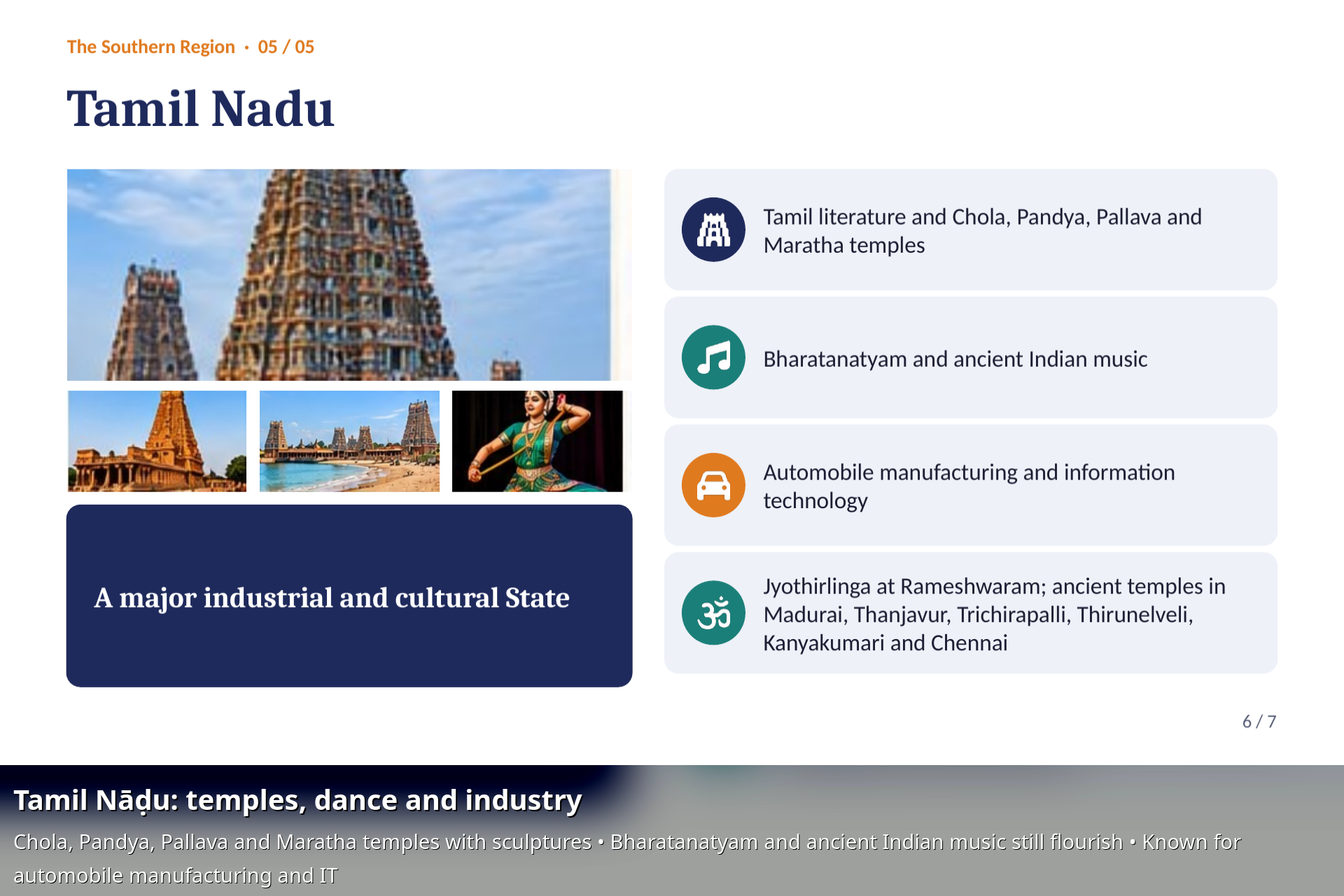
Tamil NāḍuA major industrial and cultural State renowned for Tamil literature and monumental Chola, Pandya,…
Tamil Nāḍu
A major industrial and cultural State renowned for Tamil literature and monumental Chola, Pandya, Pallava, and Maratha temples. They are filled with astonishing sculptures and paintings. Bharatanatyam, the dance of Bharat or India, is prominent here. It is one of the few places in the country where ancient Indian music continues to flourish. It is known for automobile manufacturing and information technology capabilities. The state proudly hosts the Jyothirlinga temple at Rameshwaram and also has several ancient temples in Madurai, Thanjavur, Trichirapalli, Thirunelveli, Kanyakumari, and Chennai.
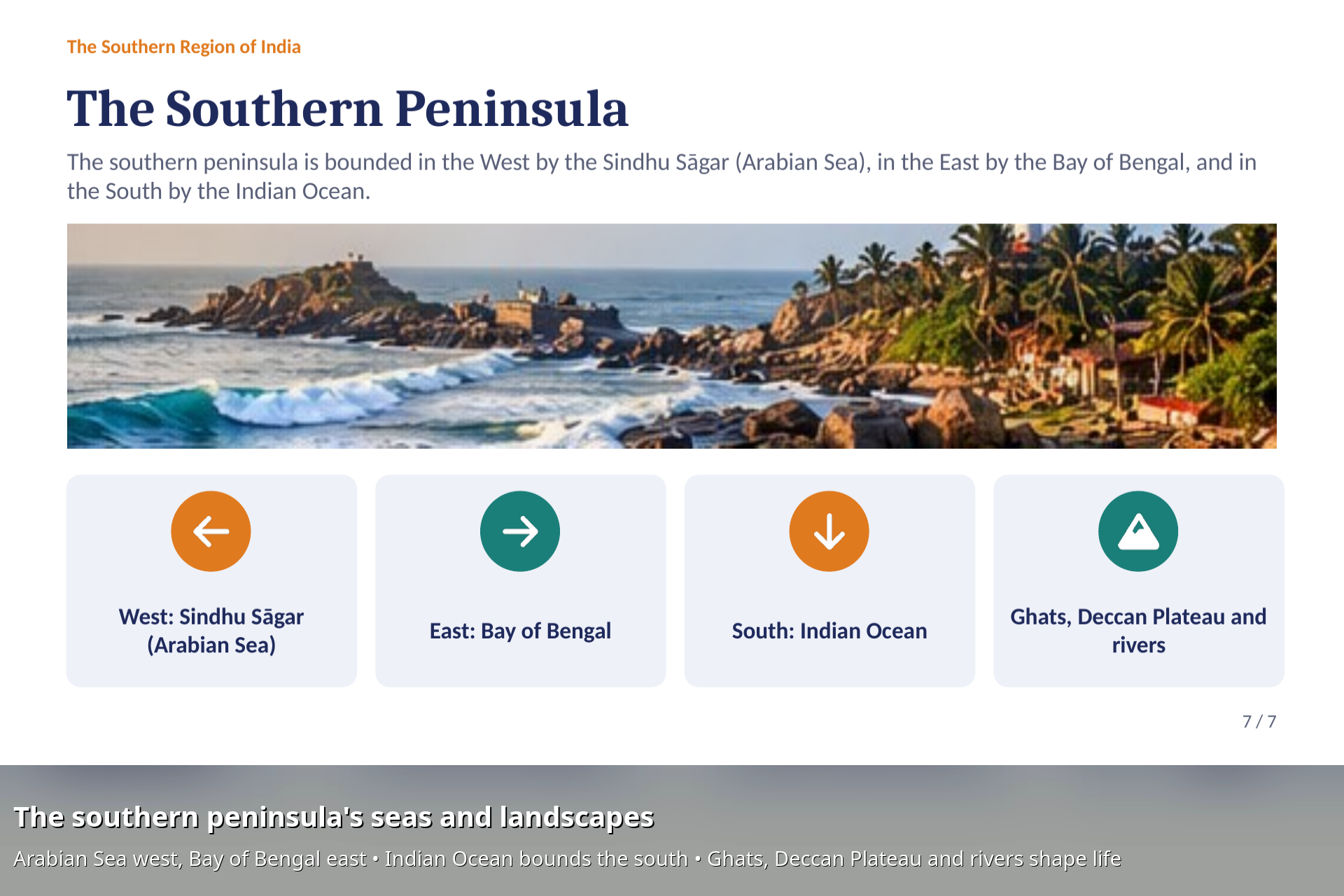
The southern peninsula is bounded in the West by the Sindhu Sāgar (Arabian Sea), in the East by the Bay of Bengal, and in the South by the Indian Ocean. The Western and Eastern Ghats, the Deccan Plateau and major rivers shape its climate, agriculture and settlement patterns.
Featuring:
The Northeastern RegionNortheastern India is a region of exceptional biodiversity, linguistic diversity, tribal heritage and…
The Northeastern Region
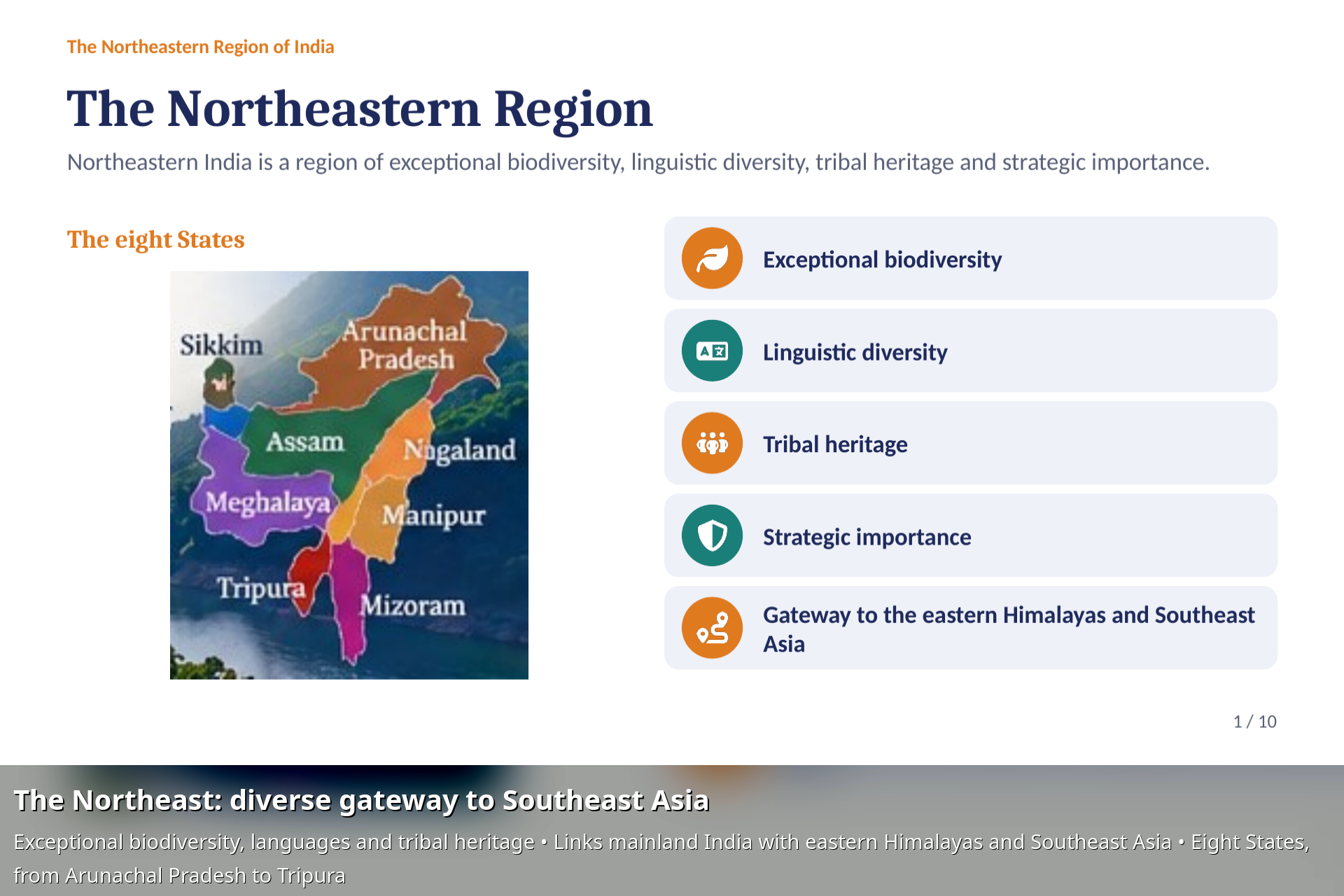
Northeastern India is a region of exceptional biodiversity, linguistic diversity, tribal heritage and strategic importance. It connects mainland India with the eastern Himalayas and Southeast Asia. The eight States are Arunachal Pradesh, Assam, Manipur, Meghalaya, Mizoram, Nagaland, Sikkim and Tripura.
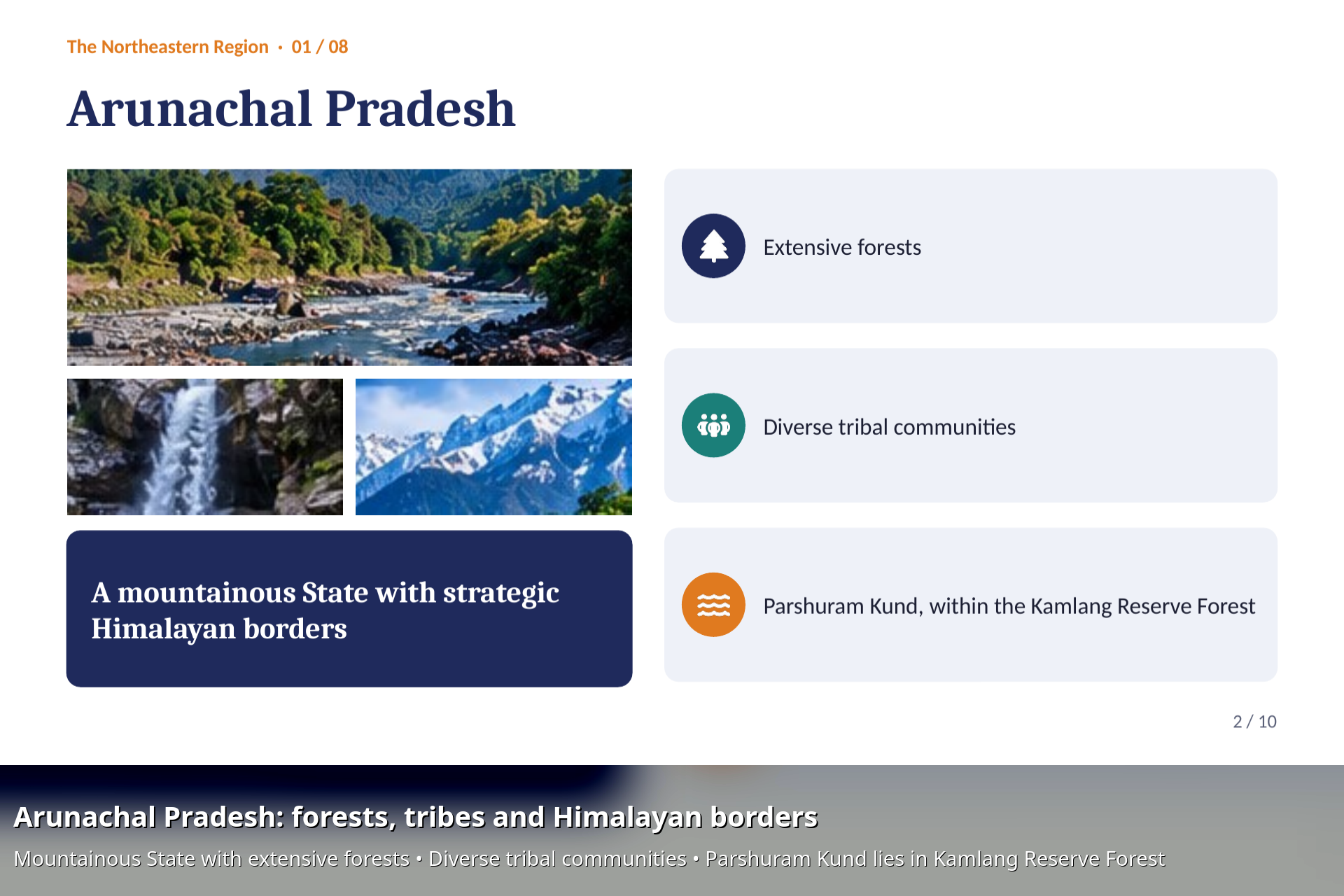
Arunachal PradeshA mountainous State with extensive forests, diverse tribal communities, and strategic Himalayan borders. It…
Arunachal Pradesh
A mountainous State with extensive forests, diverse tribal communities, and strategic Himalayan borders. It is home to the famous Parshuram Kund located within the Kamlang Reserve Forest.
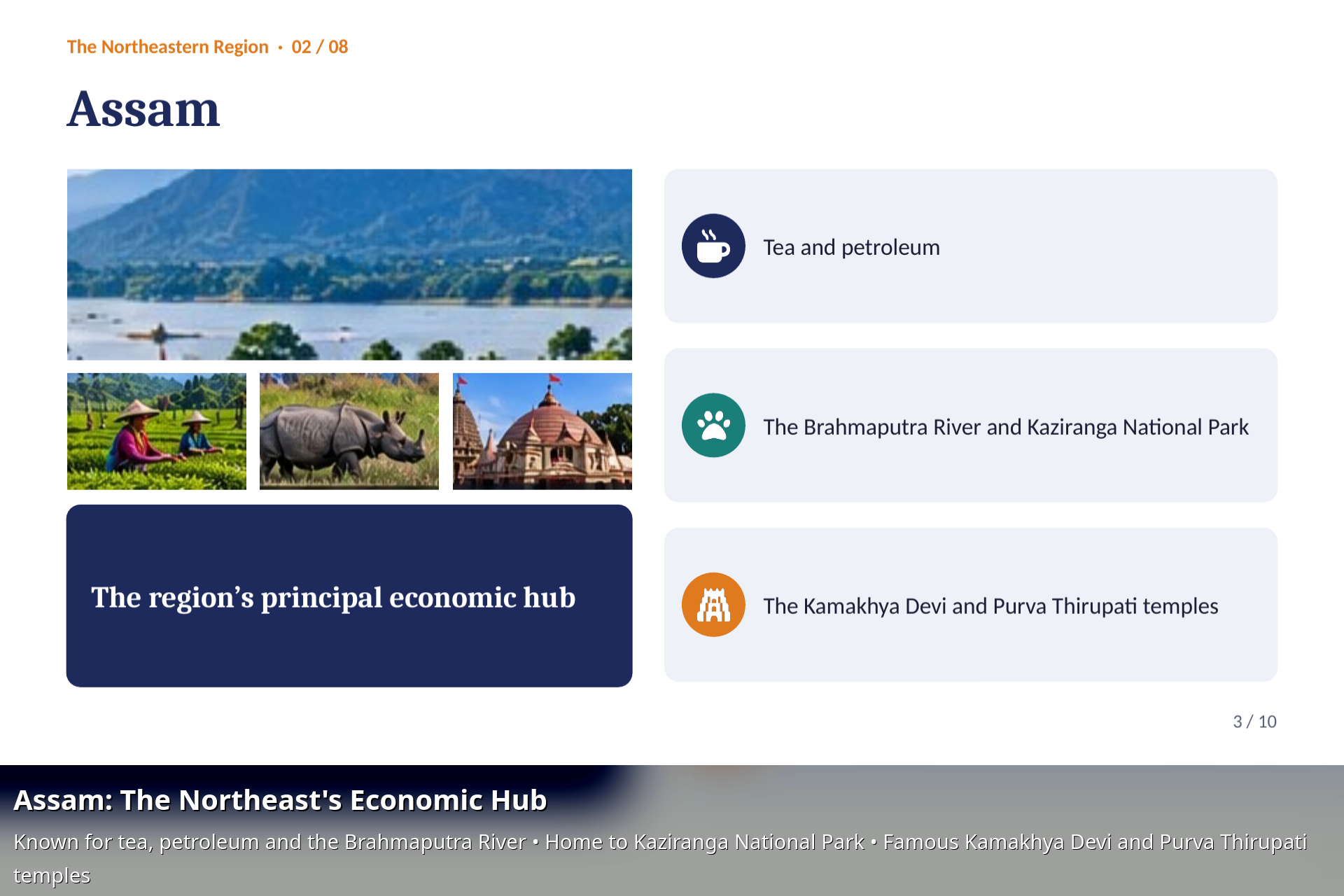
AssamThe region’s principal economic hub, known for tea, petroleum, the Brahmaputra River, and Kaziranga National…
Assam
The region’s principal economic hub, known for tea, petroleum, the Brahmaputra River, and Kaziranga National Park. It is home to the famous Kamakhya Devi and Purva Thirupati Temple.
Featuring:
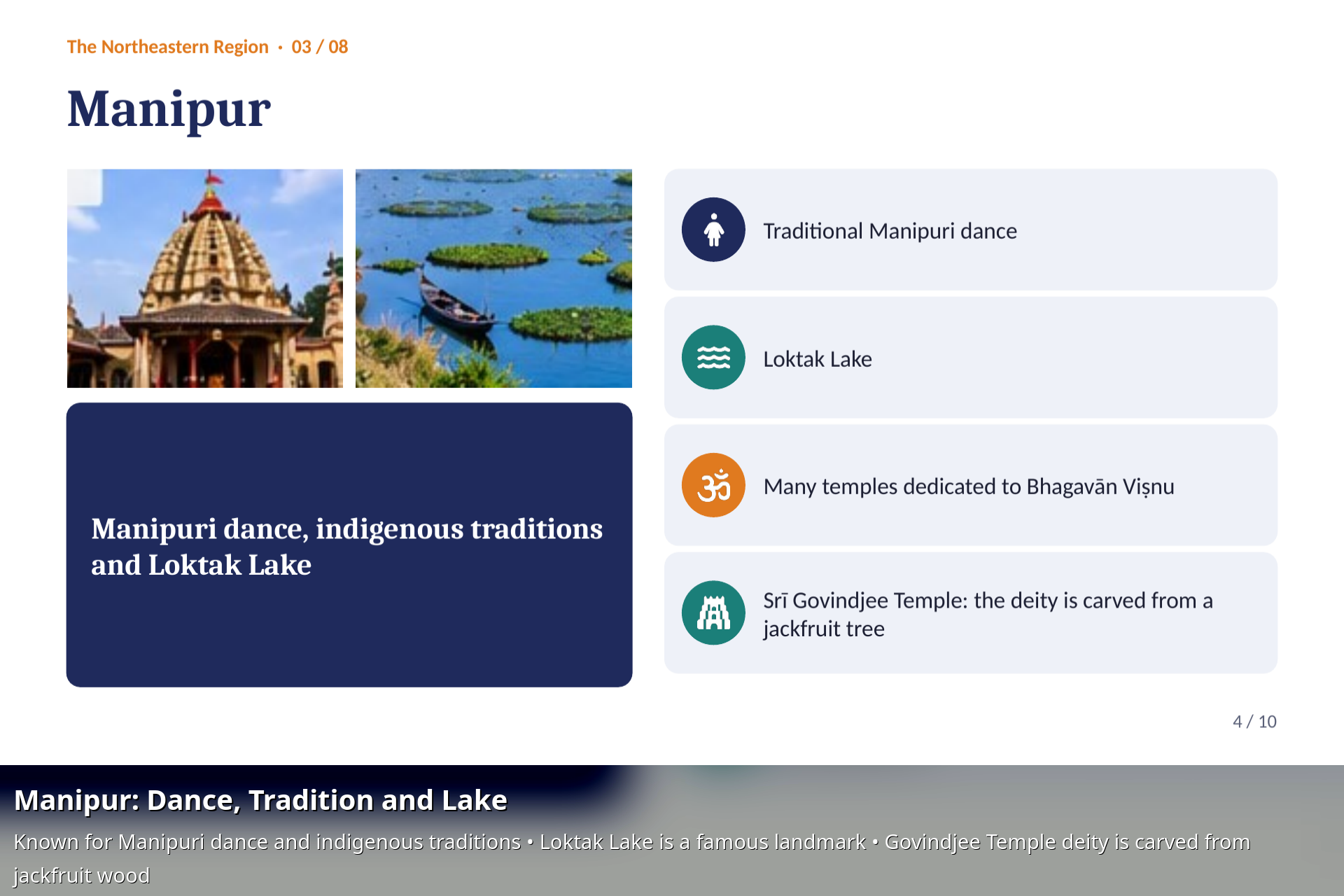
ManipurKnown for traditional Manipuri dance, indigenous traditions, and the Loktak Lake. The state has many…
Manipur
Known for traditional Manipuri dance, indigenous traditions, and the Loktak Lake. The state has many Hindu temples dedicated to Bhagavān Viṣnu, the most famous being Srī Govindjee Temple, where the deity is carved out of a jackfruit tree.
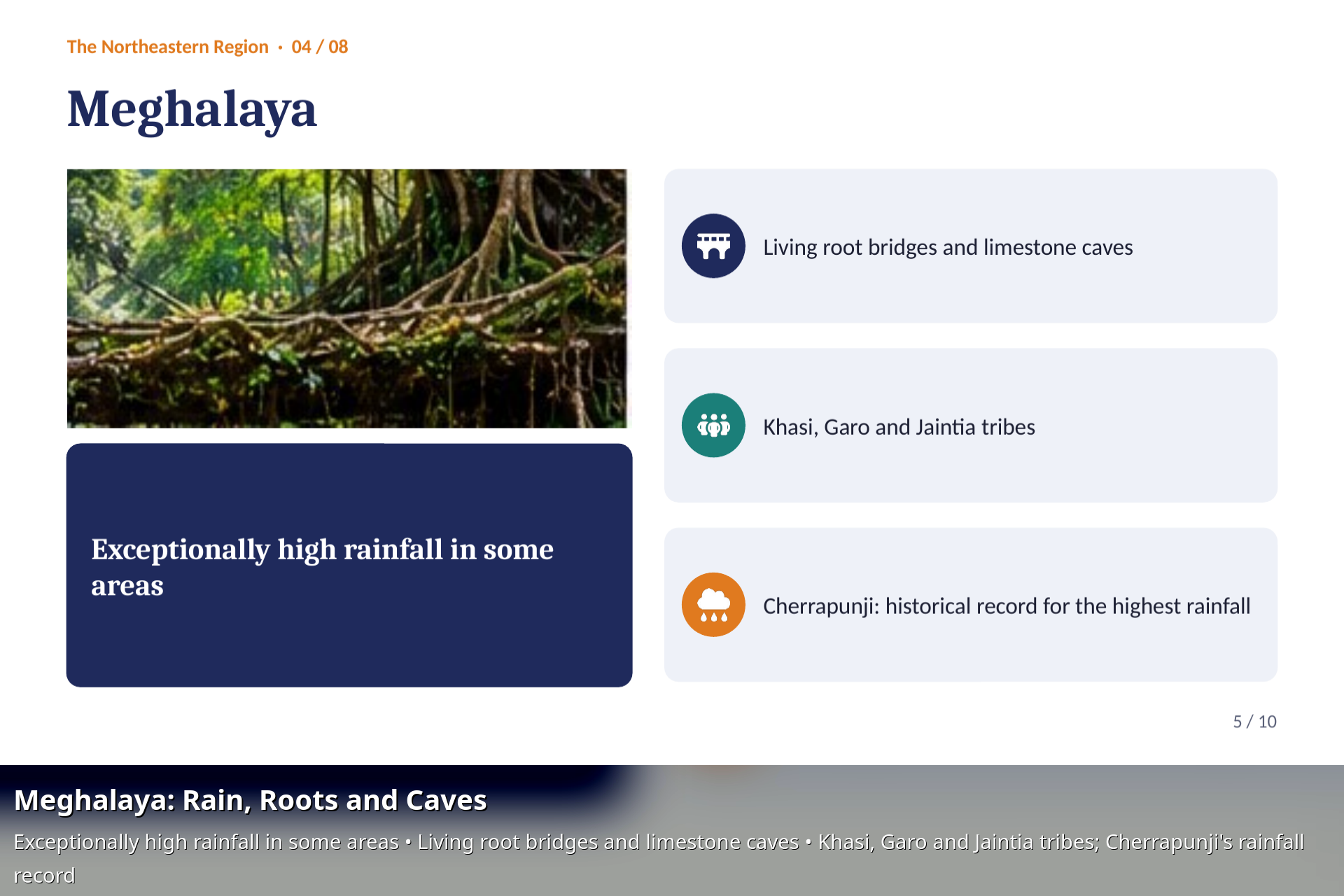
MeghalayaFamous for exceptionally high rainfall in some areas, living root bridges, and limestone caves. The…
Meghalaya
Famous for exceptionally high rainfall in some areas, living root bridges, and limestone caves. The dominant tribes there are Khasi, Garo, and Jaintia. Cherrapunji holds the historical record for the highest rainfall.
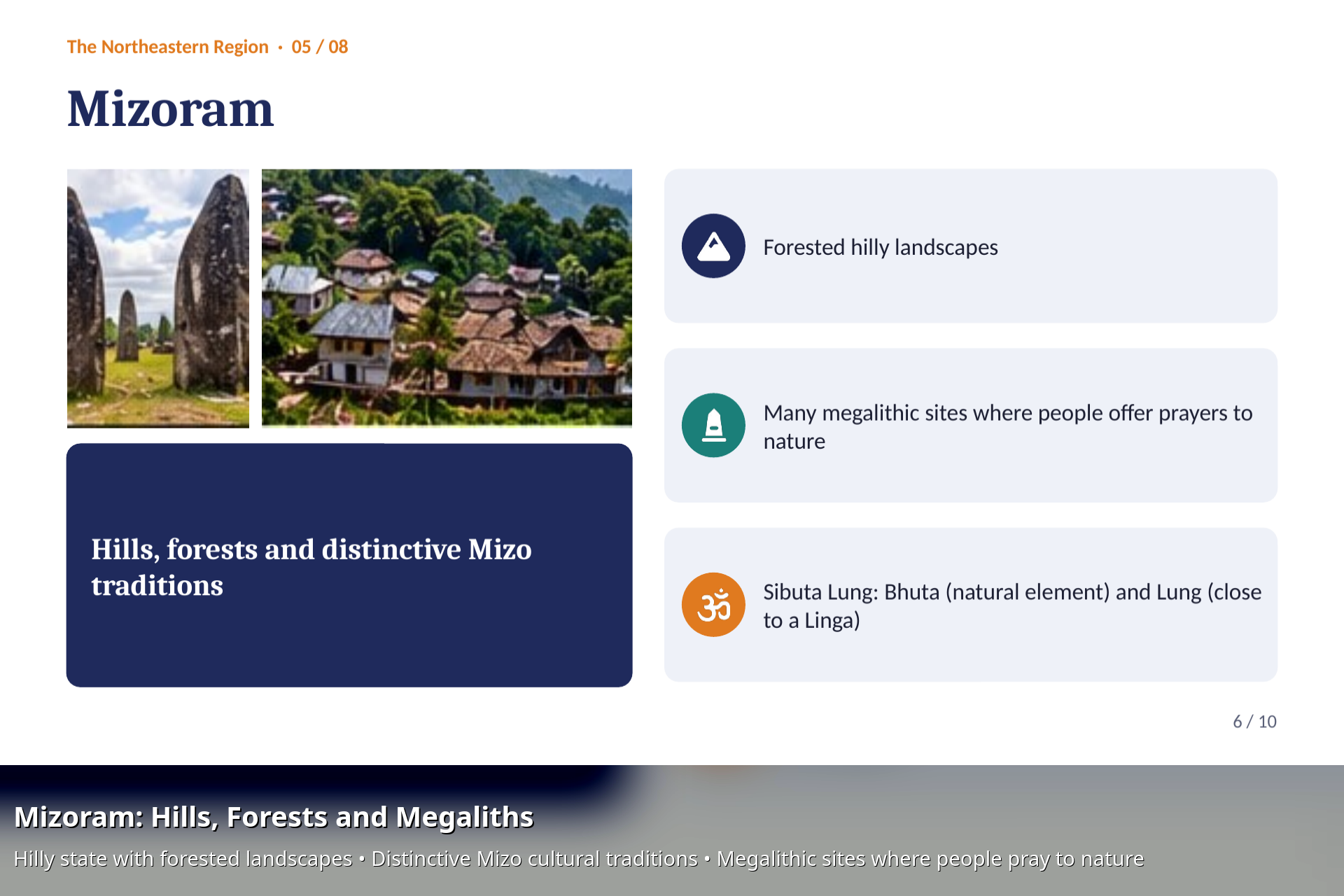
MizoramA hilly State with forested landscapes and distinctive Mizo cultural traditions. The state has many…
Mizoram
A hilly State with forested landscapes and distinctive Mizo cultural traditions. The state has many megalithic sites where people offer prayers to nature, such as the Sibuta Lung (Bhuta in Sānskrit means natural element and Lung is close to a Linga).
Featuring:
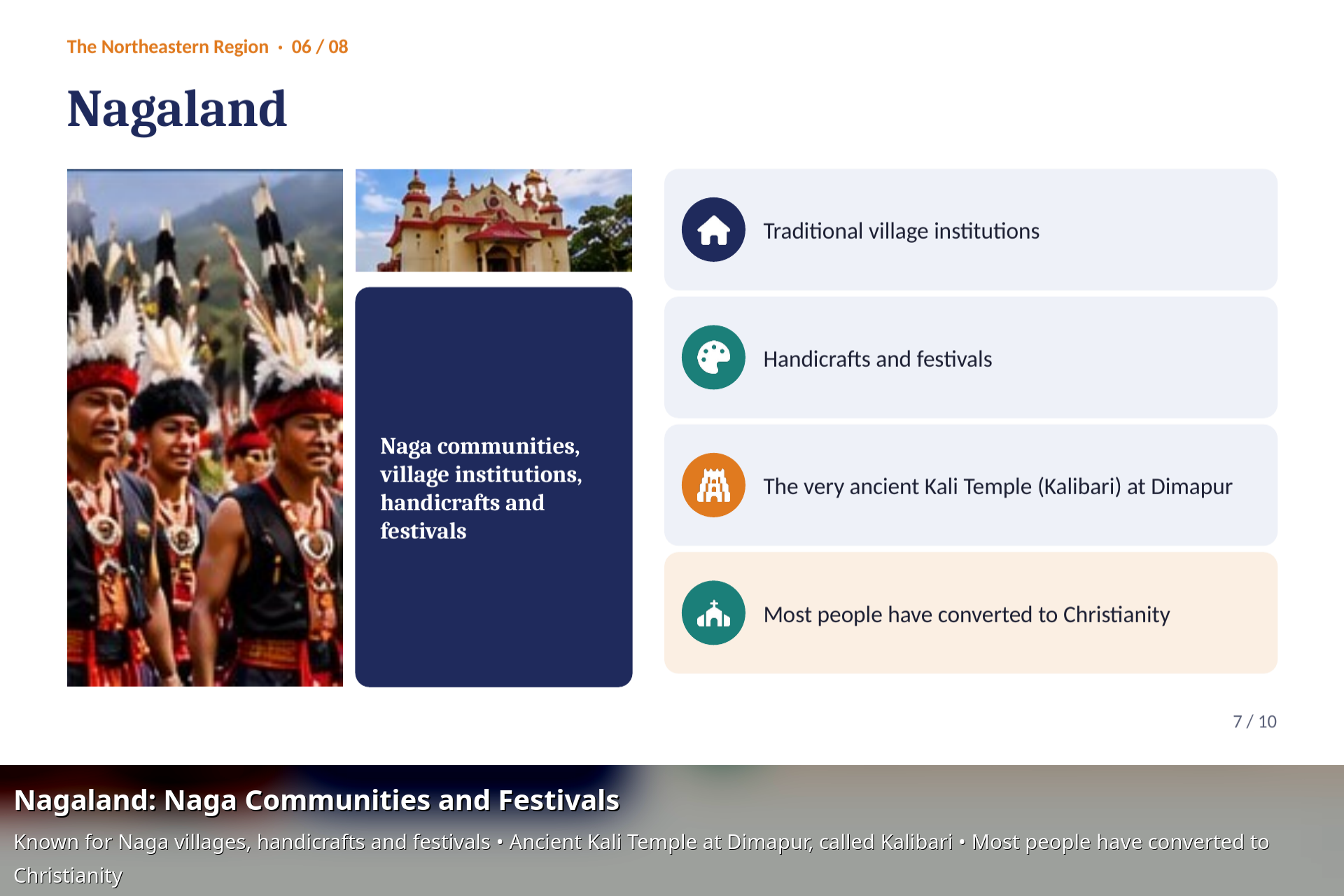
NagalandKnown for its Naga communities, traditional village institutions, handicrafts and festivals. The Kali Temple at…
Nagaland
Known for its Naga communities, traditional village institutions, handicrafts and festivals. The Kali Temple at Dimapur, called Kalibari, is very ancient. Most people in the state have converted to Christianity.
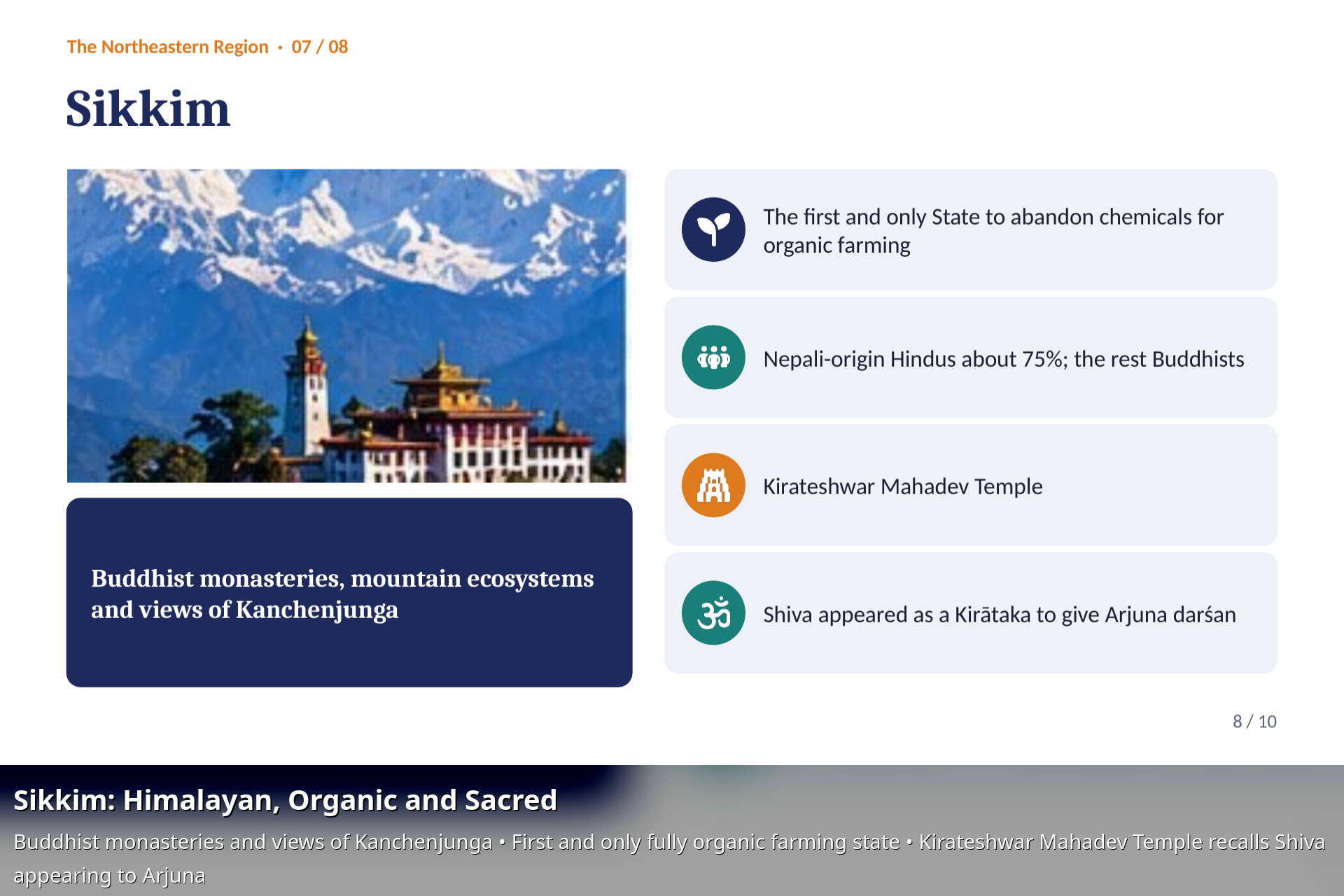
SikkimA Himalayan State renowned for Buddhist monasteries, mountain ecosystems, and views of Kanchenjunga. It is…
Sikkim
A Himalayan State renowned for Buddhist monasteries, mountain ecosystems, and views of Kanchenjunga. It is the first and only state to abandon chemicals and adopt organic farming. Nepali-origin Hindus make up about 75% of the population, and the rest are Buddhists. The state is home to Kirateshwar Mahadev Temple. Pleased with Pandava Arjuna’s penance, Bhagavān Shiva appeared as a Kirātaka (hill person) to give him darśan.
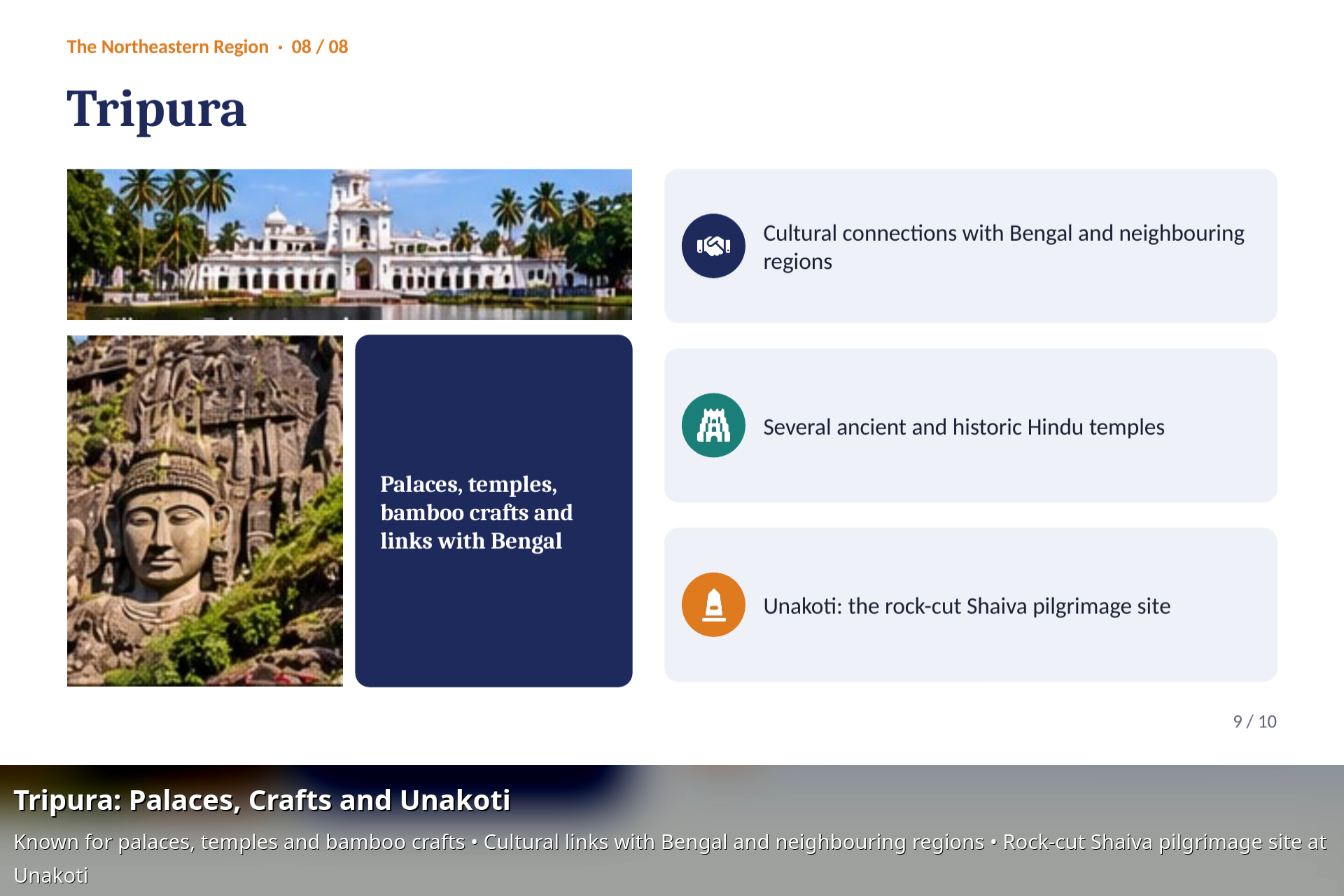
TripuraKnown for its palaces, temples, bamboo crafts, and cultural connections with Bengal and neighbouring regions.…
Tripura
Known for its palaces, temples, bamboo crafts, and cultural connections with Bengal and neighbouring regions. The state is home to several ancient and historic Hindu temples, and the most exotic being the rock-cut Shaiva pilgrimage site at Unakoti.
Featuring:
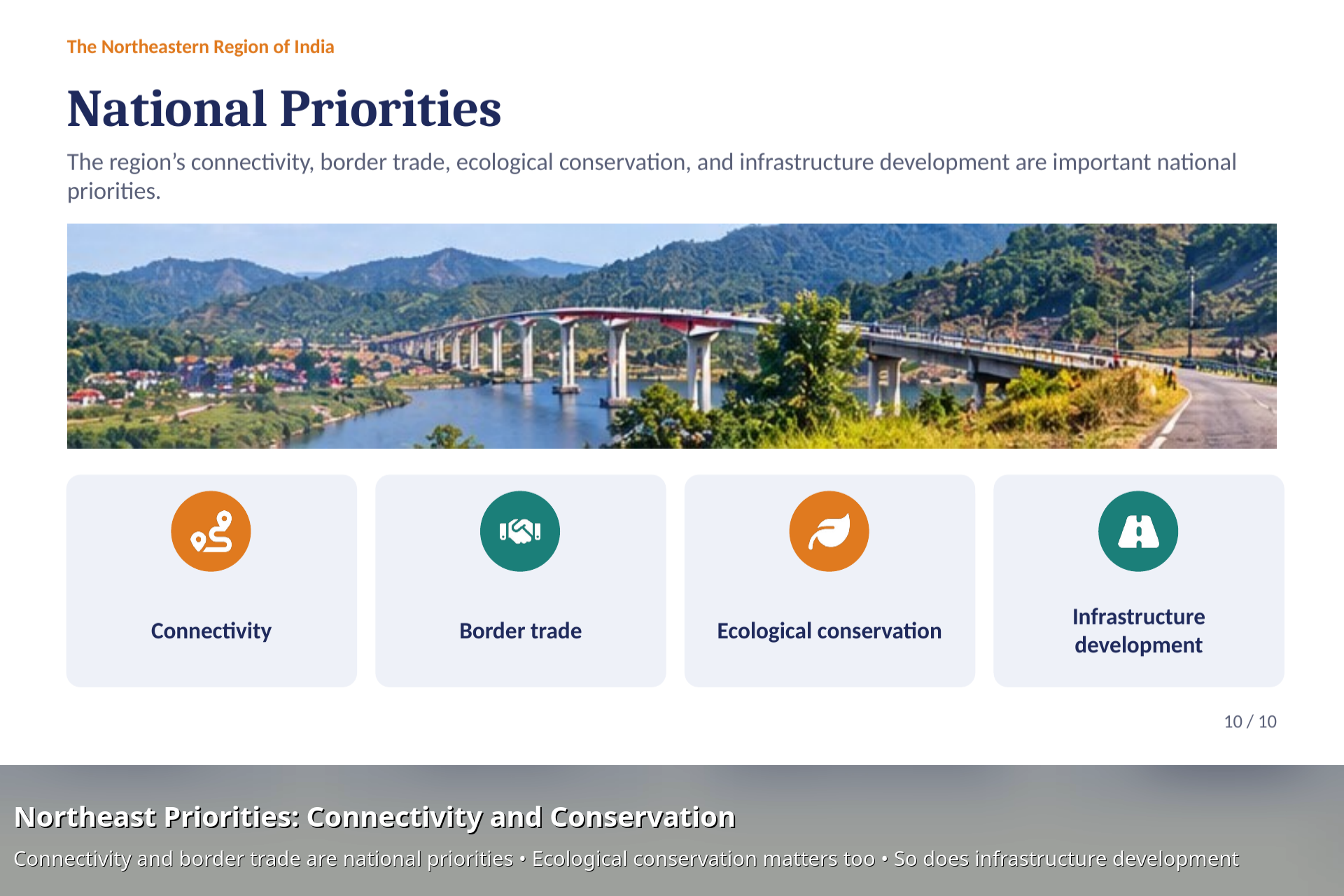
The region’s connectivity, border trade, ecological conservation, and infrastructure development are important national priorities.
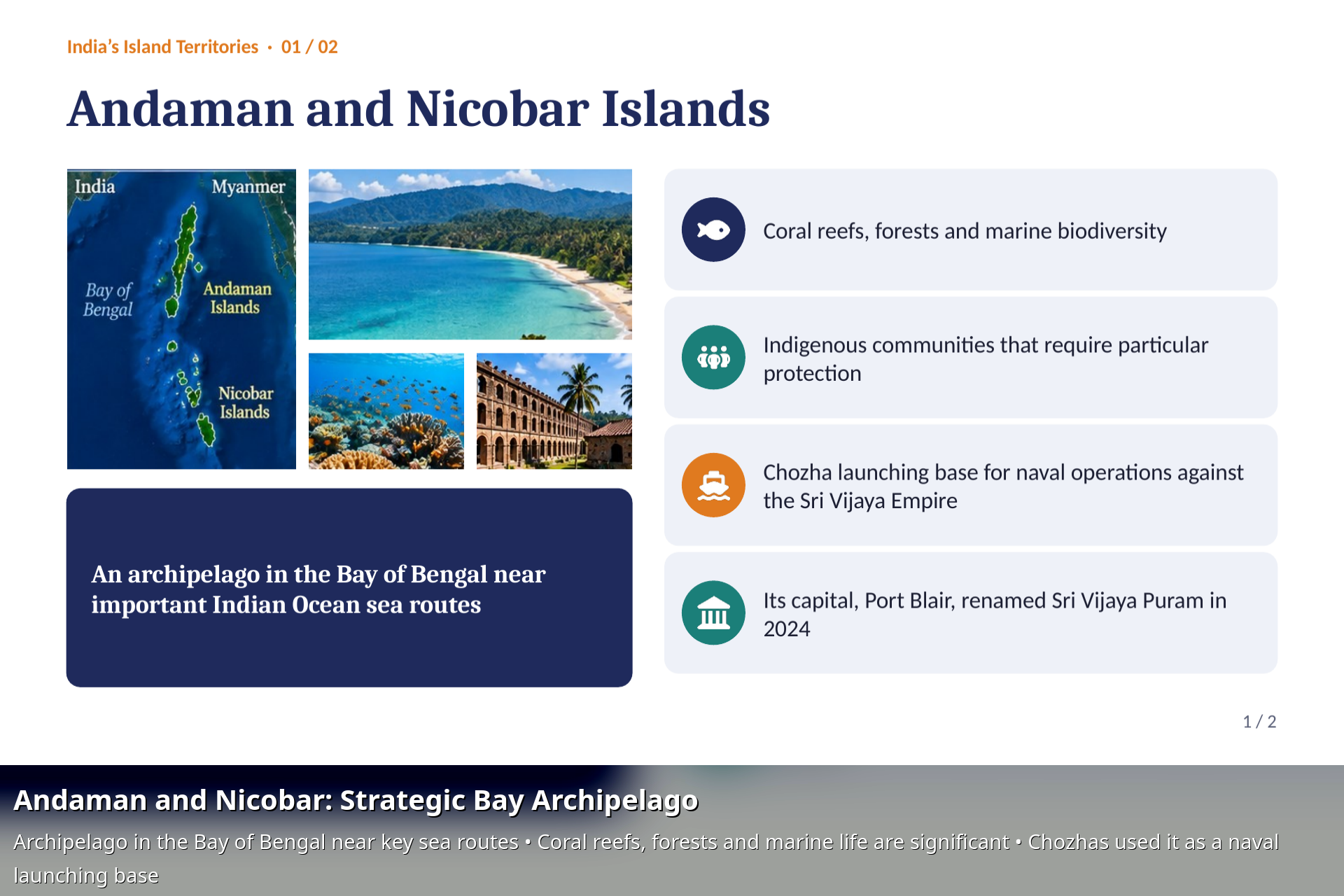
Andaman and Nicobar IslandsAn archipelago in the Bay of Bengal, strategically positioned near important Indian…
Andaman and Nicobar Islands
An archipelago in the Bay of Bengal, strategically positioned near important Indian Ocean sea routes. Its coral reefs, forests and marine biodiversity are significant, and its Indigenous communities require particular protection. The Chozha Empire used these islands as a launching base for its naval operations against the Sri Vijaya Empire. The government renamed its capital, Port Blair, as Sri Vijaya Puram in 2024.
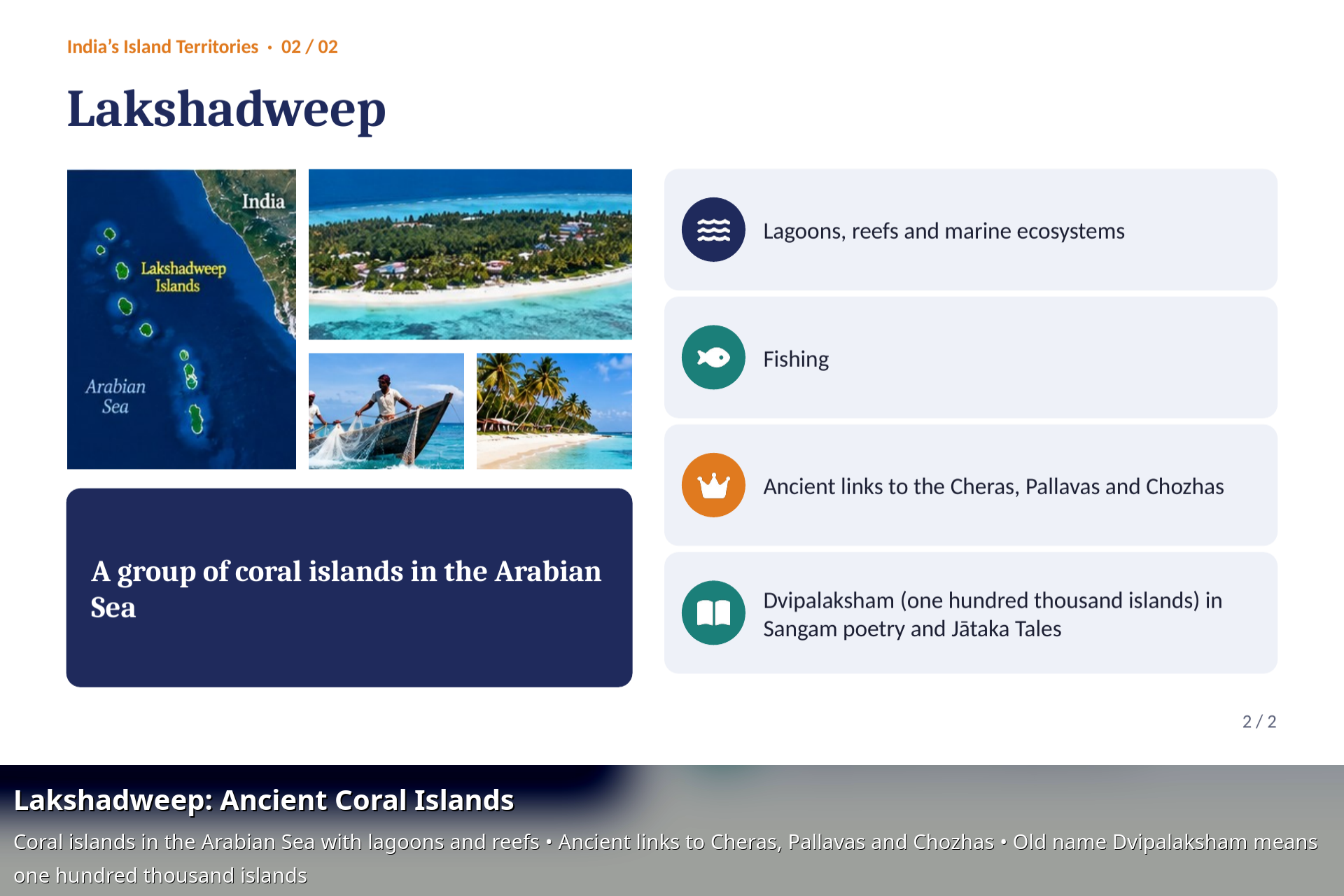
LakshadweepA group of coral islands in the Arabian Sea, known for lagoons, reefs, marine ecosystems…
Lakshadweep
A group of coral islands in the Arabian Sea, known for lagoons, reefs, marine ecosystems and fishing. These islands had ancient links to the Cheras, Pallavas, and Chozhas. Sangam poetry and Buddhist Jātaka Tales mention these islands with their ancient name Dvipalaksham (one hundred thousand islands; the same meaning as its present name).
Featuring: