


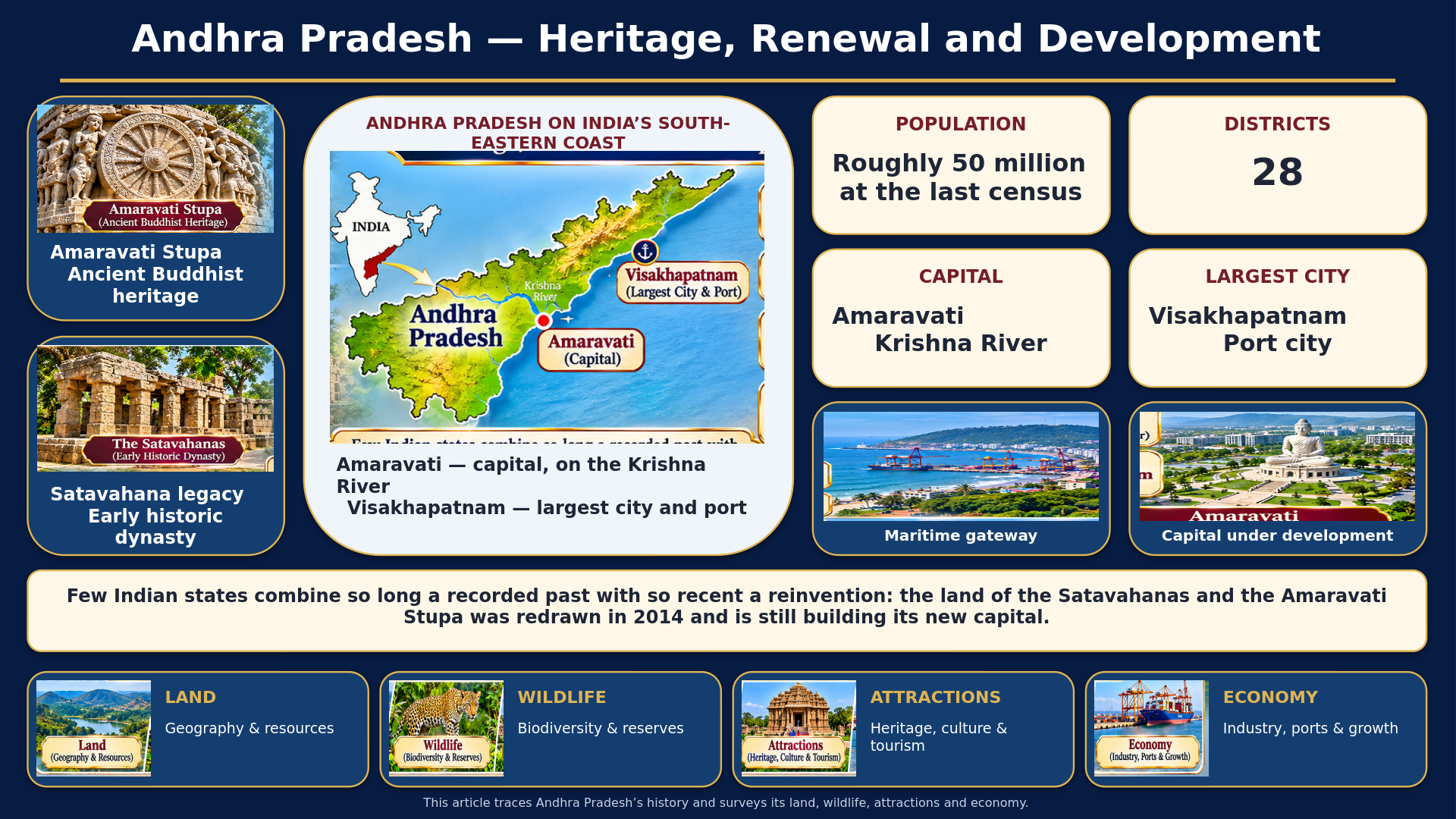
The modern state of Andhra Pradesh lies on India's south-eastern coast. It was home to roughly 50 million people at the last census, and it is organised into 28 districts. Its capital is Amaravati, on the Krishna river, and its largest city is the port of Visakhapatnam. Few Indian states combine so long a recorded past with so recent a reinvention. The land of the Satavahanas and the Amaravati stupa was redrawn in 2014, and it is still building its new capital. This account traces that history, and then surveys the state's land, wildlife, attractions and economy.
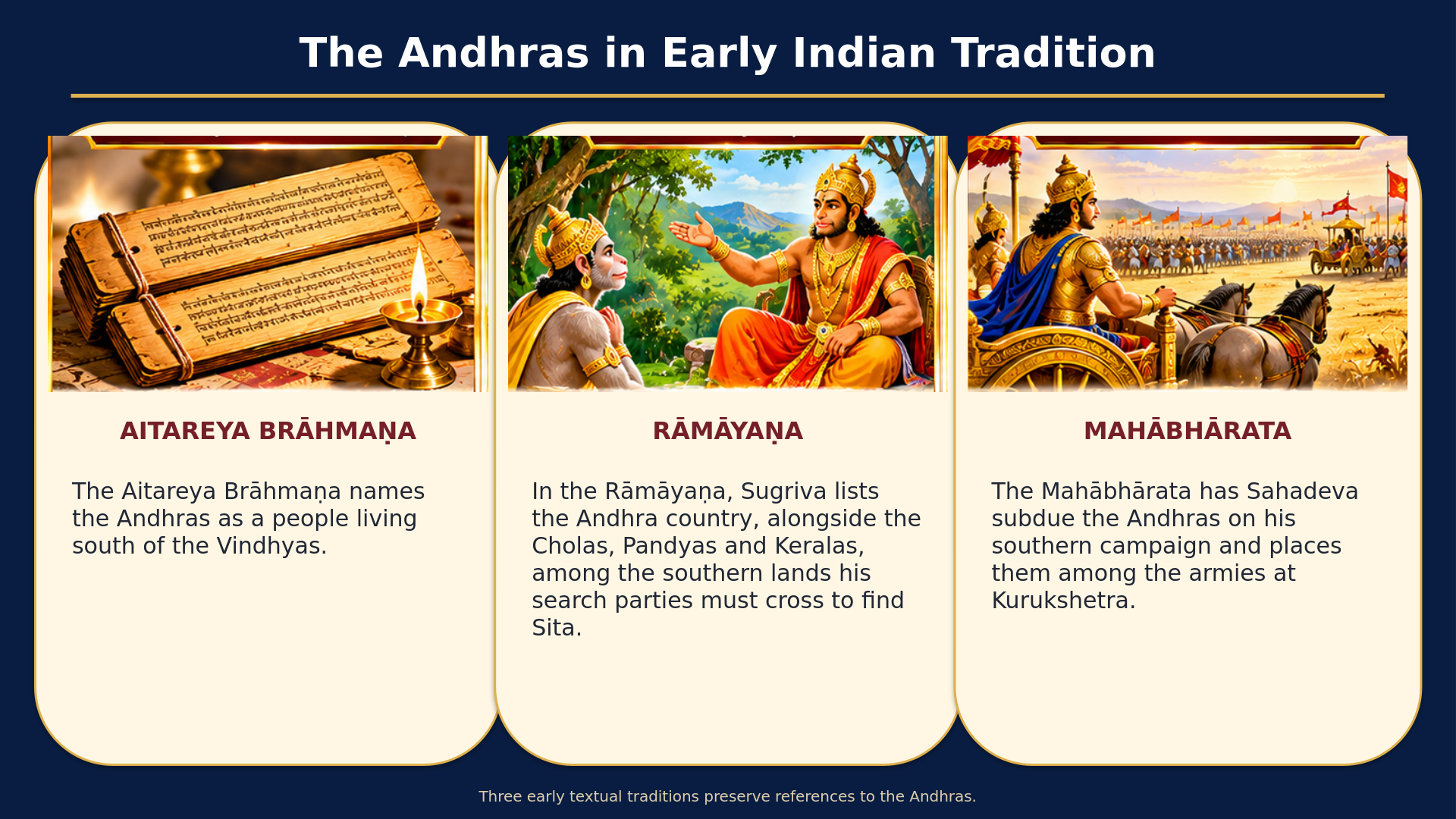
We begin in ancient times. The Andhras appear in some of the oldest layers of Indian tradition. The Aitareya Brahmana names them as a people living south of the Vindhyas. In the Ramayana, Sugriva lists the Andhra country, alongside the Cholas, Pandyas and Keralas, among the southern lands his search parties must cross to find Sita. The Mahabharata has Sahadeva subdue the Andhras on his southern campaign, and places them among the armies at Kurukshetra.
Featuring:


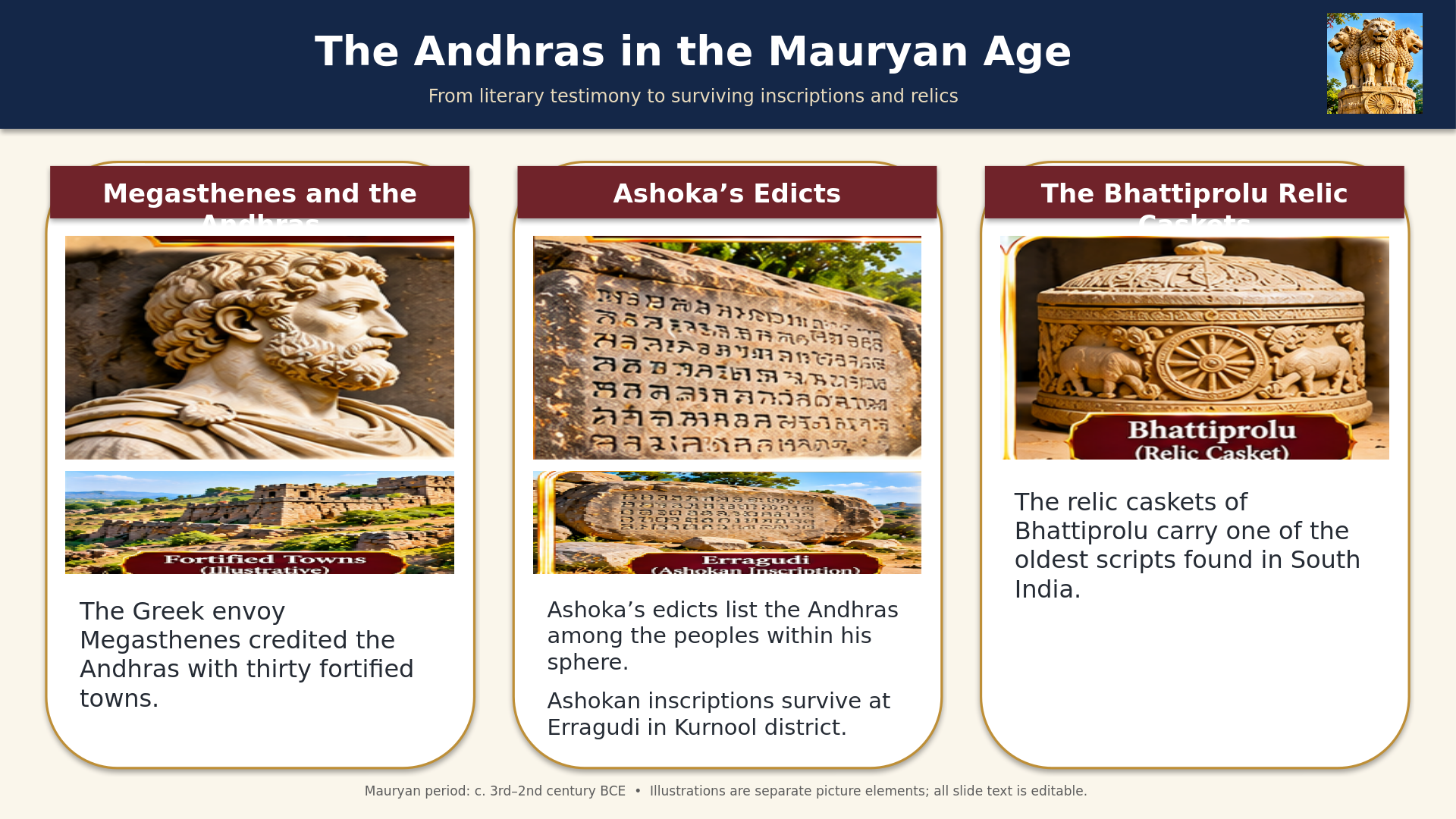
By the Mauryan age, the evidence becomes documentary. The Greek envoy Megasthenes credited the Andhras…
By the Mauryan age, the evidence becomes documentary. The Greek envoy Megasthenes credited the Andhras with thirty fortified towns, and Ashoka's edicts list them among the peoples within his sphere. Ashokan inscriptions survive at Erragudi in Kurnool district. The relic caskets of Bhattiprolu carry one of the oldest scripts found in South India.
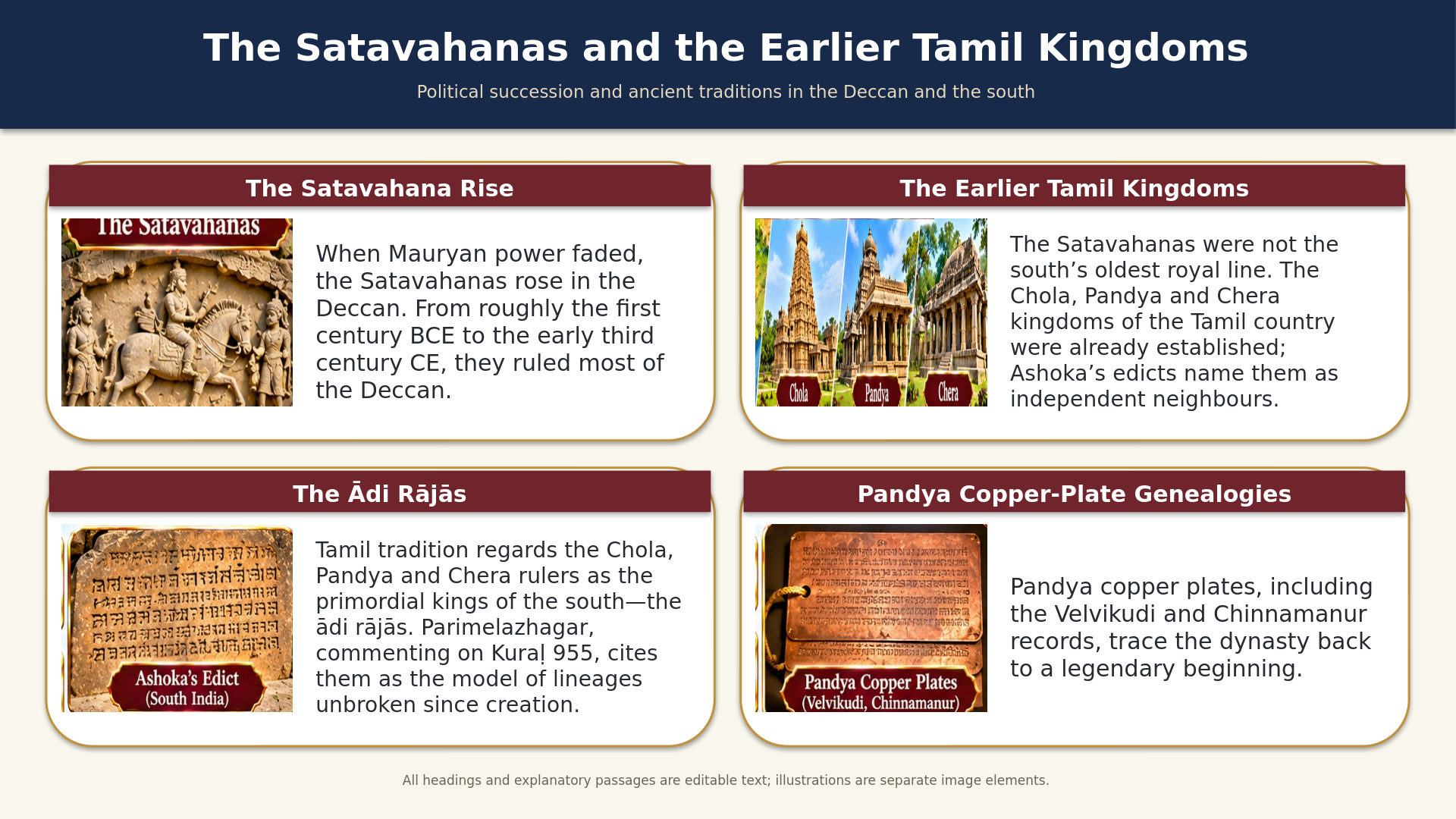
When Mauryan power faded, the Satavahanas rose in the Deccan. They were not the oldest royal line of the south. The Chola, Pandya and Chera kingdoms of the Tamil country were already established, and Ashoka's edicts name them as independent neighbours. Tamil tradition regards these three as the primordial kings of the south, the adi rajas. The commentator Parimelazhagar, explaining verse 955 of the Kural, cites them as the model of lineages unbroken since creation. Pandya copper plates, such as those of Velvikudi and Chinnamanur, trace that dynasty back to a legendary beginning. Even so, from roughly the first century before the common era to the early third century of the common era, the Satavahanas ruled most of the Deccan.
At its height, under Gautamiputra Satakarni, the realm stretched from the Konkan coast and the…
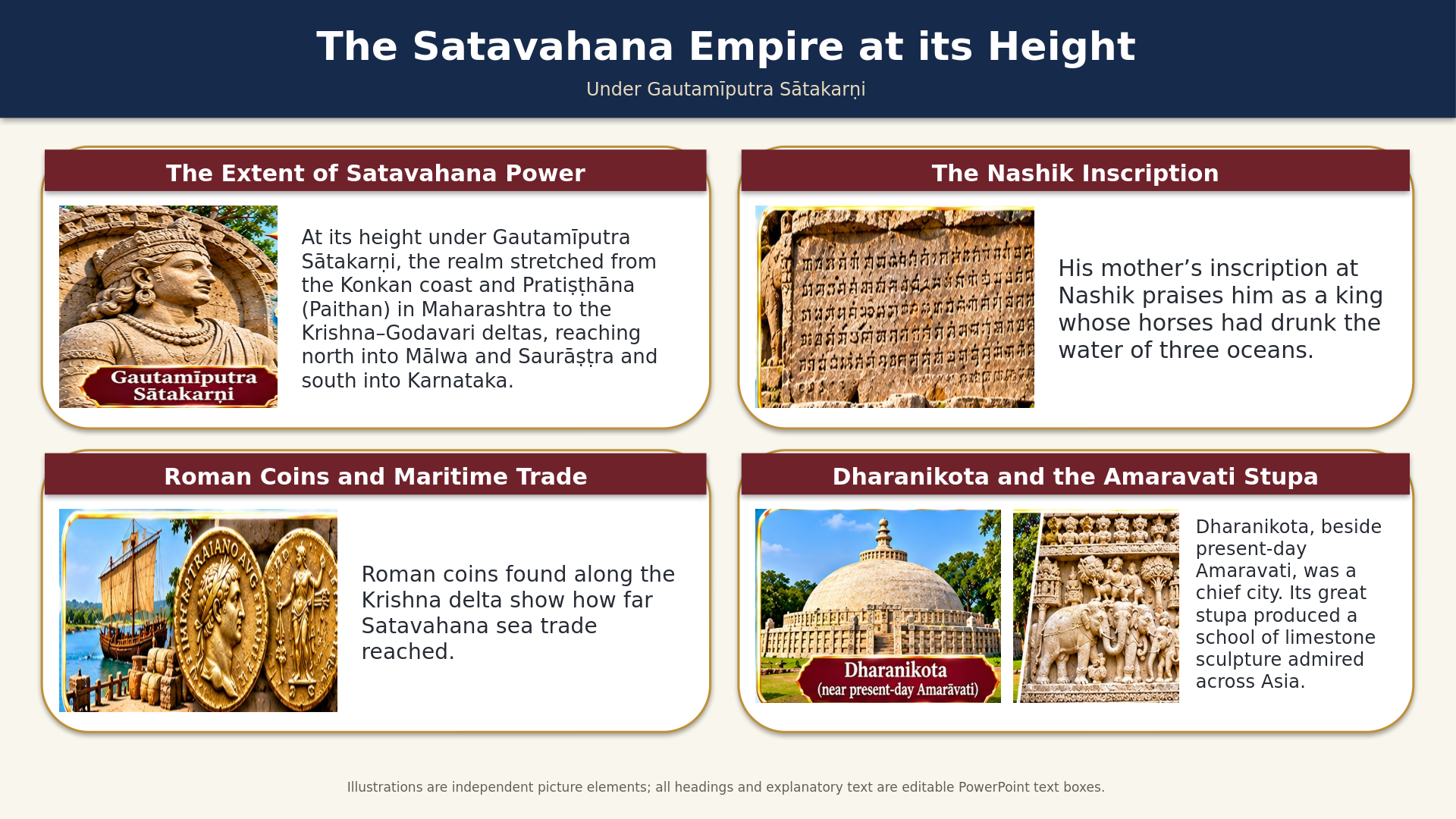
At its height, under Gautamiputra Satakarni, the realm stretched from the Konkan coast and the city of Pratishthana, the modern Paithan in Maharashtra, to the deltas of the Krishna and the Godavari. It reached north into Malwa and Saurashtra, and south into Karnataka. His mother's inscription at Nashik praises him as a king whose horses had drunk the water of three oceans. Roman coins found along the Krishna delta show how far Satavahana sea trade reached. Dharanikota, beside present-day Amaravati, was one of their chief cities. The great stupa there produced a school of limestone sculpture admired across Asia.
Featuring:


The Ikshvakus followed in the third and fourth centuries. Their capital was Vijayapuri, in the Nagarjunakonda valley, a major seat of Buddhist learning linked with the philosopher Nagarjuna. Smaller dynasties then held the coast. These were the Salankayanas, the Vishnukundins and, in the south, the early Pallavas.

We turn now to the medieval period. From the year 624, the Eastern Chalukyas ruled…
We turn now to the medieval period. From the year 624, the Eastern Chalukyas ruled the coastal country from Vengi for more than four centuries. Their court gave Telugu its literary standing. Around the eleventh century, under Rajaraja Narendra at Rajahmundry, the poet Nannaya began the Telugu Mahabharata, the starting point of classical Telugu literature.

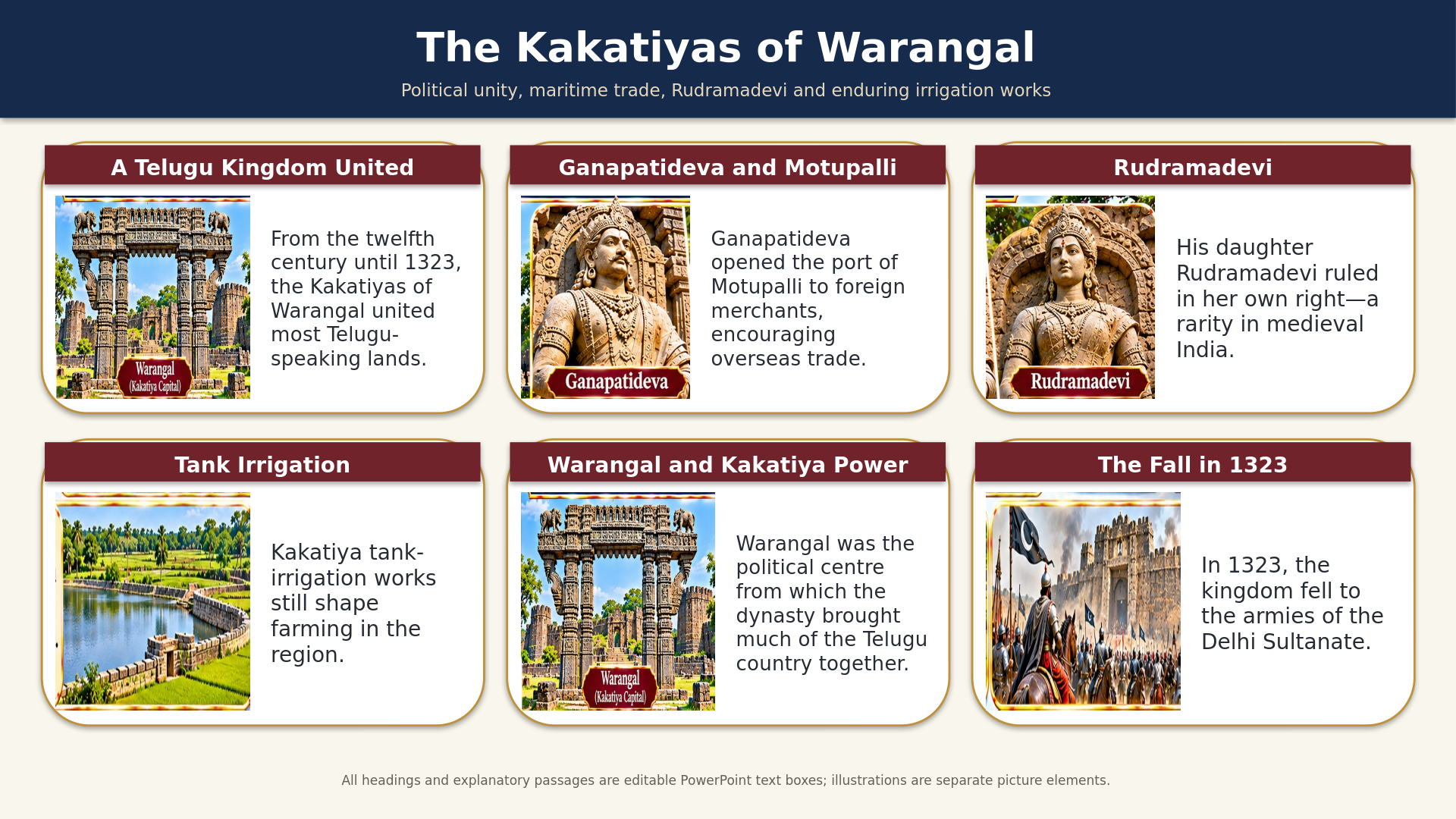
The Kakatiyas of Warangal then united most Telugu-speaking lands, between the twelfth century and the year 1323. Ganapatideva opened the port of Motupalli to foreign merchants. His daughter Rudramadevi ruled in her own right, a rarity in medieval India. Their irrigation tanks still shape farming in the region. The kingdom fell to the armies of the Delhi Sultanate in 1323.
Featuring:



Local powers filled the gap. The Reddi kings held the coast from Addanki, Kondavidu and…
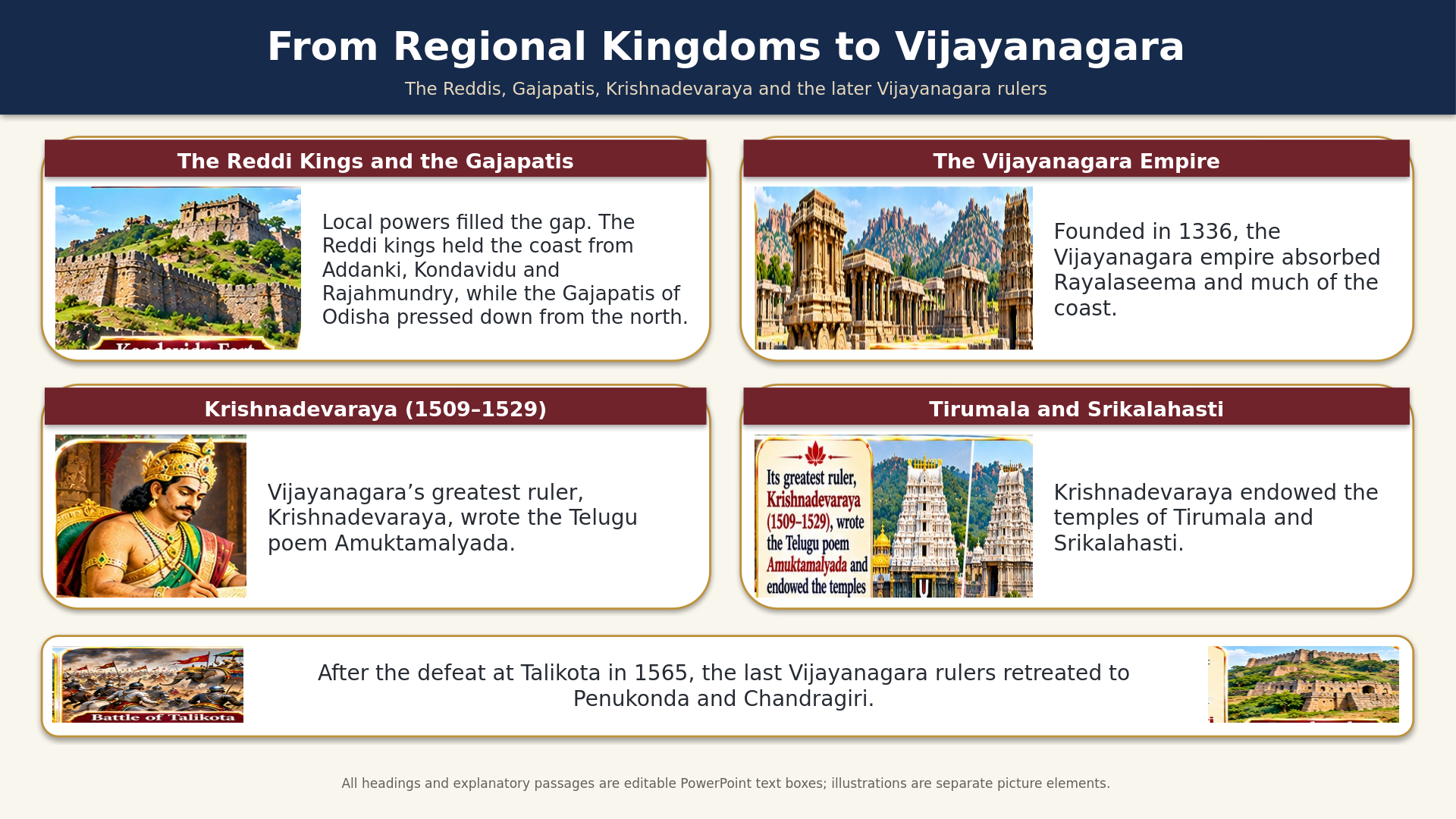
Local powers filled the gap. The Reddi kings held the coast from Addanki, Kondavidu and Rajahmundry, while the Gajapatis of Odisha pressed down from the north. The Vijayanagara empire, founded in 1336, absorbed Rayalaseema and much of the coast. Its greatest ruler, Krishnadevaraya, reigned from 1509 to 1529. He wrote the Telugu poem Amuktamalyada, and endowed the temples of Tirumala and Srikalahasti. After the defeat at Talikota in 1565, the last Vijayanagara rulers retreated to Penukonda and Chandragiri.
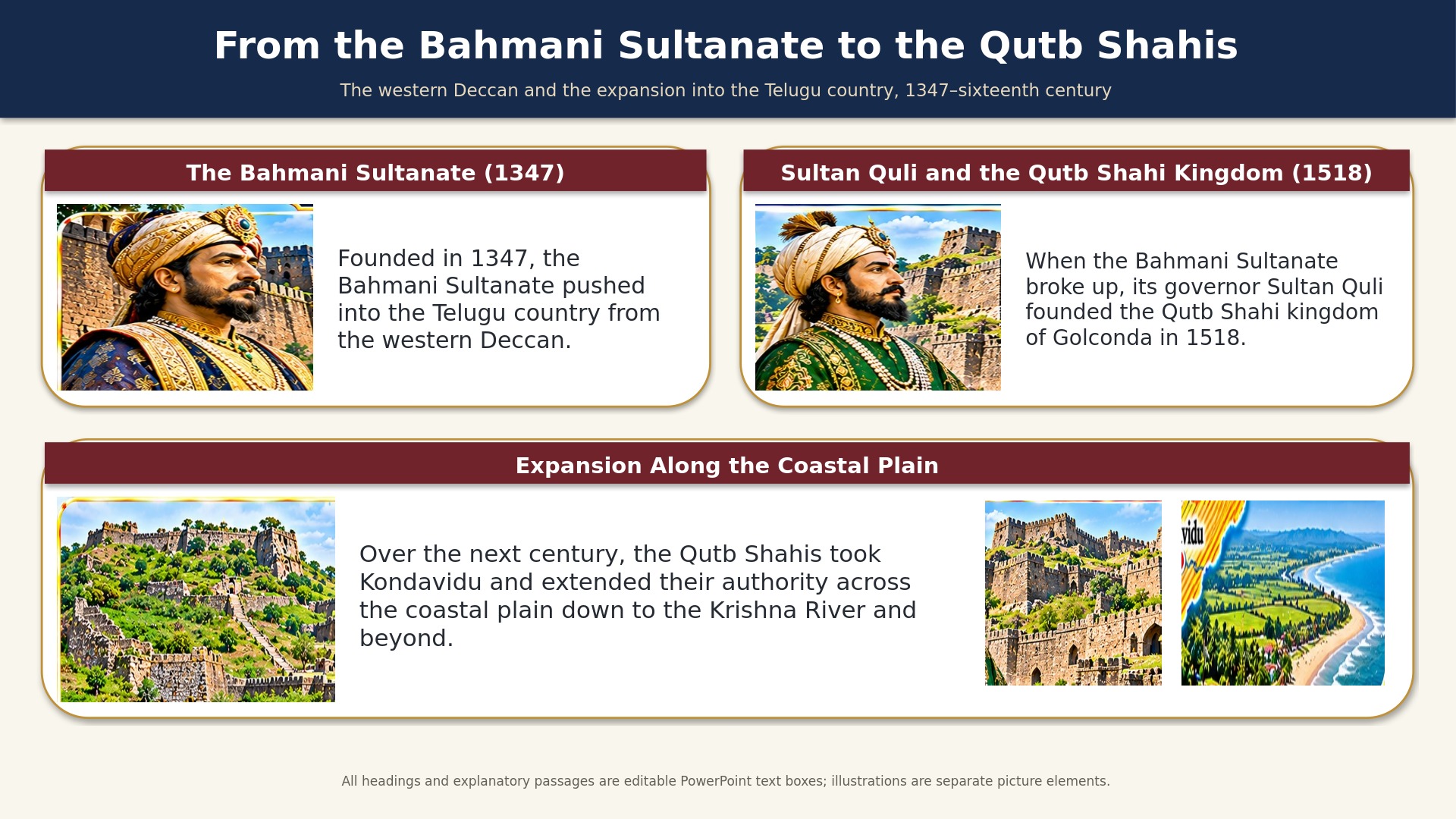
Next came the Islamic sultanates. The Bahmani Sultanate, founded in 1347, pushed into the Telugu country from the western Deccan. When it broke up, its governor Sultan Quli founded the Qutb Shahi kingdom of Golconda, in 1518. Over the next century, the Qutb Shahis took Kondavidu and the whole coastal plain, down to the Krishna and beyond.
Golconda rule was notable for its accommodation of local culture. Ibrahim Qutb Shah patronised Telugu…
Golconda rule was notable for its accommodation of local culture. Ibrahim Qutb Shah patronised Telugu poets, and Telugu officials held high posts in the revenue administration. Masulipatnam became the kingdom's chief port, exporting painted kalamkari cottons to Persia and Southeast Asia. The Kollur mines on the Krishna supplied the diamonds that made Golconda famous. The Dutch opened a trading post at Masulipatnam in 1606, and the English followed in 1611.

Featuring:


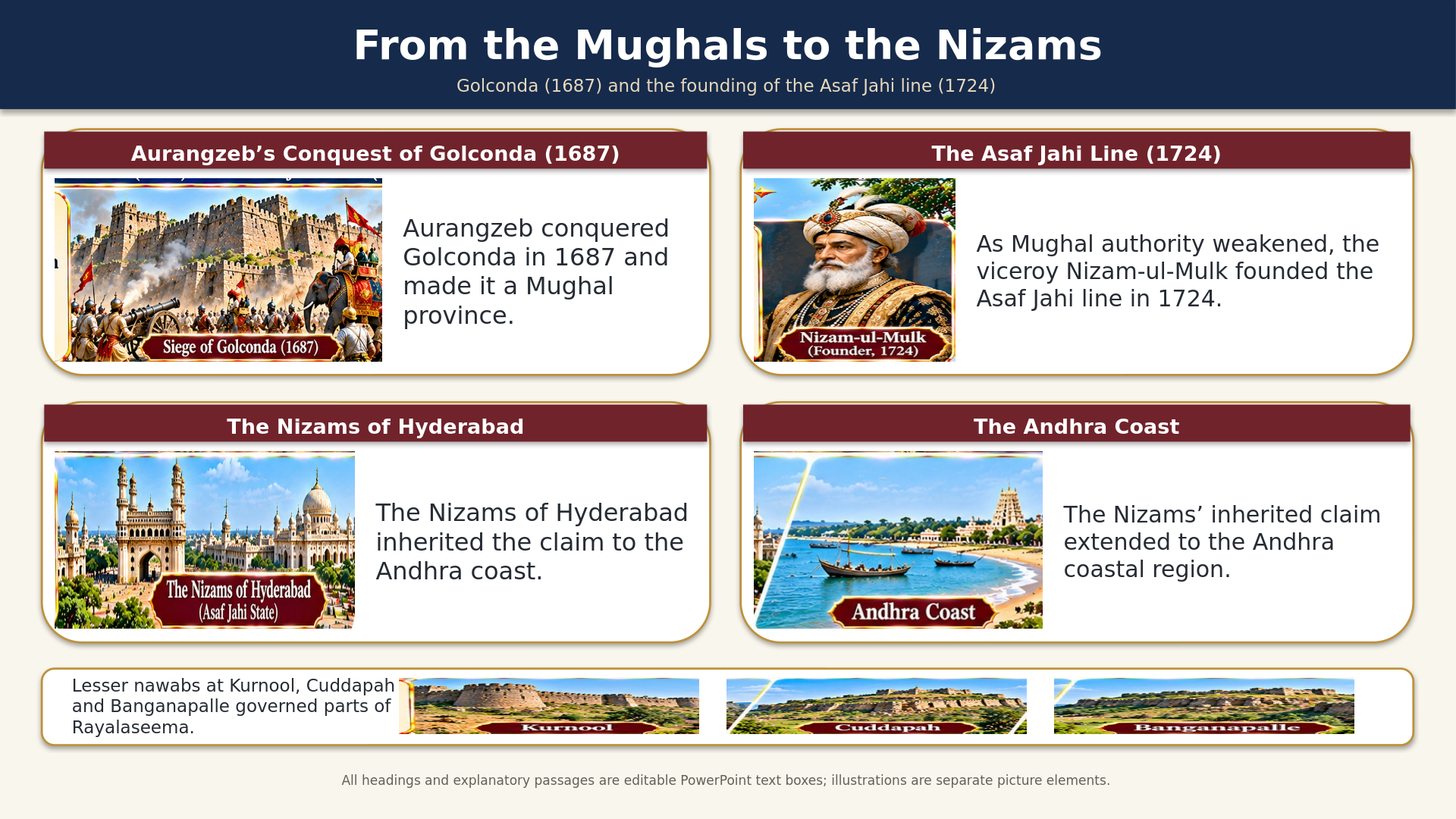
Aurangzeb conquered Golconda in 1687 and made it a Mughal province. As Mughal authority weakened, the viceroy Nizam-ul-Mulk founded the Asaf Jahi line in 1724, and the Nizams of Hyderabad inherited the claim to the Andhra coast. Lesser nawabs at Kurnool, Cuddapah and Banganapalle governed parts of Rayalaseema.
Then came the British. They acquired Andhra in stages, not by a single conquest. The…
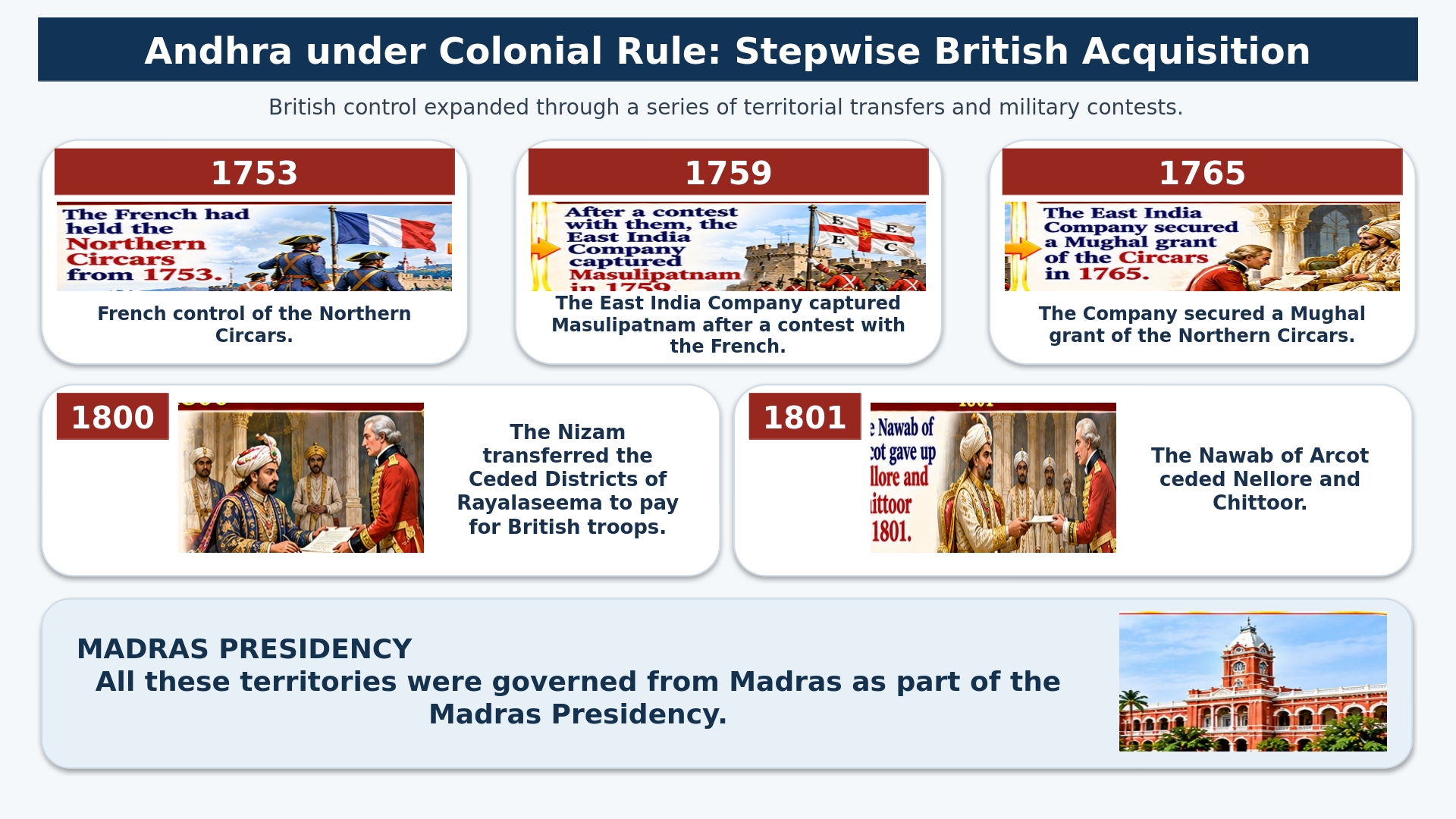
Then came the British. They acquired Andhra in stages, not by a single conquest. The French had held the Northern Circars from 1753. After a contest with them, the East India Company captured Masulipatnam in 1759, and secured a Mughal grant of the Circars in 1765. In 1800, the Nizam handed over the Ceded Districts of Rayalaseema to pay for British troops. In 1801, the Nawab of Arcot gave up Nellore and Chittoor. All of it was governed from Madras, as part of the Madras Presidency.
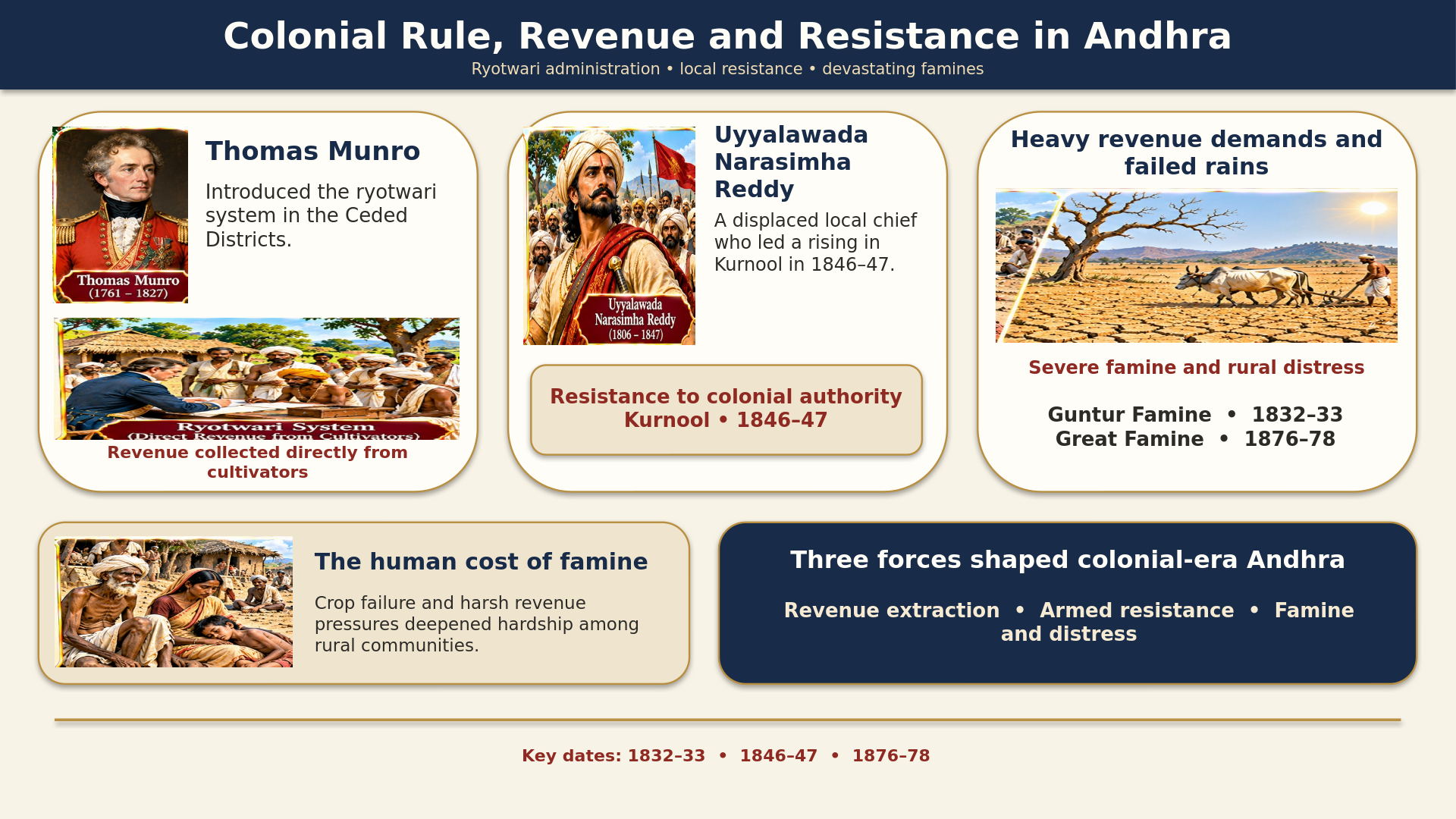
Thomas Munro introduced the ryotwari system in the Ceded Districts, collecting revenue directly from cultivators. Resistance came from displaced local chiefs. The most famous was Uyyalawada Narasimha Reddy, who led a rising in Kurnool in 1846 and 1847. Heavy revenue demands and failed rains produced severe famines, including the Guntur famine of 1832 to 1833, and the Great Famine of 1876 to 1878.
Featuring:

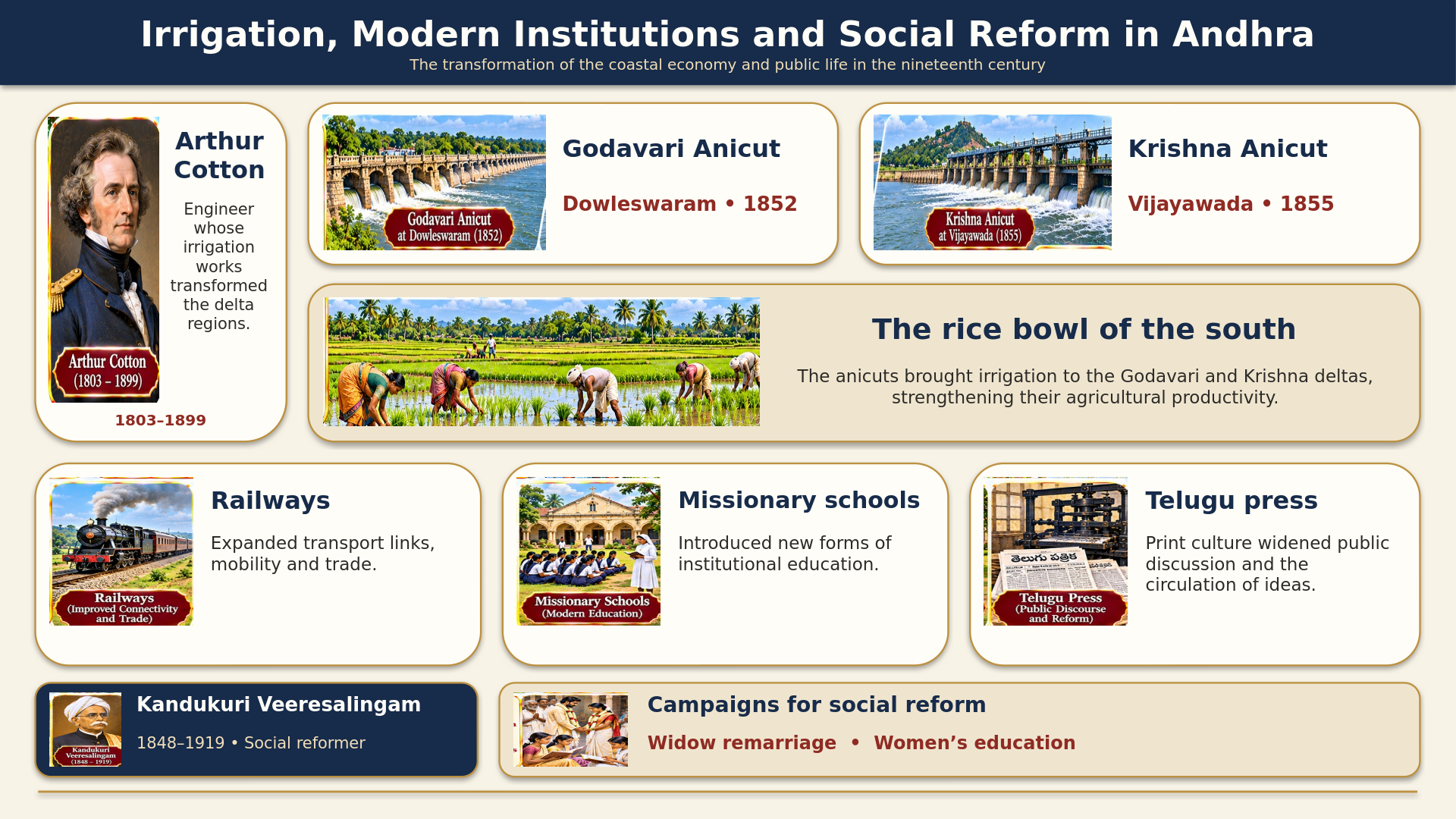
The engineer Arthur Cotton changed the coastal economy. He built the Godavari anicut at Dowleswaram…
The engineer Arthur Cotton changed the coastal economy. He built the Godavari anicut at Dowleswaram in 1852, and the Krishna anicut at Vijayawada in 1855. Together, these dams turned the two deltas into the rice bowl of the south. Railways, missionary schools and a Telugu press followed. Reformers such as Kandukuri Veeresalingam campaigned for widow remarriage and women's education.
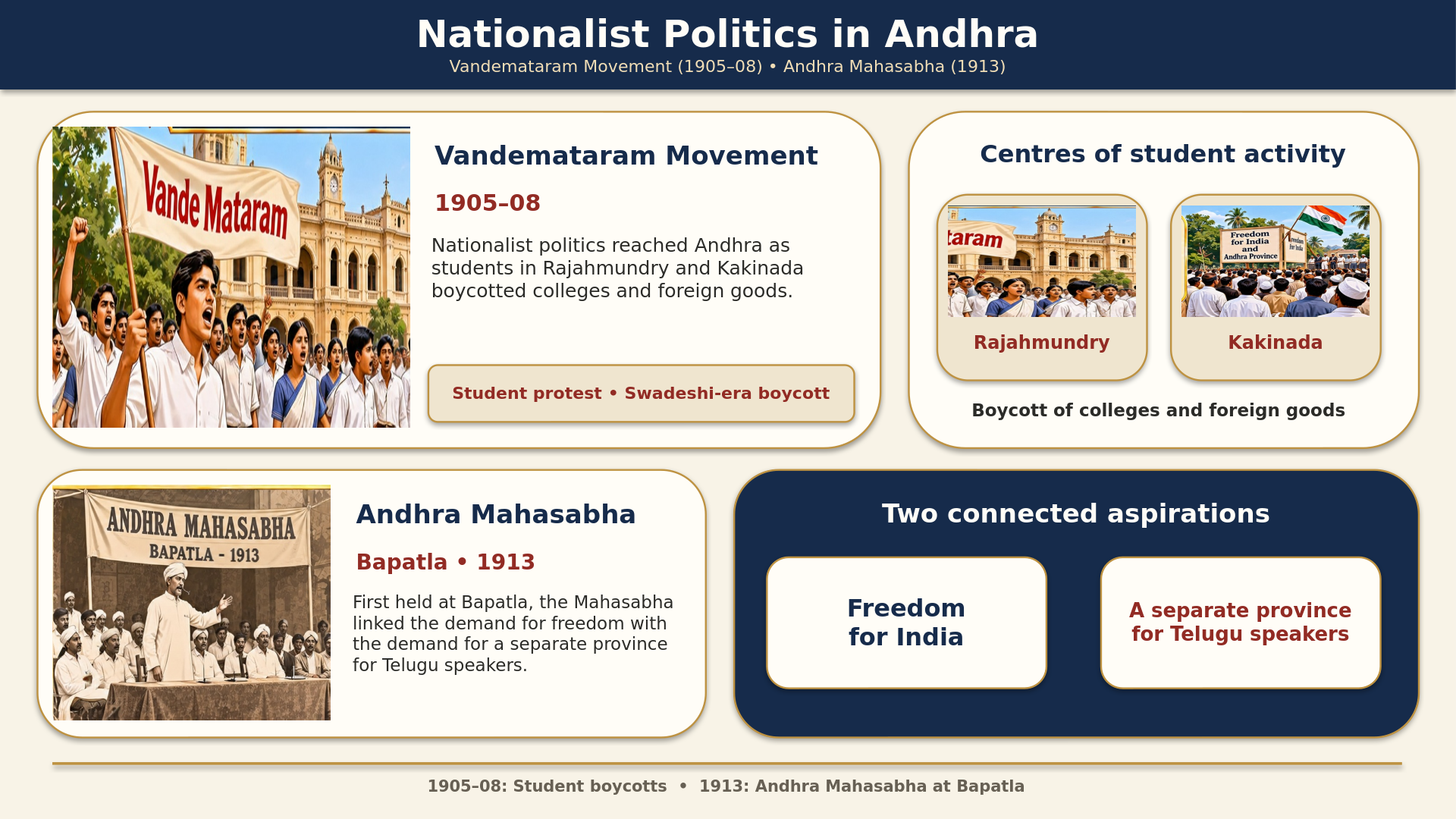
Now, the freedom struggle. Nationalist politics reached Andhra with the Vandemataram movement of 1905 to 1908, when students in Rajahmundry and Kakinada boycotted colleges and foreign goods. The Andhra Mahasabha was first held at Bapatla in 1913. It tied the demand for freedom to a second demand, a separate province for Telugu speakers.
The non-cooperation years produced some of the most original protests in India. In 1921, Duggirala…
The non-cooperation years produced some of the most original protests in India. In 1921, Duggirala Gopalakrishnayya led the people of Chirala and Perala out of their town, so that they would not have to pay a new municipal tax. Farmers at Pedanandipadu refused land revenue, and villagers in Palnadu defied the forest laws. In the same year, at Vijayawada, Pingali Venkayya presented Gandhi with the flag design that grew into the national tricolour.

Featuring:

In the hill tracts of the Godavari Agency, Alluri Sitarama Raju led Adivasi fighters in the Rampa rebellion of 1922 to 1924. They raided police stations until he was captured and shot, in May 1924. Tanguturi Prakasam earned the title Andhra Kesari, the Lion of Andhra, by facing police rifles during the 1928 protest against the Simon Commission in Madras. Salt satyagraha camps along the coast in 1930, and the Quit India protests of 1942, including the police firing at Tenali, completed the story.

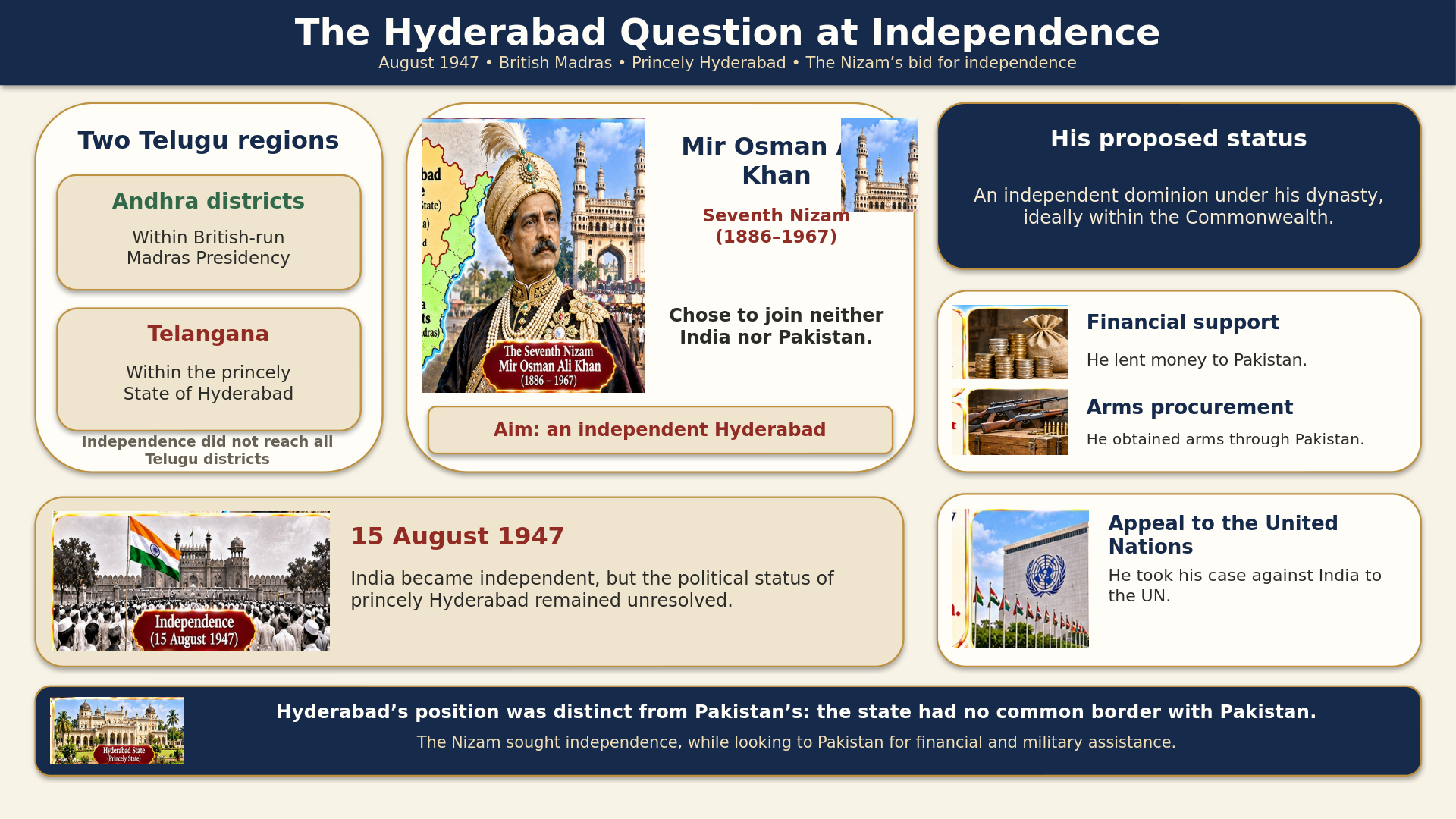
Independence in August 1947 did not reach every Telugu district. The districts of today's Andhra…
Independence in August 1947 did not reach every Telugu district. The districts of today's Andhra Pradesh were in British-run Madras. But Telangana lay inside the princely state of Hyderabad. Its ruler, the seventh Nizam, Mir Osman Ali Khan, chose to join neither India nor Pakistan. His aim was an independent Hyderabad under his own dynasty, ideally as a separate dominion within the Commonwealth. He did not seek to merge with Pakistan, which had no common border with his state. But he looked to Pakistan for support. He lent it money, obtained arms through it, and took his case against India to the United Nations.
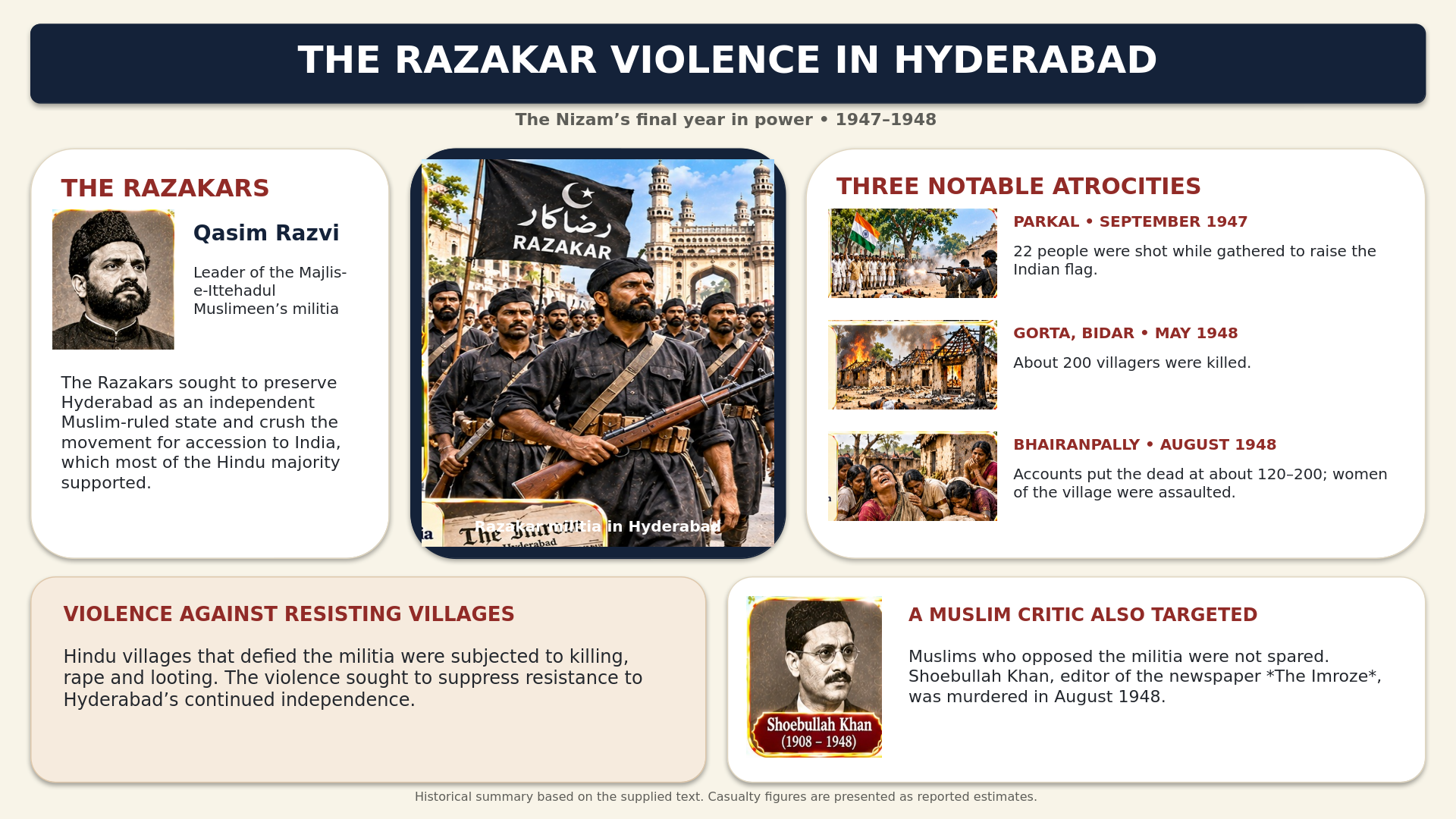
His last year in power was violent. The Razakars were a Nizam-sponsored militia of the Majlis-e-Ittehadul Muslimeen, led by Qasim Razvi. They acted with the sanction of the Nizam's government, and often alongside its police. They set out to keep Hyderabad an independent Muslim-ruled state, and to crush the movement for accession, which most of the Hindu majority supported. They killed, raped and looted in Hindu villages that defied them. At Parkal, in September 1947, they shot 22 people gathered to raise the Indian flag. At Gorta, in Bidar district, about 200 villagers were killed in May 1948. At Bhairanpally that August, accounts put the dead at between about 120 and 200, with the women of the village assaulted. Muslims who opposed the militia were not spared. The editor Shoebullah Khan was murdered in August 1948.
Featuring:

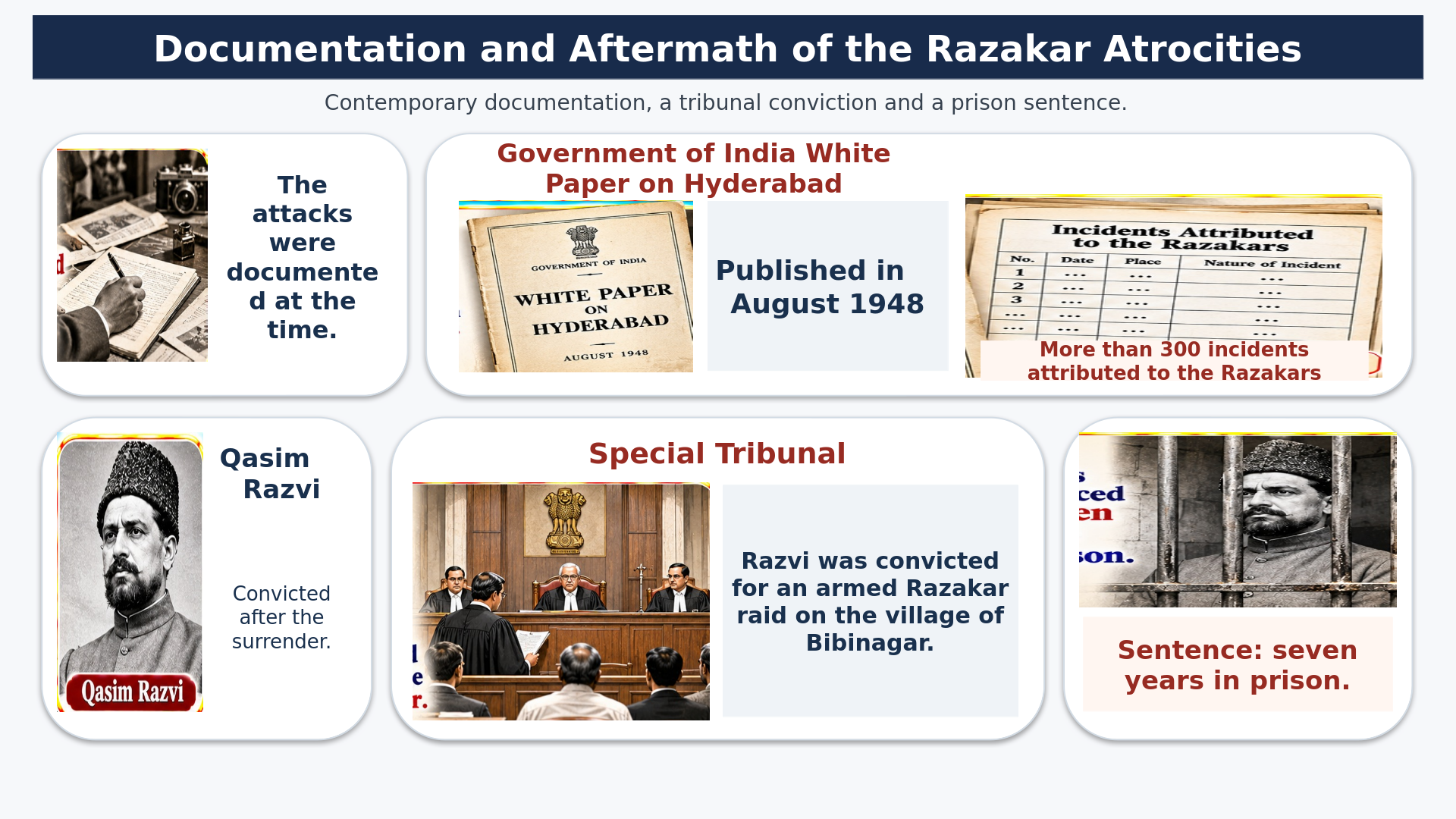
These attacks were documented at the time. The Government of India's White Paper on Hyderabad,…
These attacks were documented at the time. The Government of India's White Paper on Hyderabad, published in August 1948, listed more than 300 incidents attributed to the Razakars. After the surrender, a special tribunal convicted Razvi for an armed Razakar raid on the village of Bibinagar, and sentenced him to seven years in prison.
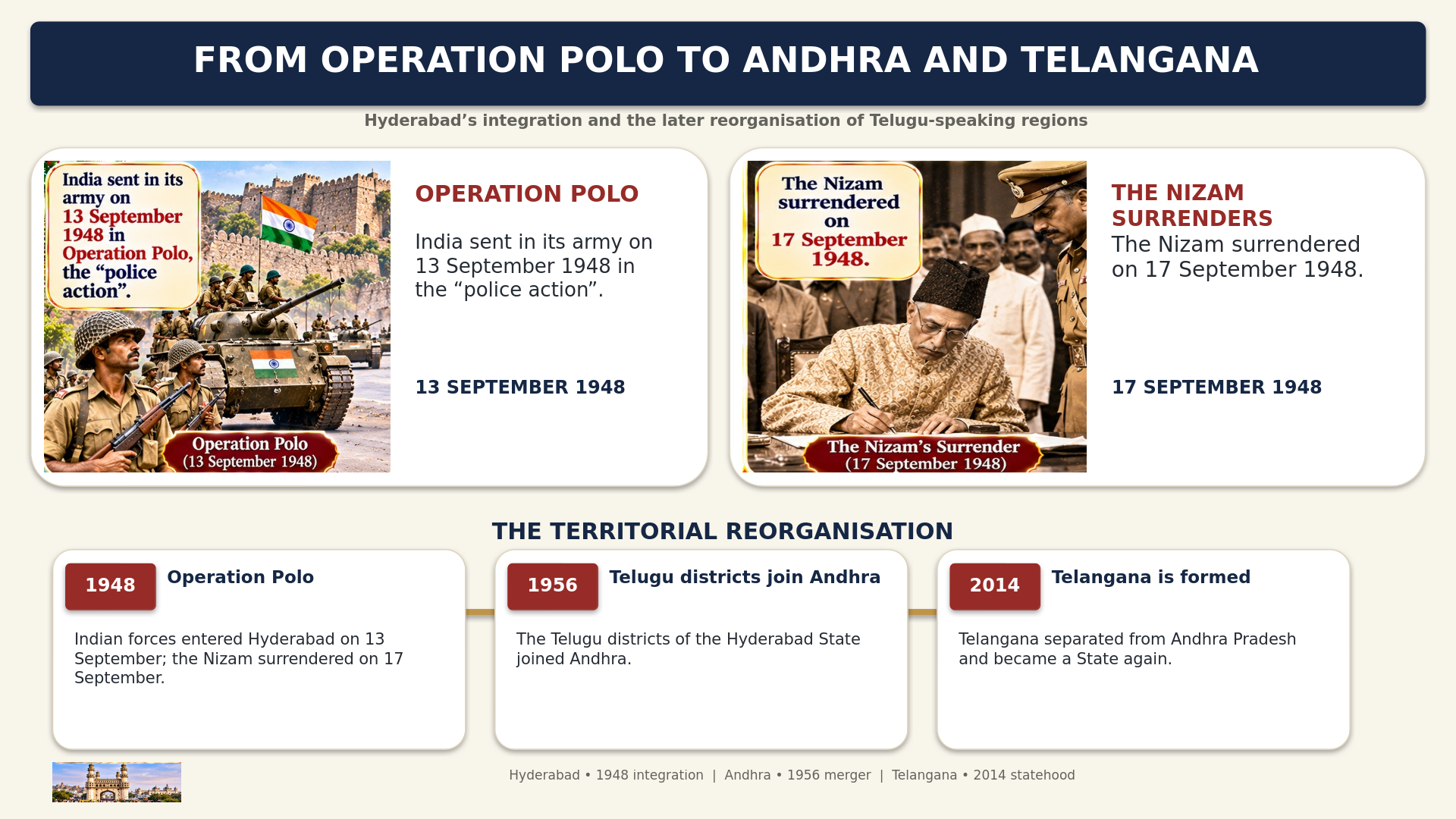
India sent in its army on the 13th of September 1948, in Operation Polo, known as the police action. The Nizam surrendered on the 17th of September. The Telugu districts of Hyderabad joined Andhra in 1956, and left again as Telangana in 2014.
The violence did not end with the surrender. The Sunderlal Committee, a goodwill mission sent…
The violence did not end with the surrender. The Sunderlal Committee, a goodwill mission sent by Nehru, reported on what happened during and after the police action. The Razakar period was not its subject, though its notes record that where the Razakars were resisted, loot, rape and the murder of Hindus followed. It found that the districts where the Razakars had been strongest then saw the worst reprisals, with killing, rape, abduction and forced conversion. The report describes the victims of this phase as Muslims.

Featuring:

The date is still marked every year across the former Hyderabad State, under different names. Marathwada, the Marathi-speaking districts that went to Maharashtra, keeps Marathwada Mukti Sangram Din, or Liberation Struggle Day. Kalyana Karnataka is the name for the Kannada-speaking districts around Bidar, Kalaburagi and Raichur, which went to Karnataka and were long known as Hyderabad-Karnataka. It keeps its own Liberation Day. The Union government has held Hyderabad Liberation Day in Hyderabad since 2022. In Telangana, the name is contested. The state government called the day National Integration Day from 2022, and has called it Praja Palana Dinotsavam, or People's Governance Day, since 2024. The B J P presses for the name Liberation Day. It says the Congress and the B R S avoid the word for fear of the Majlis party, which has a largely Muslim base. The observance belongs to these regions, not to present-day Andhra Pradesh.

We come now to the years after independence. In 1947, the Telugu districts were still…
We come now to the years after independence. In 1947, the Telugu districts were still part of Madras State. Potti Sriramulu fasted for a separate Telugu state, and died on the 15th of December 1952. The unrest that followed led the Union government to create Andhra State on the 1st of October 1953, with Kurnool as capital and Tanguturi Prakasam as chief minister. It was India's first state formed on a linguistic basis. On the 1st of November 1956, it merged with the Telugu districts of Hyderabad State to form Andhra Pradesh, with Hyderabad as capital and Neelam Sanjiva Reddy as chief minister.

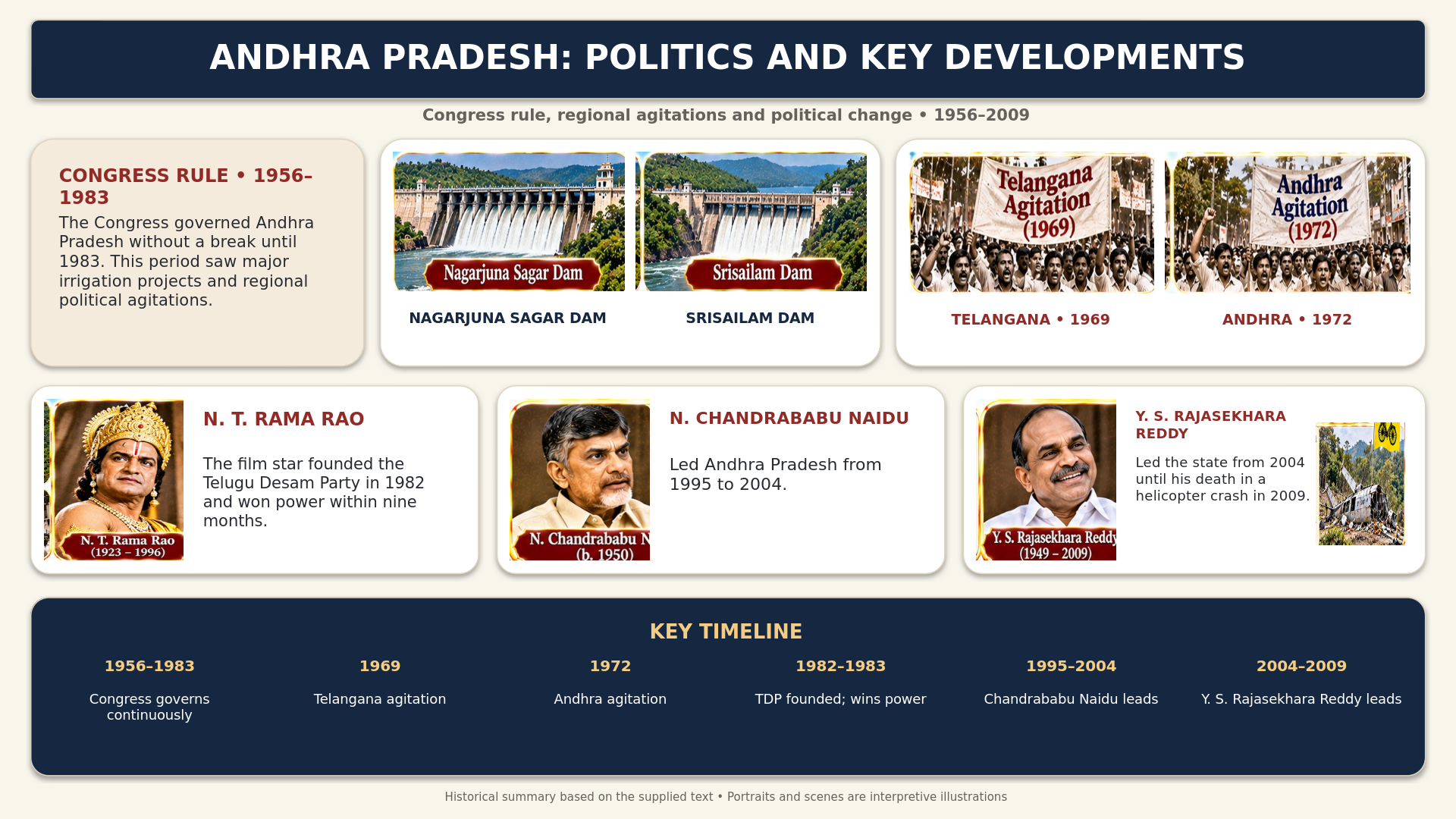
The Congress governed without a break until 1983. That period saw the Nagarjuna Sagar and Srisailam dams built, and regional agitations in Telangana in 1969 and in Andhra in 1972. The film star N T Rama Rao founded the Telugu Desam Party in 1982, and won power within nine months. Chandrababu Naidu led the state from 1995 to 2004. Y S Rajasekhara Reddy of the Congress led it from 2004 until his death in a helicopter crash in 2009.
Featuring:
A renewed statehood movement ended with the creation of Telangana on the 2nd of June…
A renewed statehood movement ended with the creation of Telangana on the 2nd of June 2014. Telangana kept Hyderabad. The remaining state has since alternated between three governments. Naidu's Telugu Desam Party ruled from 2014 to 2019. Jagan Mohan Reddy's Y S R Congress Party ruled from 2019 to 2024. Then an alliance of the Telugu Desam, the Jana Sena and the B J P returned Naidu to office in 2024. The capital question, including a 2020 plan for three capitals, was settled in April 2026, when Parliament amended the Reorganisation Act to name Amaravati the sole capital.

Now to the land itself. Andhra Pradesh covers about 163,000 square kilometres on India's south-eastern coast. It is bordered by Odisha, Chhattisgarh, Telangana, Karnataka and Tamil Nadu. Its shoreline on the Bay of Bengal runs for roughly one thousand kilometres, one of the longest of any Indian state.

The land falls into three belts. The coastal plain is widest where the Godavari and…
The land falls into three belts. The coastal plain is widest where the Godavari and Krishna spread into twin deltas, among the most fertile rice lands in the country. Behind it, the Eastern Ghats run as broken ranges. In the north are the forested hills of the Visakhapatnam Agency, where Jindhagada rises to about 1,690 metres. Further south are the Nallamala, Velikonda and Seshachalam hills. To the south-west lies Rayalaseema, a dry plateau of granite and red soil, where Anantapur ranks among the least rainy districts in peninsular India.

Featuring:
Besides the two great rivers, the Penna drains Rayalaseema, and the Vamsadhara and Nagavali water the north. The main wetlands are Kolleru, a large freshwater lake between the deltas, and Pulicat, a brackish lagoon shared with Tamil Nadu. The south-west monsoon brings most of the rain from June to September. The north-east monsoon and Bay of Bengal cyclones affect the coast from October to December.

The state's wildlife is protected in parks and sanctuaries. There are three national parks. Papikonda…
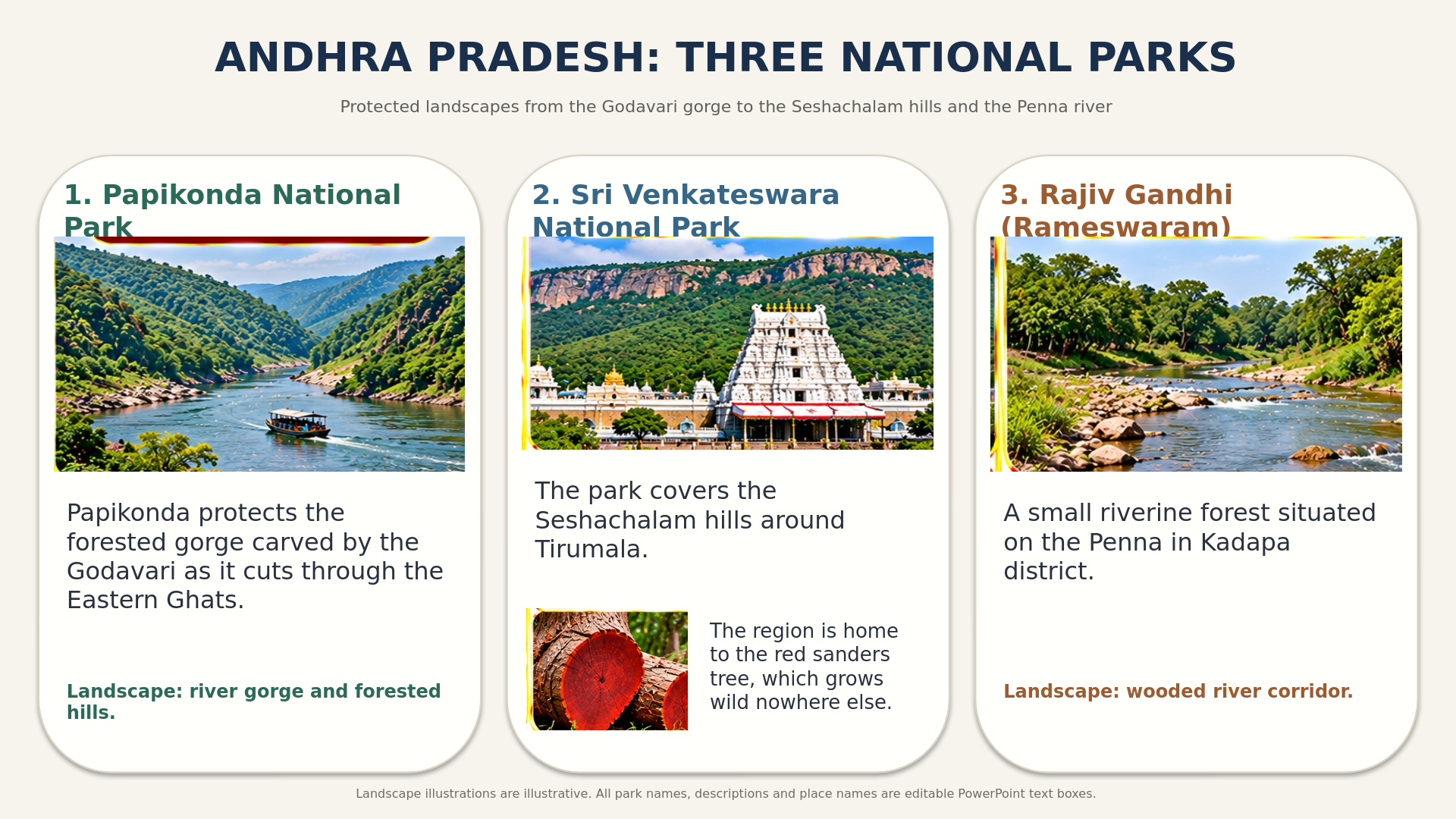
The state's wildlife is protected in parks and sanctuaries. There are three national parks. Papikonda protects the forested gorge that the Godavari cuts through the Eastern Ghats. Sri Venkateswara National Park covers the Seshachalam hills around Tirumala, home of the red sanders tree, which grows wild nowhere else. Rajiv Gandhi National Park, at Rameswaram in Kadapa district, is a small riverine forest on the Penna.
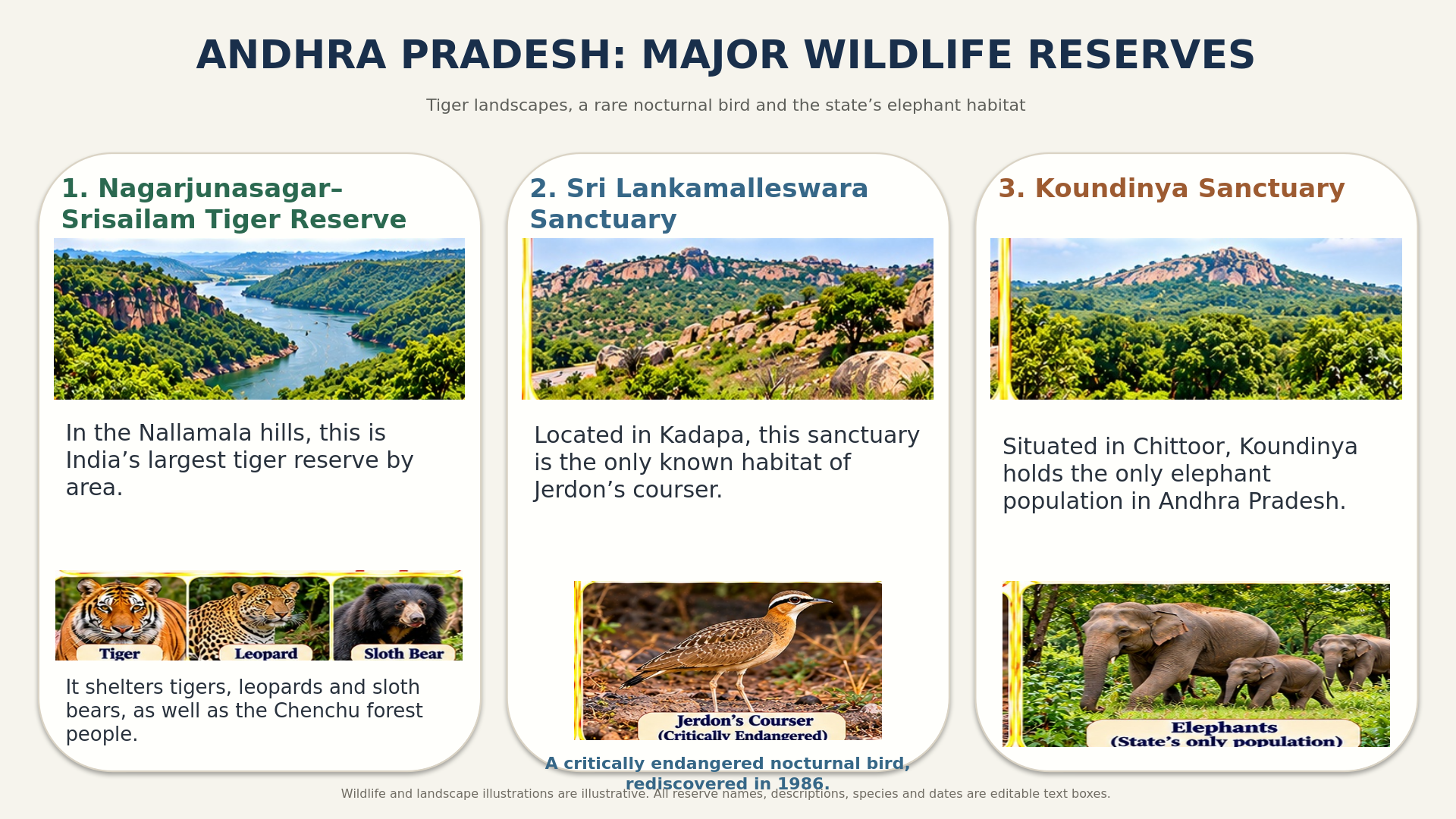
The largest protected landscape is the Nagarjunasagar Srisailam Tiger Reserve, in the Nallamala hills. It is the biggest tiger reserve in India by area, and it also shelters leopards, sloth bears and the Chenchu forest people. Sri Lankamalleswara Sanctuary in Kadapa is the only known habitat of Jerdon's courser, a critically endangered night bird rediscovered in 1986. Koundinya Sanctuary in Chittoor holds the state's only elephant population.
Featuring:
Wetlands are equally rich. Coringa, near Kakinada, is one of the largest mangrove forests on…
Wetlands are equally rich. Coringa, near Kakinada, is one of the largest mangrove forests on the east coast, with fishing cats, otters and nesting olive ridley turtles. Kolleru is a protected wetland of international importance, known for its pelicans and painted storks. Nelapattu and Pulicat, in the south, draw flamingos and breeding spot-billed pelicans each winter. Zoological parks at Visakhapatnam and Tirupati serve city visitors.

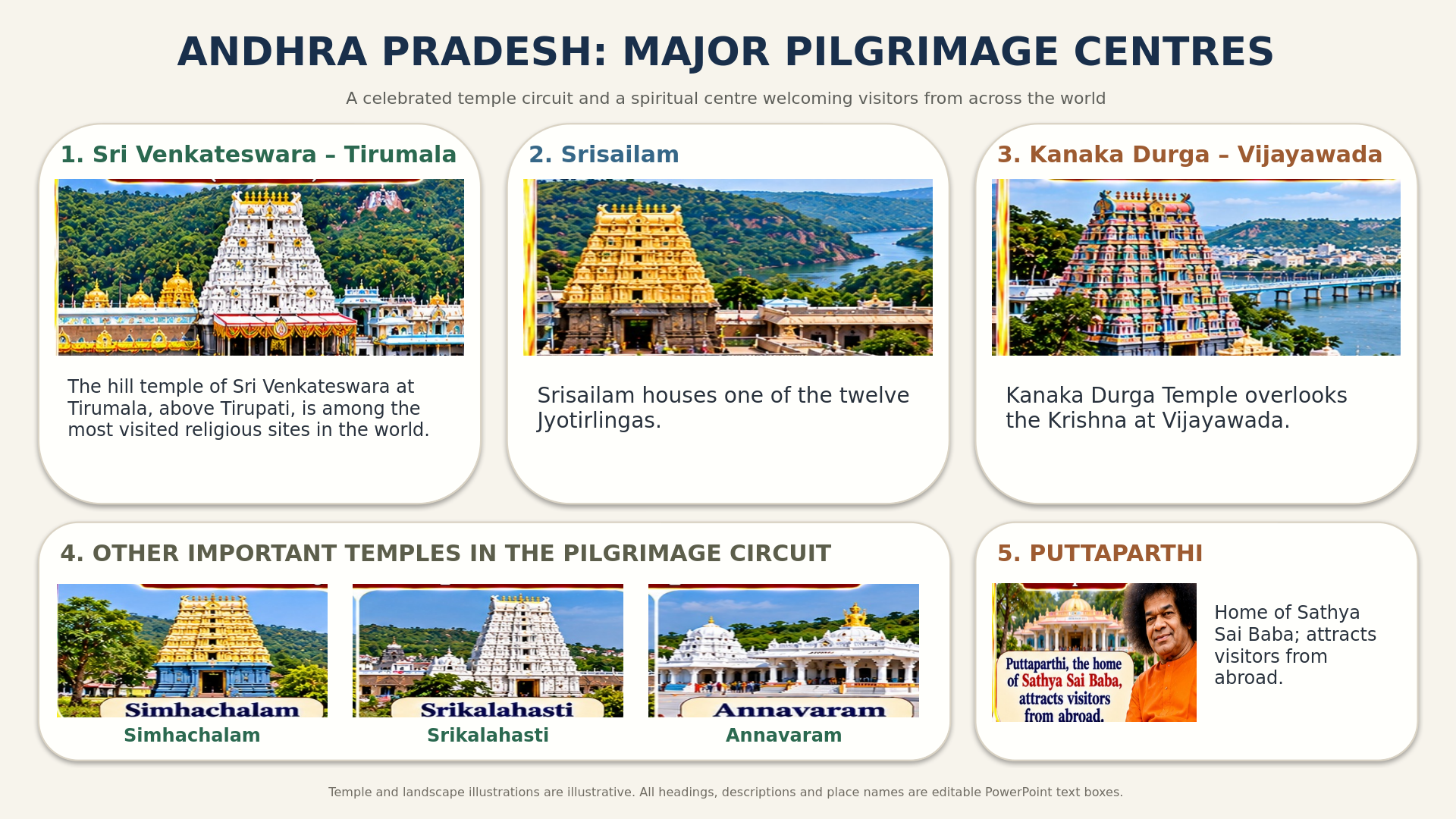
For the visitor, pilgrimage draws the largest crowds. The hill temple of Sri Venkateswara at Tirumala, above Tirupati, is among the most visited religious sites in the world. Srisailam houses one of the twelve jyotirlingas. The Kanaka Durga temple overlooks the Krishna at Vijayawada. Simhachalam, Srikalahasti and Annavaram complete a dense temple circuit. Puttaparthi, the home of Sathya Sai Baba, attracts visitors from abroad.
Heritage sites span two thousand years. They include the Amaravati stupa and its museum, the…
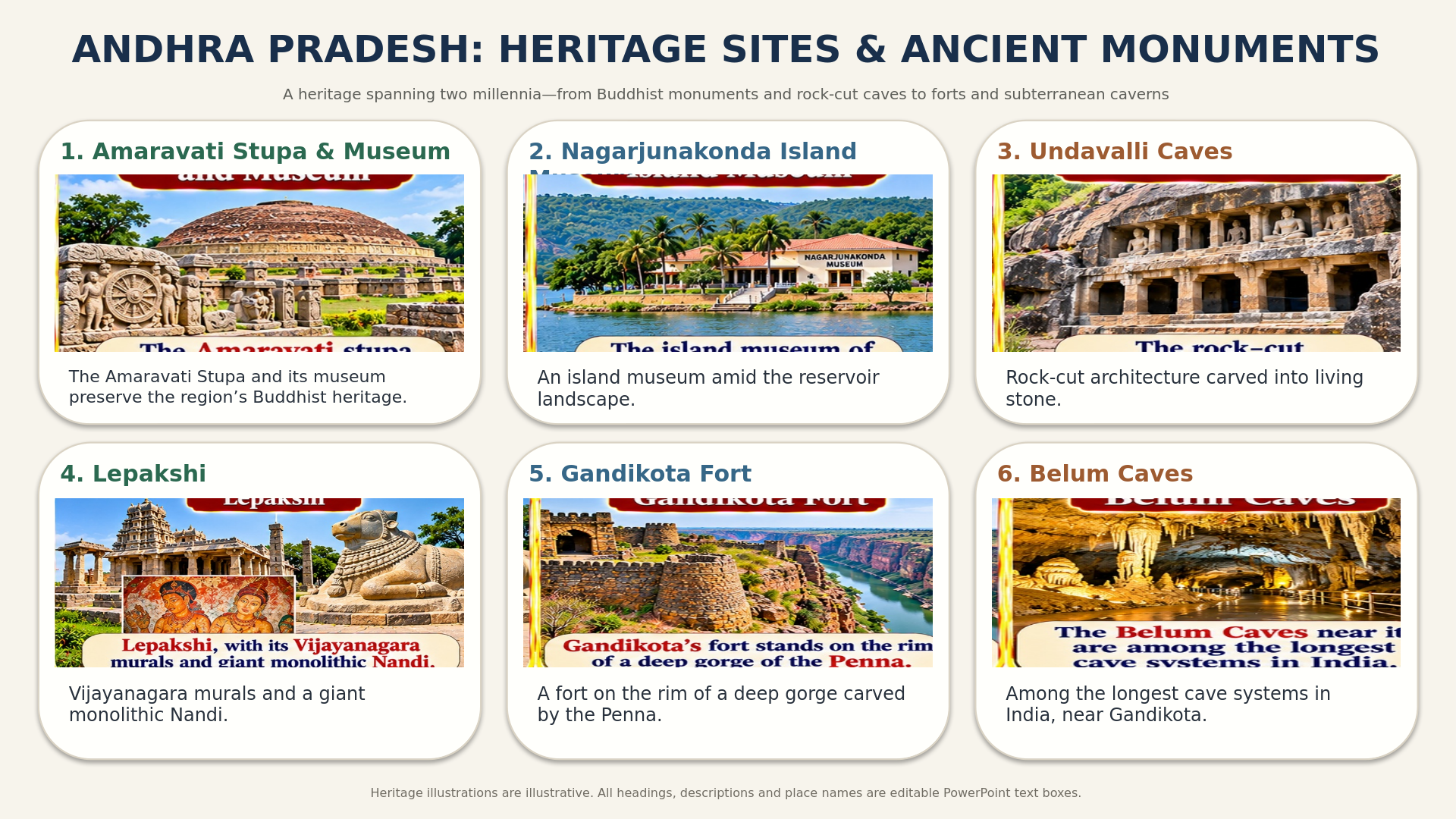
Heritage sites span two thousand years. They include the Amaravati stupa and its museum, the island museum of Nagarjunakonda, the rock-cut Undavalli caves, and Lepakshi, with its Vijayanagara murals and its giant Nandi carved from a single rock. Gandikota's fort stands on the rim of a deep gorge of the Penna. The Belum Caves, near it, are among the longest cave systems in India.
Featuring:
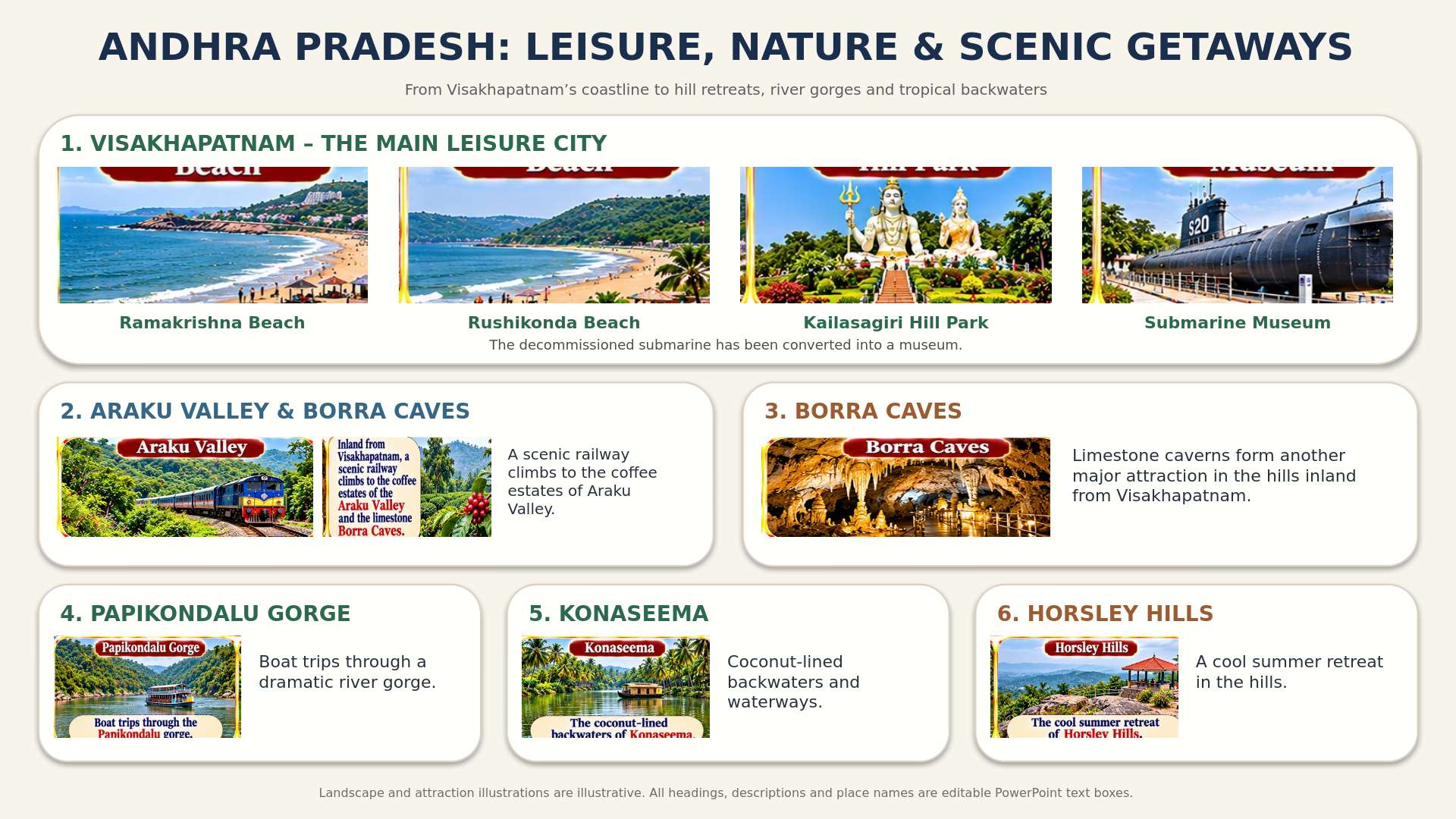
Visakhapatnam is the main leisure city, with Ramakrishna and Rushikonda beaches, the Kailasagiri hill park, and a decommissioned submarine turned museum. Inland from it, a scenic railway climbs to the coffee estates of the Araku Valley and the limestone Borra Caves. Boat trips through the Papikondalu gorge, the coconut-lined backwaters of Konaseema, and the cool summer retreat of Horsley Hills round out the list.
The long coast gives the state its ports. Visakhapatnam is the only one run by…
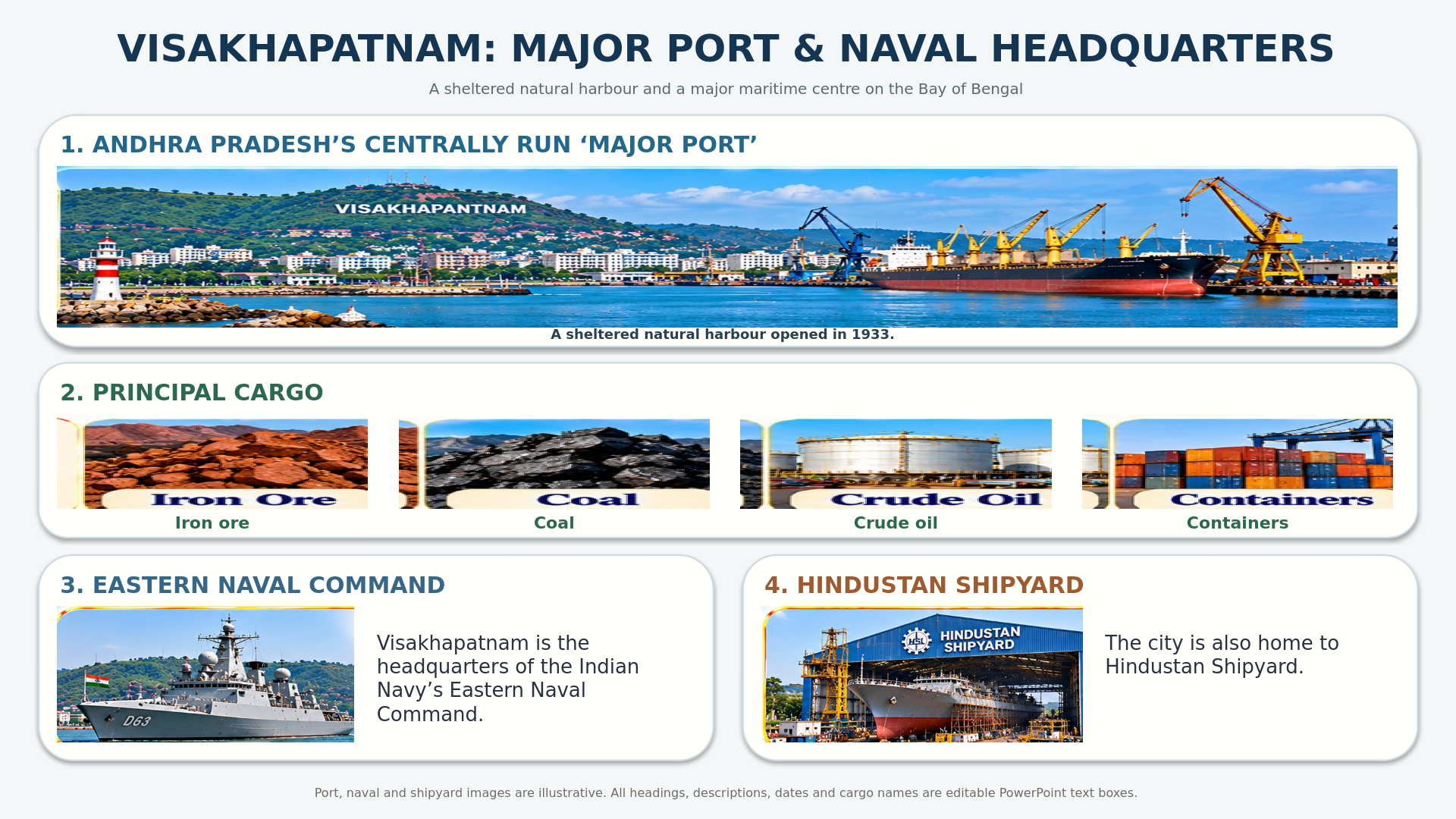
The long coast gives the state its ports. Visakhapatnam is the only one run by the central government and classed as a major port. It is a sheltered natural harbour, opened in 1933, that handles iron ore, coal, crude oil and containers. The city is also the headquarters of the Indian Navy's Eastern Naval Command, and the home of Hindustan Shipyard.
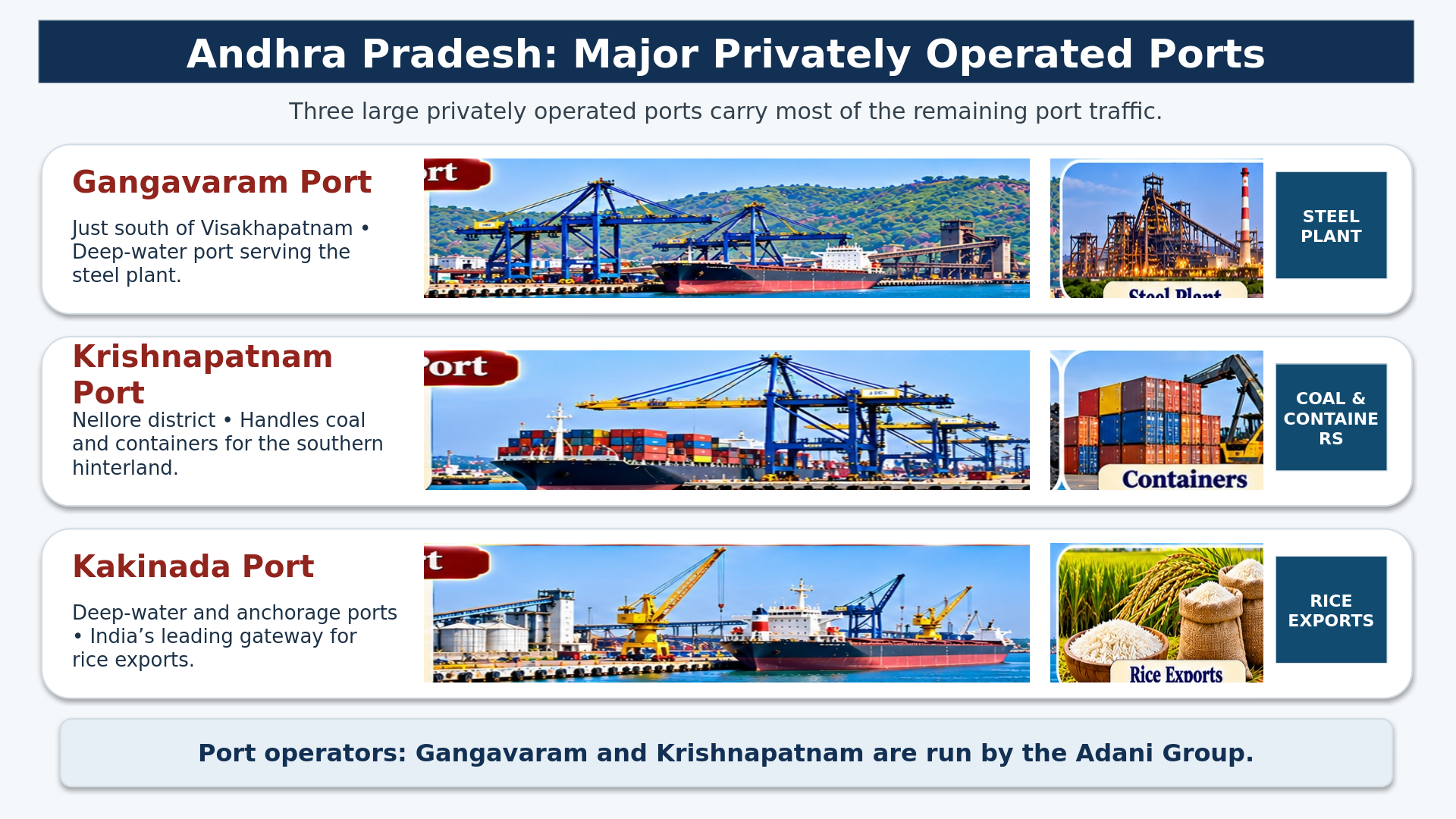
Three large privately operated ports carry most of the remaining traffic. Gangavaram, just south of Visakhapatnam, is a deep-water port serving the steel plant. Krishnapatnam, in Nellore district, handles coal and containers for the southern hinterland. Kakinada, with its deep-water and anchorage ports, is India's leading gateway for rice exports. Gangavaram and Krishnapatnam are run by the Adani group.
Featuring:
The state is adding four more. Ramayapatnam, Machilipatnam and Mulapeta are new ports that the…
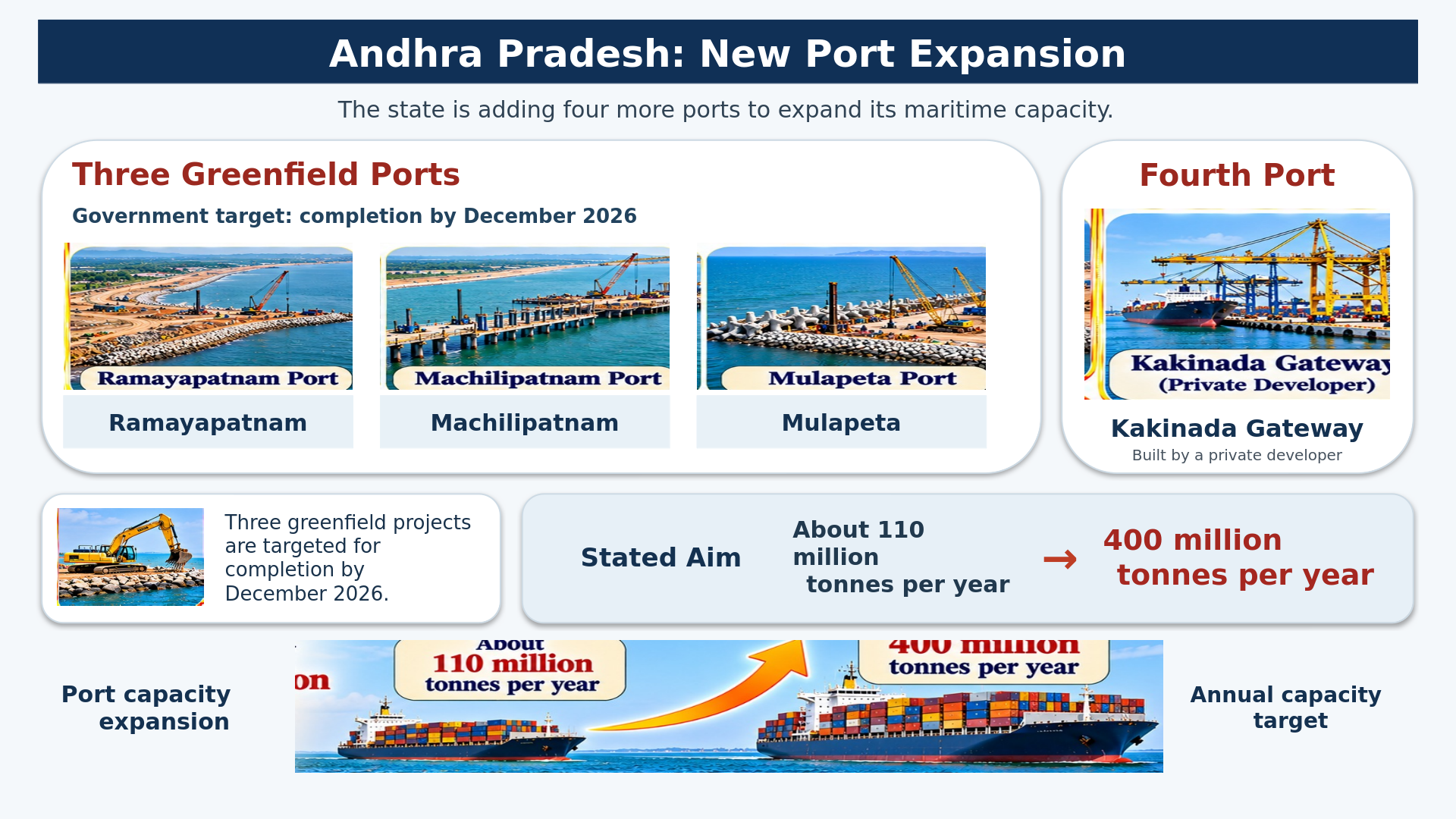
The state is adding four more. Ramayapatnam, Machilipatnam and Mulapeta are new ports that the government has targeted for completion by December 2026. A fourth, Kakinada Gateway, is being built by a private developer. The stated aim is to raise port capacity from about 110 million tonnes a year to 400 million.
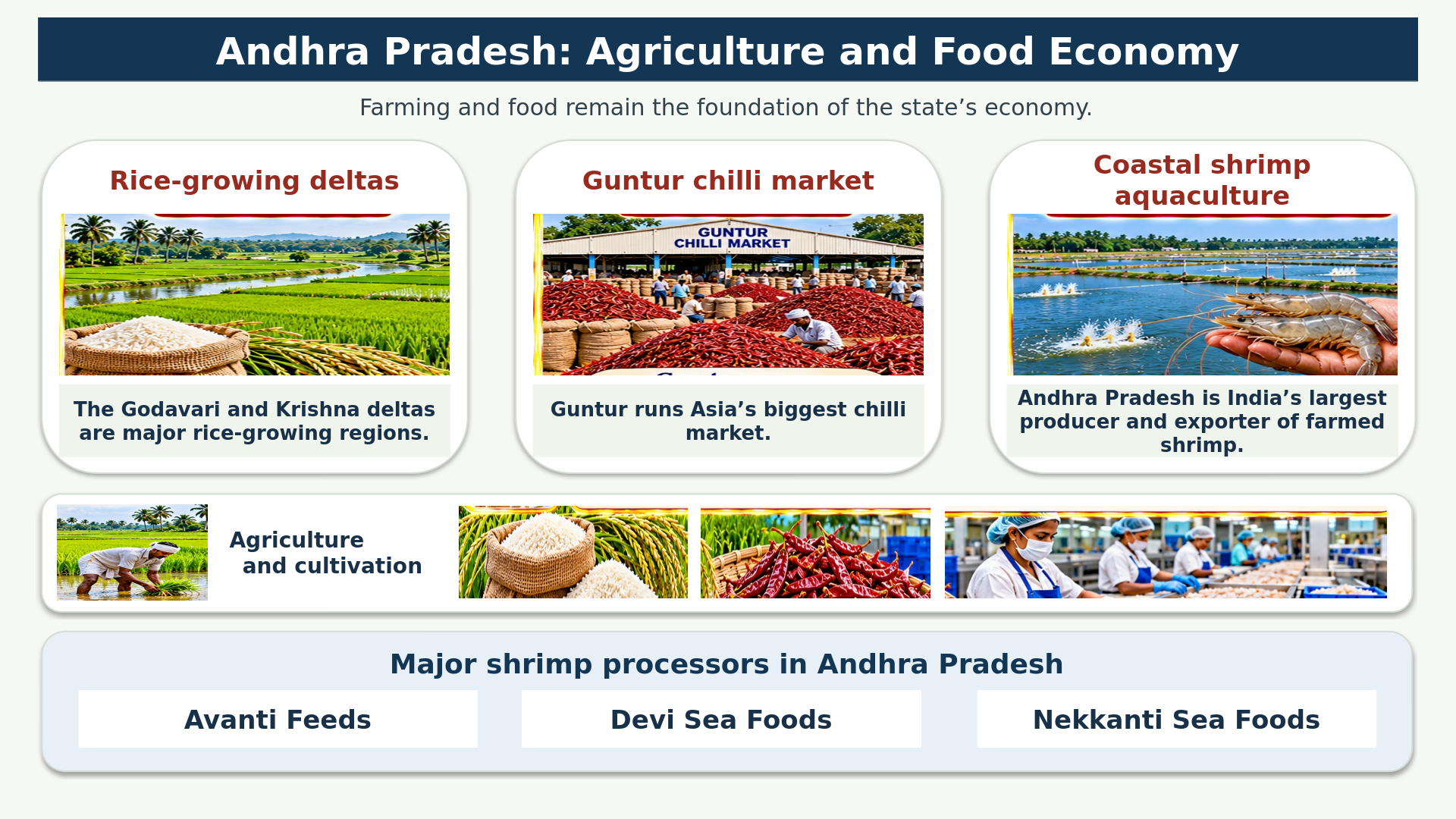
Finally, the economy. Farming and food remain its base. The deltas grow rice, and Guntur runs Asia's biggest chilli market. The coast makes Andhra Pradesh India's largest producer and exporter of farmed shrimp, with processors such as Avanti Feeds, Devi Sea Foods and Nekkanti Sea Foods.
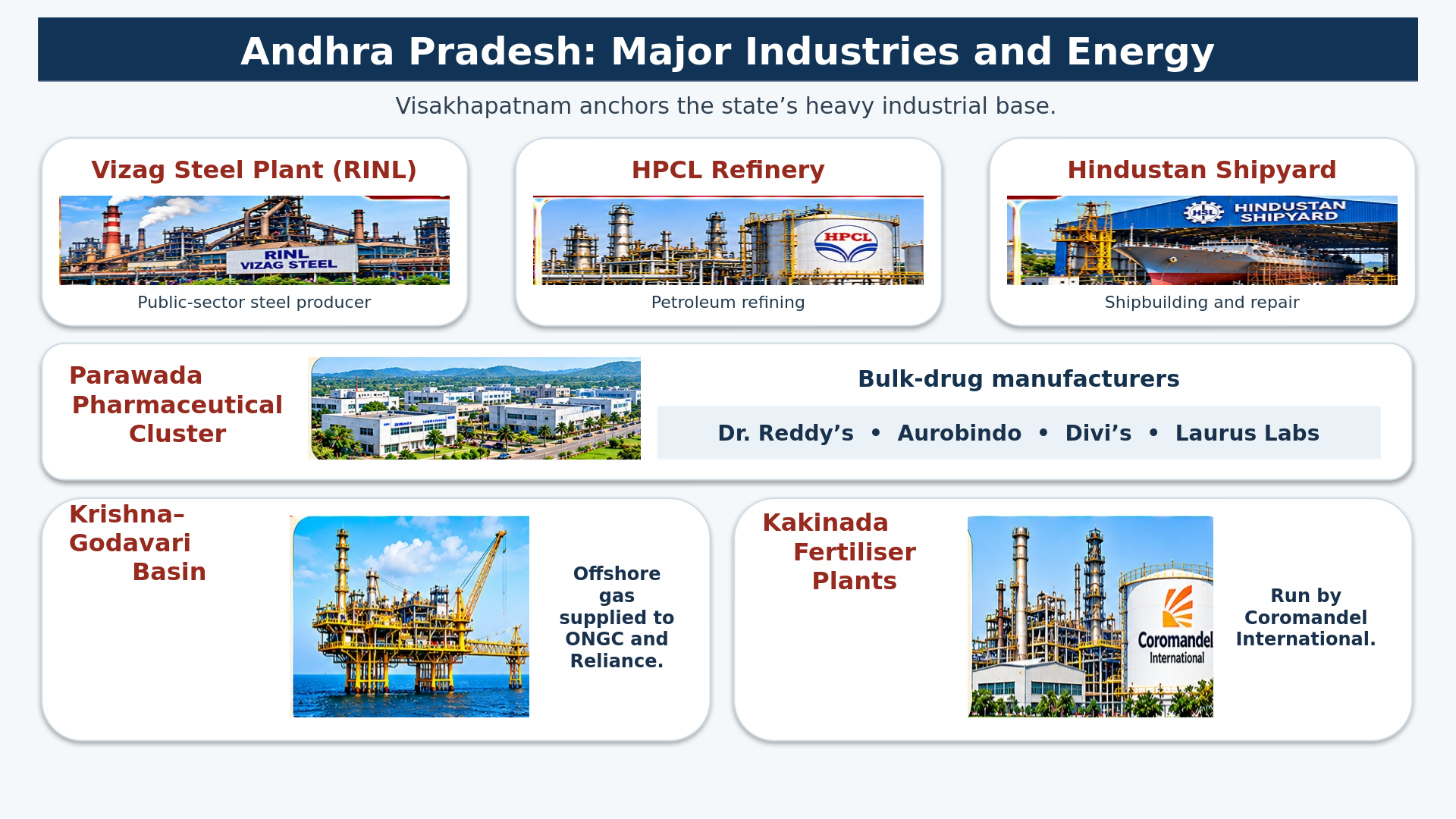
Visakhapatnam anchors heavy industry. It has the public-sector Vizag Steel Plant, the Hindustan Petroleum refinery,…
Visakhapatnam anchors heavy industry. It has the public-sector Vizag Steel Plant, the Hindustan Petroleum refinery, and Hindustan Shipyard. At nearby Parawada there is a pharmaceutical cluster, where Doctor Reddy's, Aurobindo, Divi's and Laurus Labs make bulk drugs. The Krishna Godavari basin supplies offshore gas to the Oil and Natural Gas Corporation and to Reliance. Kakinada has fertiliser plants run by Coromandel International.
Featuring:
The south is the manufacturing belt. Kia builds cars at Penukonda, in the former Anantapur district. Sri City, near the Tamil Nadu border, hosts Isuzu, Hero MotoCorp, Daikin, Mondelez and Colgate-Palmolive. Tirupati is home to the battery maker Amara Raja. Limestone in Kadapa and Kurnool feeds cement plants, and Kurnool has one of India's largest solar parks. India's space agency launches its rockets from Sriharikota.

Several very large projects are now under way. Google is building a one-gigawatt artificial intelligence…
Several very large projects are now under way. Google is building a one-gigawatt artificial intelligence data-centre hub at Visakhapatnam. ArcelorMittal Nippon Steel is building a steel plant in Anakapalli district. And Bharat Petroleum is building a refinery and petrochemical complex near Ramayapatnam.