



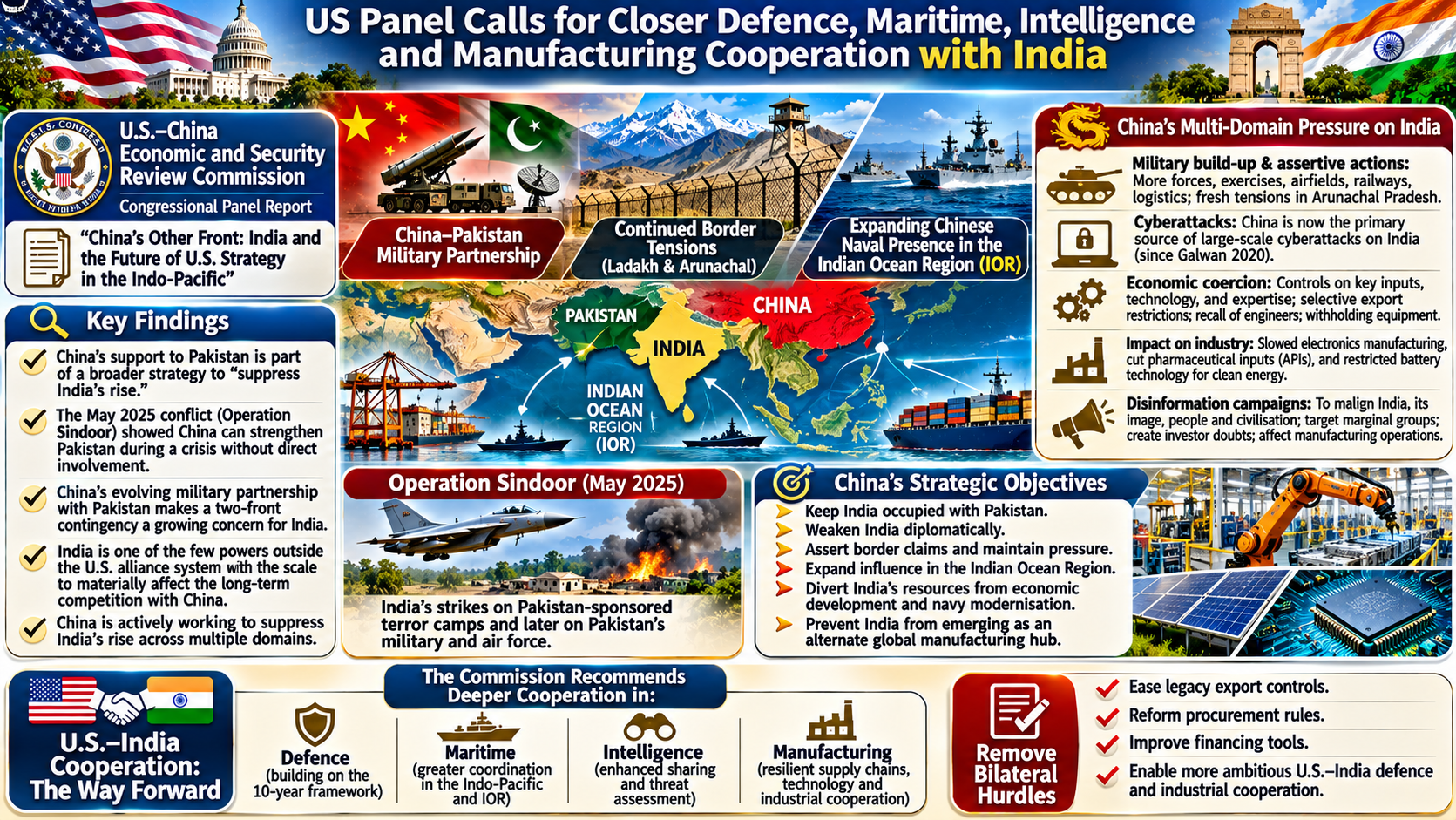
The US-China Economic and Security Review Commission, a United States of America Congressional panel, found that China’s support of Pakistan is part of a broader strategy to "suppress India's rise.” In a chapter titled “'China's Other Front: India and the Future of U.S. Strategy in the Indo-Pacific,’ it observed that “The May 2025 conflict demonstrated how China could strengthen Pakistan during a crisis without Beijing entering the fighting directly.” The reference is to Operation Sindoor that India launched in May 2025 against Pakistan-sponsored terror camps and later on Pakistan military and airforce.
By supporting Pakistan through covert and overt means, "China's evolving military partnership with Pakistan has made a two-front contingency an increasingly critical concern for India.” Marking the anniversary of Operation Sindoor, India Today had reported that China's state broadcaster CCTV aired interviews with engineers from the Aviation Industry Corporation of China's (AVIC) Chengdu Aircraft Design and Research Institute. China has a long-standing military relationship with Pakistan where it uses that country as a testbed for its weapons. The presence of engineers during a conflict takes this partnership to another level.
Featuring:





The panel pointed out that Beijing understand India’s strategic importance in the strategically vital Indian…
The panel pointed out that Beijing understand India’s strategic importance in the strategically vital Indian Ocean Region or IOR. To weaken India diplomatically and keep New Delhi busy with Pakistan, China increased its military build-up, asserted its claims on the border, expanded its naval presence in the IOR, backed Pakistan’s border claims.
Even though the flash point of 2020 cooled with various agreements on the Ladhak front, Beijing has started fresh tensions in Arunachal Pradesh. The head of the Indo-Tibetan Border Police or ITBP admitted continuing confrontations with Chinese troops at multiple locations. It frequently conducts military exercises across Tibet and neighbouring provinces. By expanding its airfields, railway lines, and logistics capabilities, China is forcing India to divert funds from economic development and navy modernisation towards matching China’s military buildup. Chinese hackers frequently attempt large-scale cyber attacks on India’s IT, telecommunications, and digital services infrastructure.
Featuring:




China also applies economic pressure by exploiting Indian dependence of Chinese industrial inputs by selectively…
China also applies economic pressure by exploiting Indian dependence of Chinese industrial inputs by selectively tightening or loosening flow of goods, technology, and expertise. Since India’s massive domestic market, skilled workforce, engineering talent, and growing industrial base threatens to become an alternate manufacturing location to China, Beijing uses these measures to impose costs and affect consistent manufacturing from India. <a href = “https://www.whatisindia.com/news/2026/11/modi-urges-industries-to-invest-focus-on-quality-and-exports/modi-urges-industries-to-invest-focus-on-quality-and-exports.html">Prime Minister Modi addressed this exact point in his address to the Federation of Indian Chambers of Commerce and Industry or FICCI.</a>
Beijing restricted exports of key inputs and products to India, recalled engineers, and withheld equipment. This slowed India's electronics manufacturing, cut key pharmaceutical inputs shipments, and imposed export controls on battery technology to impede India's clean energy sector. India eased certain restrictions on Chinese investment and equipment as the costs of limiting access to Chinese inputs, technology, and expertise have risen. The panel says that India relies heavily on Chinese machinery, components, and technical know-how.
Featuring:


China frequently launches disinformation campaigns to malign India, its image, people, and civilisation. Independent studies…
China frequently launches disinformation campaigns to malign India, its image, people, and civilisation. Independent studies confirm that since the Galwan clash of 2020, China is now the primary source of cyberattacks on India. These disinformation campaigns aims to bring together disaffected marginal groups, increase doubts in the minds of investors to lower investor confidence, and affect manufacturing operations.
The panel emphasised that “India is one of the few powers outside the US alliance system with the scale to materially affect the long-term competition with China.” India’s large army and navy limits its ability to expand by land and sea. Therefore, Beijing is forced to devote more resources on its Western flank when it would prefer to have those investments on the Pacific to counter the USA. It says that “"China understands this” and this precisely why “it is actively working to suppress India's rise across multiple domains.”
Featuring:


To counter China’s multi-domain campaign to limit India’s rise, the commission called for deeper intelligence,…
To counter China’s multi-domain campaign to limit India’s rise, the commission called for deeper intelligence, maritime, and manufacturing cooperation between the US and India. The report warned that legacy export controls, procurement rules, and financing tools are stifling ambitious bilateral foundation built over 25 years, including a 10-year defence framework.
Source: India Today, The Week, India Gazette
Featuring: