



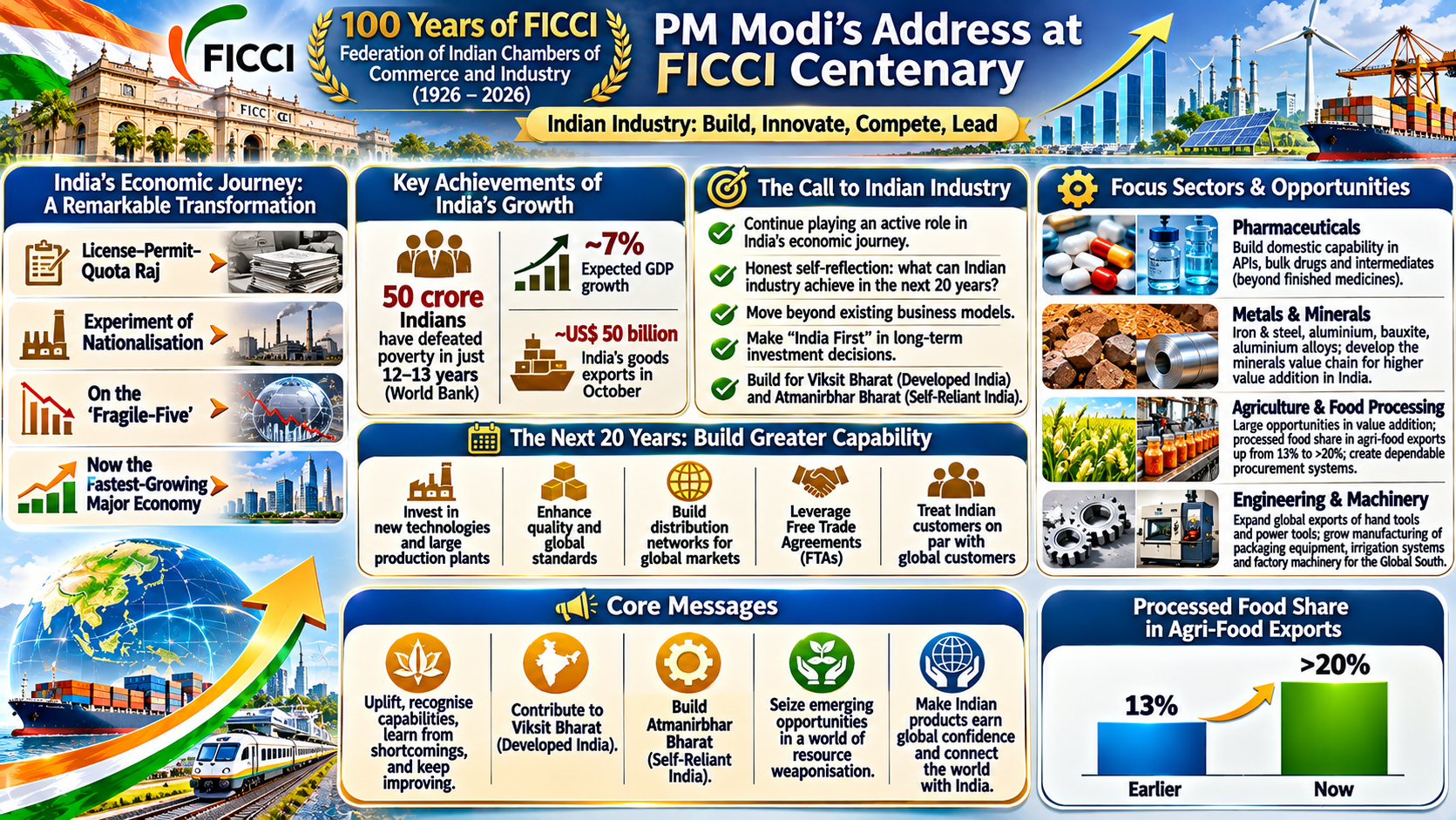
Speaking at the centenary of the Federation of Indian Chambers of Commerce and Industry (FICCI), Prime Minister Narendra Modi entreated the organisation and its members “to continue playing an active role in the country’s economic journey.” He recalled the many phases of the Indian economy, from the “License-Permit-Quota Raj,” “the unsuccessful experiment of nationalisation,” being on the infamous “Fragile-Five,” to become the “fastest-growing major economy.” He reminded everyone that growth is not about making the rich richer. “The latest World Bank report,” he said, “says that in just 12–13 years, 50 crore Indians have defeated poverty.” He said that India is expected to grow at “around seven percent” and “India’s goods exports reached nearly 50 billion dollars” in October 2026. This is because of “the right policies” put in place by a government “with the right intent” and the hard work of every Indian.
Indian scriptures implore us to “uplift ourselves, recognise our own capabilities, learn from our shortcomings, and continuously strive to become better.” With that in mind, he called for an “honest self-reflection” so the nation can figure out “what Indian industry can achieve over the next 20 years.” To contribute to Viksit Bharat of Developed India and Atmanirbhar Bharat (self-reliant India), Modi challenged the industries to move beyond where businesses “already established” so they can “prepare for the demands that will emerge in the future at both the national and global levels.” He said this is especially true in an “era of the weaponisation of resources.” He requested the industrial leaders to consider making “India First” the basis of every long-term investment decision over the next 20 years. He concluded that this “will make the country self-reliant and will also open new opportunities for the growth of your businesses.”
Featuring:




He pointed out that while the Indian industry has grown and contributed a lot, it…
He pointed out that while the Indian industry has grown and contributed a lot, it has not made enough progress in moving beyond established sectors. He cited the example of the pharmaceutical industry. Despite India being the Pharmacy of the World, “India imports APIs (Active Pharmaceutical Ingredients), bulk drugs, and drug intermediates worth billions of dollars every year.” He urged all industries to determine in which sectors and new technologies to invest and to set up “large production plants” to “become more competitive.” Just as the pharmaceutical industry has succeeded in “finished medicines,” the industry “must also build capability in ingredients.” The same opportunity exists in iron ore and steel, bauxite and aluminium alloys, etc. To make this happen, he said the industry needs “expertise in the minerals value chain so that greater value addition takes place within India.”
Agriculture is another area where, despite having a huge population working on agriculture, exports from this sector make up only around two to two-and-a-half percent of global agricultural exports. He observed that the “corporate world is afraid of investing in agriculture” but pointed out the opportunities “linked to value addition and the food-processing industry.” While “the share of processed food in agri-food exports has increased from 13 percent to more than 20 percent” over the past 12 years, the industry should identify “what we are producing and what the world needs.” He wanted the industry to create “dependable procurement systems” to meet export demand.
Featuring:





He also identified daily engineering products as an area for growth. After all, India’s share…
He also identified daily engineering products as an area for growth. After all, India’s share in “global exports of hand tools and power tools is still quite small.” Similarly, he identified machinery manufacturing for “packaging equipment, irrigation systems, and factory-related machinery” targeting the Global South as a large opportunity. The many free trade agreements signed by India mean that doors to new markets are now open.
He urged industries to seize this opportunity and give up the mindset “My product will sell anyway.” He also wanted the industries to consider Indian customers on par with foreign customers and therefore focus a lot on quality. In conclusion, “It is essential for us to invest in meeting global standards and building distribution networks that serve global needs.” This, he said, will make Indian products “earn the confidence of customers in global markets and connect them with India.”
Featuring:


Source: PMO, PIB, BusinessLine, ANI
Source: PMO, PIB, BusinessLine, ANI