


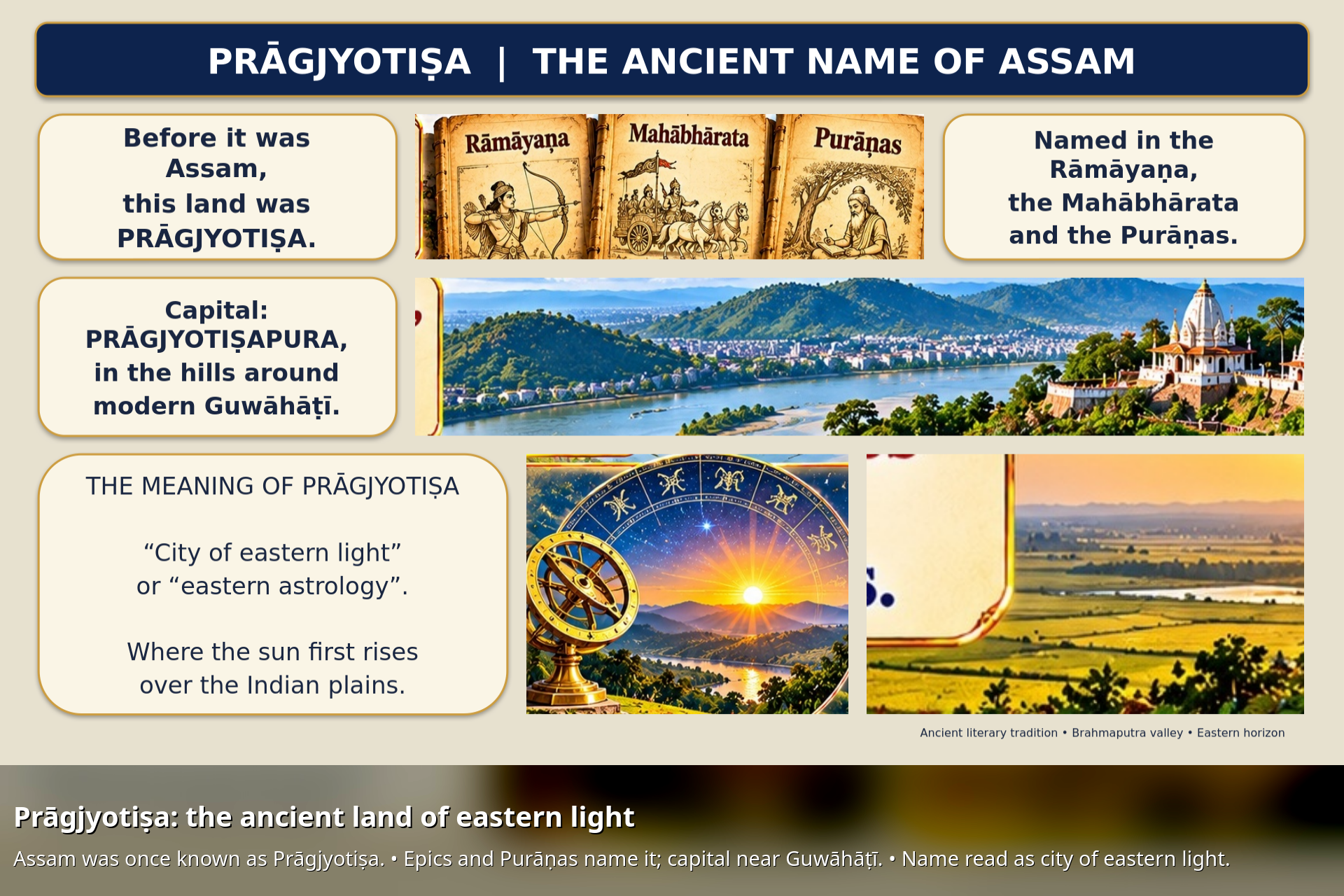
Long before it was called Assam, this country was Prāgjyotiṣa. The Rāmāyaṇa, the Mahābhārata and the Purāṇas all know it by that name, and its capital, Prāgjyotiṣapura, is identified with the hills around modern Guwāhāṭī. The name is usually read as the city of eastern light, or eastern astrology, a fitting title for the place where the sun first rises over the Indian plains.
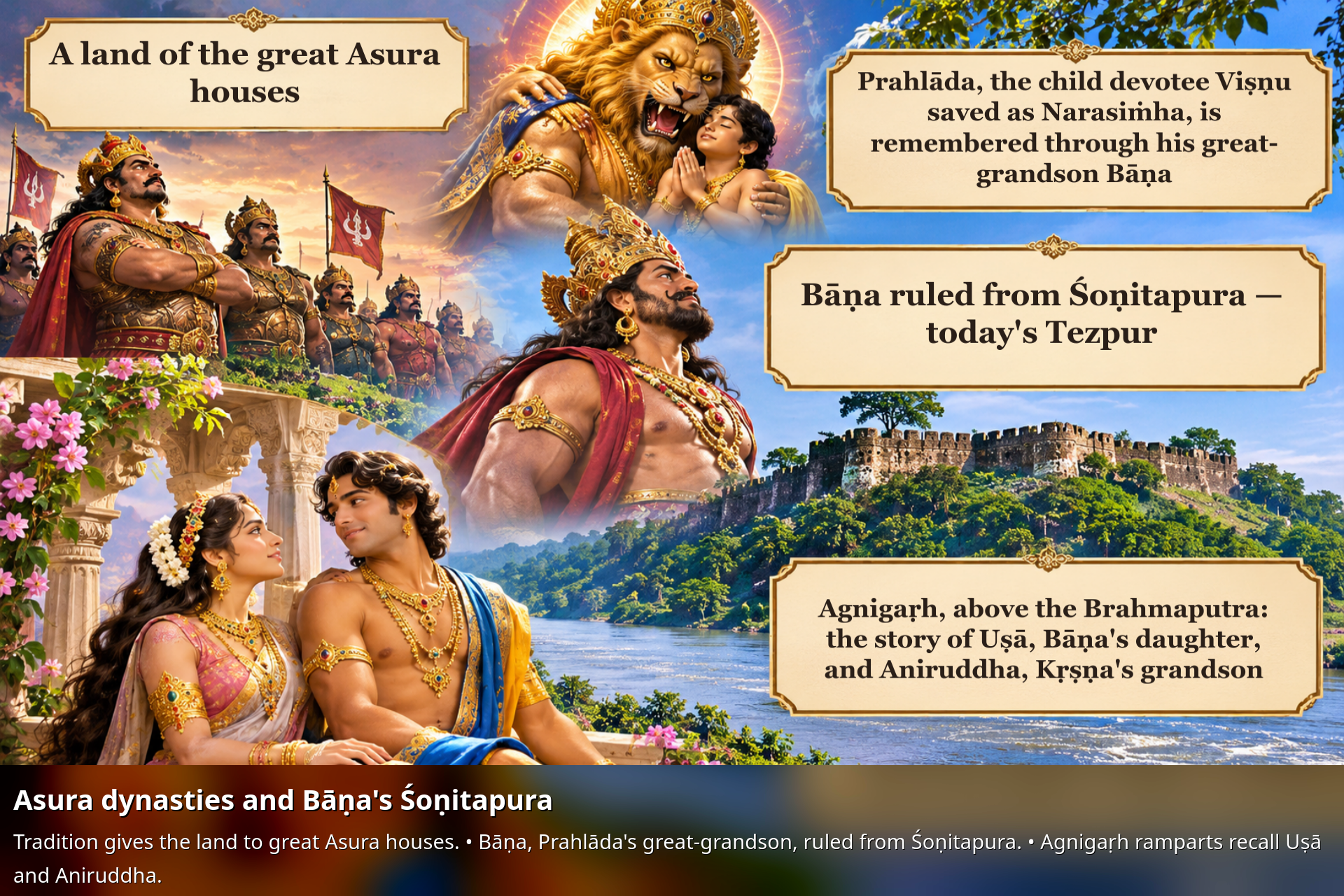
Tradition gives the land to the great Asura houses. The line of Prahlāda, the child devotee whom Viṣṇu saved as Narasiṁha, is remembered here through his great-grandson Bāṇa, who ruled from Śoṇitapura, today's Tezpur. The ramparts of Agnigaṛh above the Brahmaputra still carry the story of Bāṇa's daughter Uṣā and Kṛṣṇa's grandson Aniruddha.
Featuring:



The best-known ruler of Prāgjyotiṣa was Naraka. Born of Bhūdevī, the Earth, and Viṣṇu in…
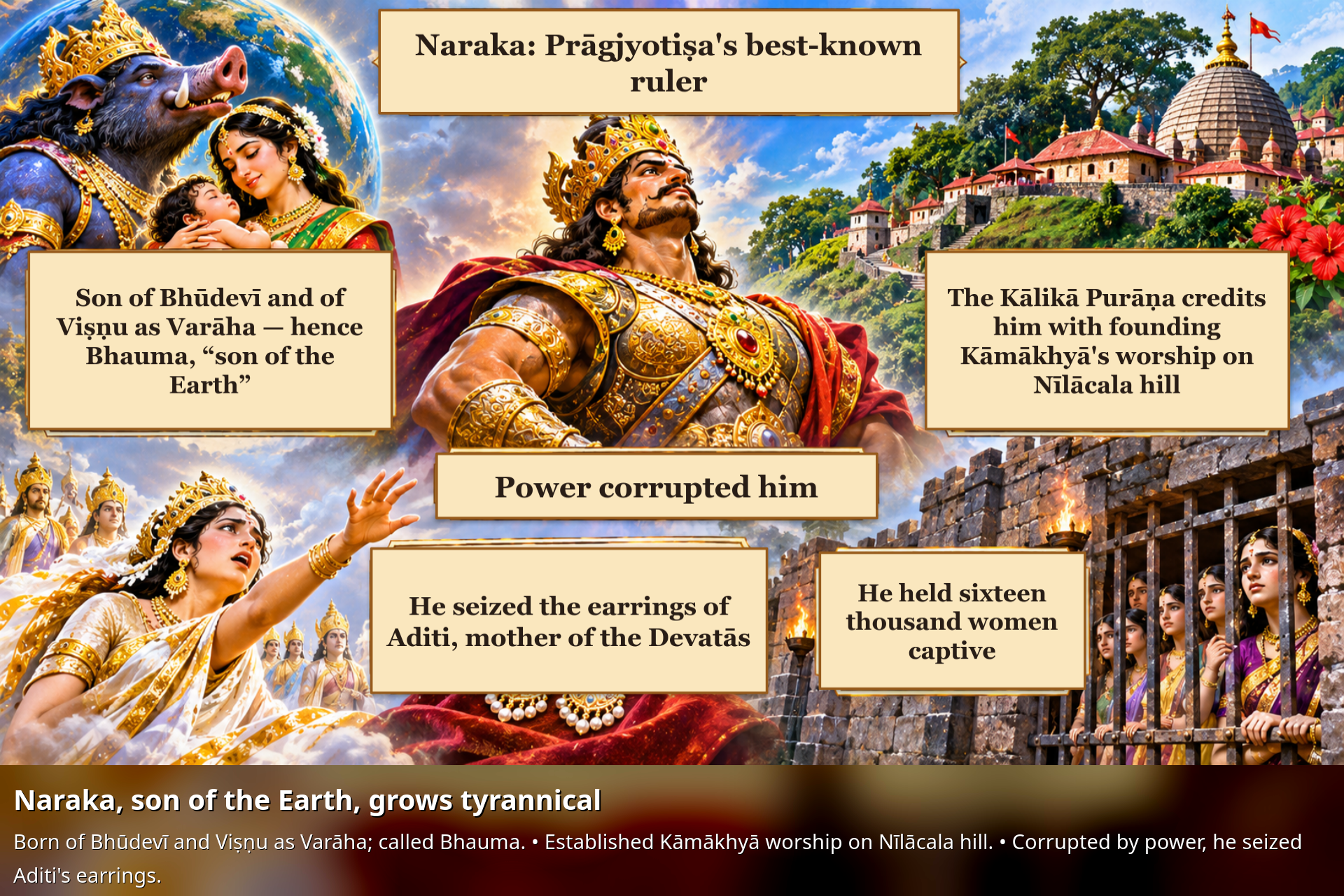
The best-known ruler of Prāgjyotiṣa was Naraka. Born of Bhūdevī, the Earth, and Viṣṇu in his Varāha form, he was called Bhauma, meaning son of the Earth. The Kālikā Purāṇa credits him with establishing the worship of Kāmākhyā on Nīlācala hill. Power corrupted him. He seized the earrings of Aditi, mother of the Devatās, and held sixteen thousand women captive.
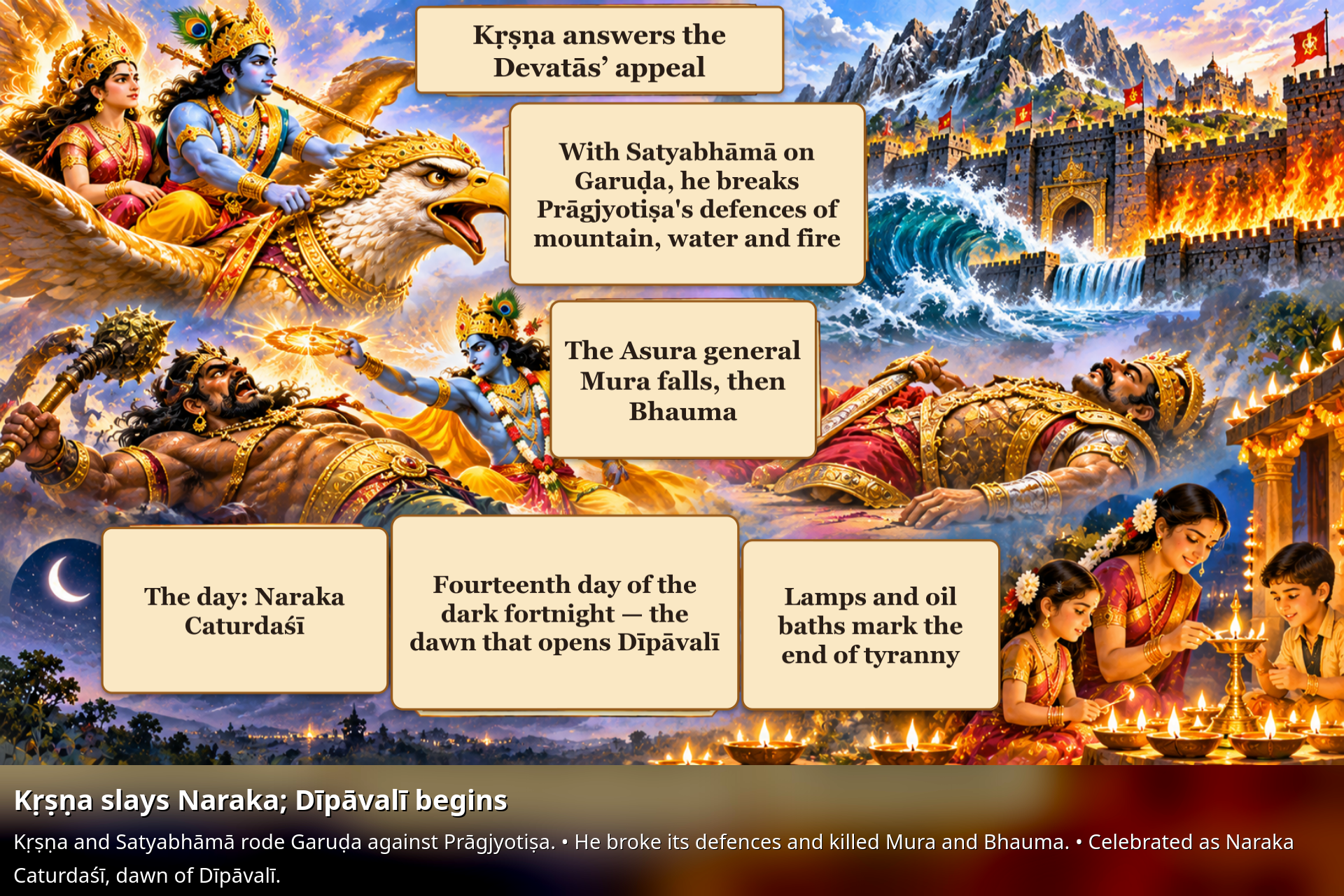
Kṛṣṇa answered the Devatās' appeal. Riding Garuḍa with Satyabhāmā beside him, he broke through the mountain, water and fire defences of Prāgjyotiṣa, slew the Asura general Mura, and killed Bhauma. The victory fell on Caturdaśī, the fourteenth day of the dark fortnight. It is celebrated as Naraka Caturdaśī, the dawn that opens Dīpāvalī across much of India, with oil baths and lamps marking the end of his tyranny.
Kṛṣṇa placed Naraka's son Bhagadatta on the throne. Bhagadatta became one of the most feared…
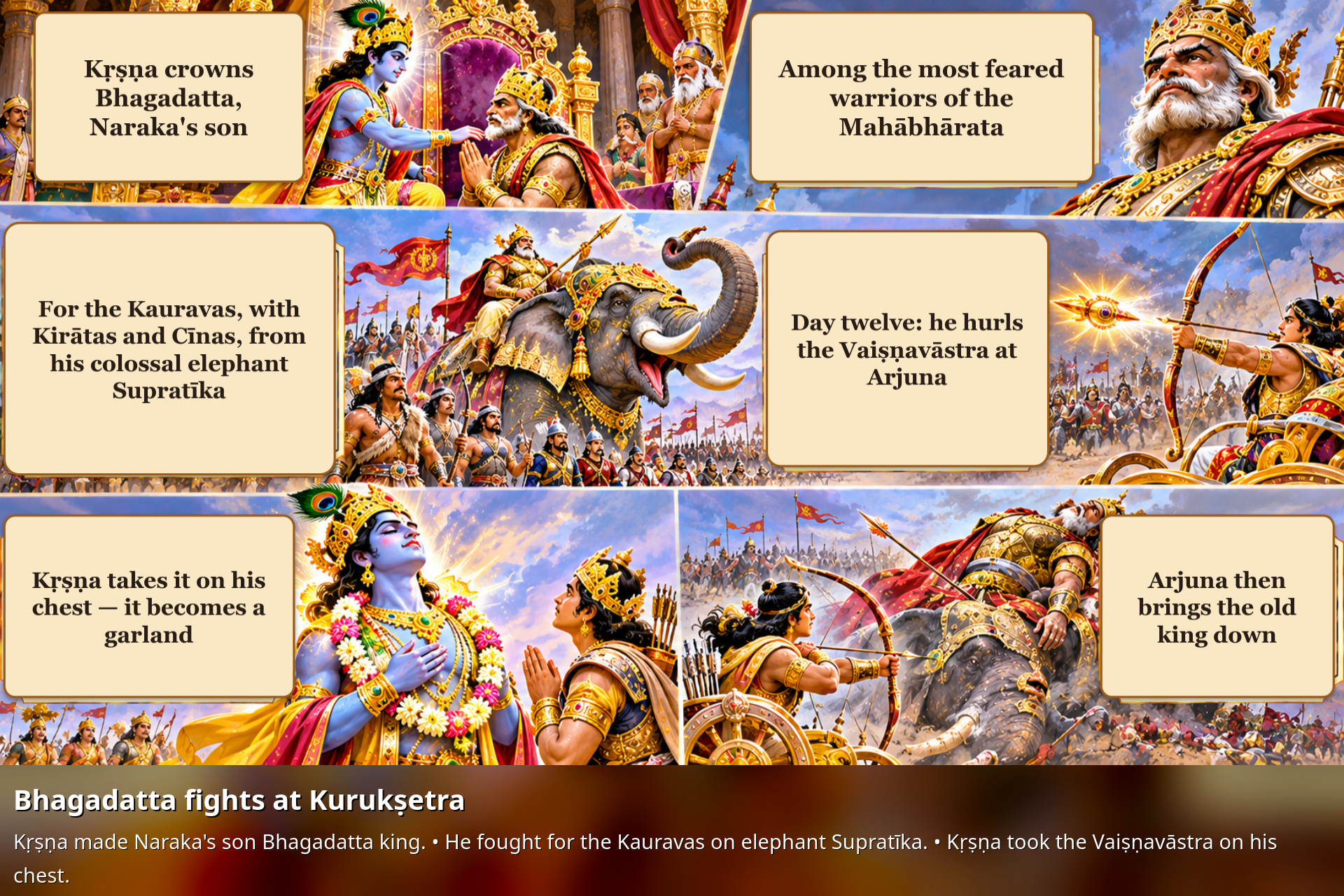
Kṛṣṇa placed Naraka's son Bhagadatta on the throne. Bhagadatta became one of the most feared warriors of the Mahābhārata. He came to Kurukṣetra on the Kaurava side with an army of Kirātas and Cīnas, fighting from his colossal elephant Supratīka. On the twelfth day he scattered the Pāṇḍava ranks and hurled the Vaiṣṇavāstra at Arjuna. Kṛṣṇa took it on his own chest, where it became a garland, before Arjuna brought the old king down.
Featuring:


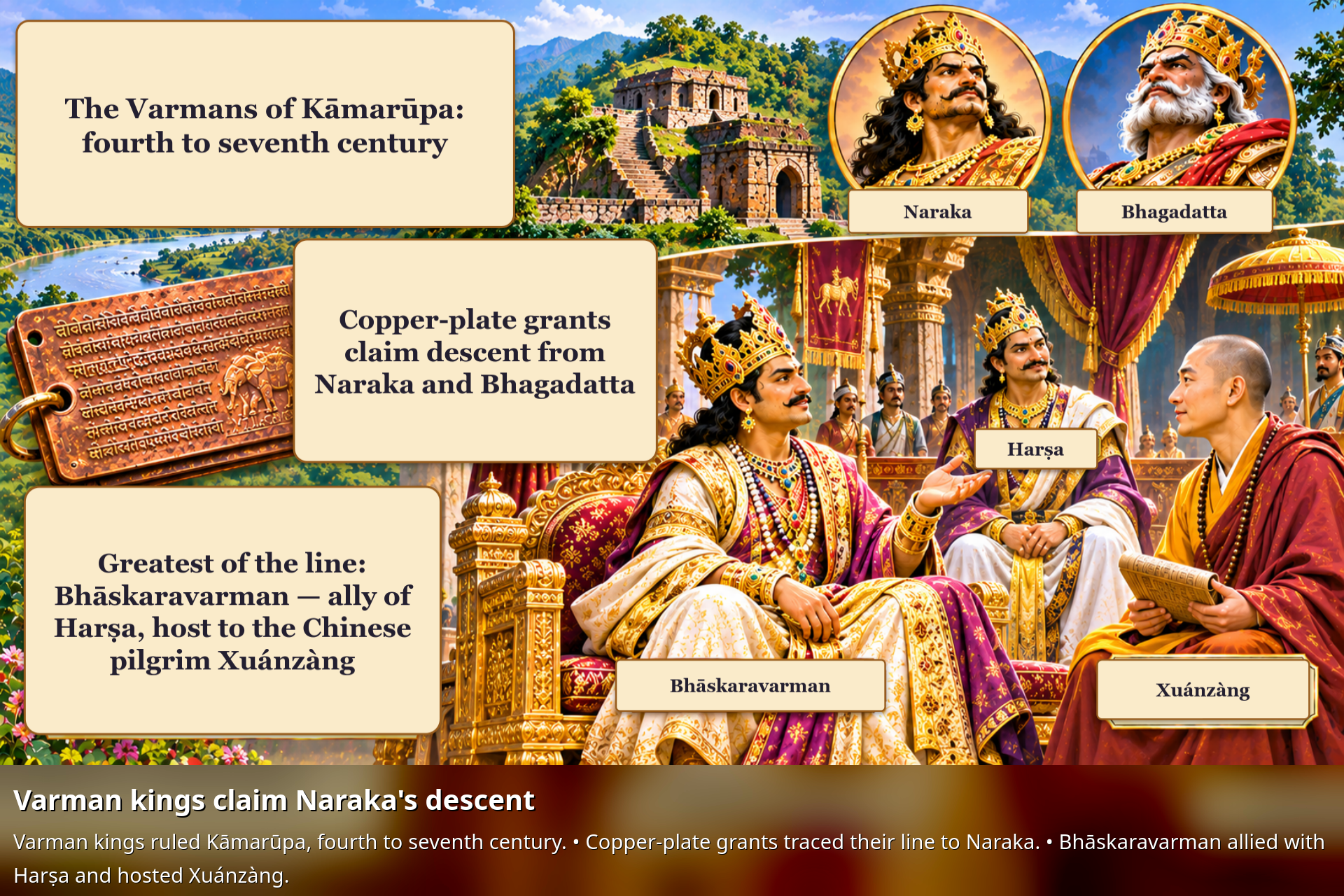
Later, the Varman kings of Kāmarūpa, who ruled from the fourth to the seventh century, traced their descent from Naraka and Bhagadatta in their copper-plate grants. The greatest of them, Bhāskaravarman, was an ally of Harṣa and hosted the Chinese pilgrim Xuánzàng.
The next great chapter belongs to the Āhoms. The Āhom kingdom lasted almost six hundred…
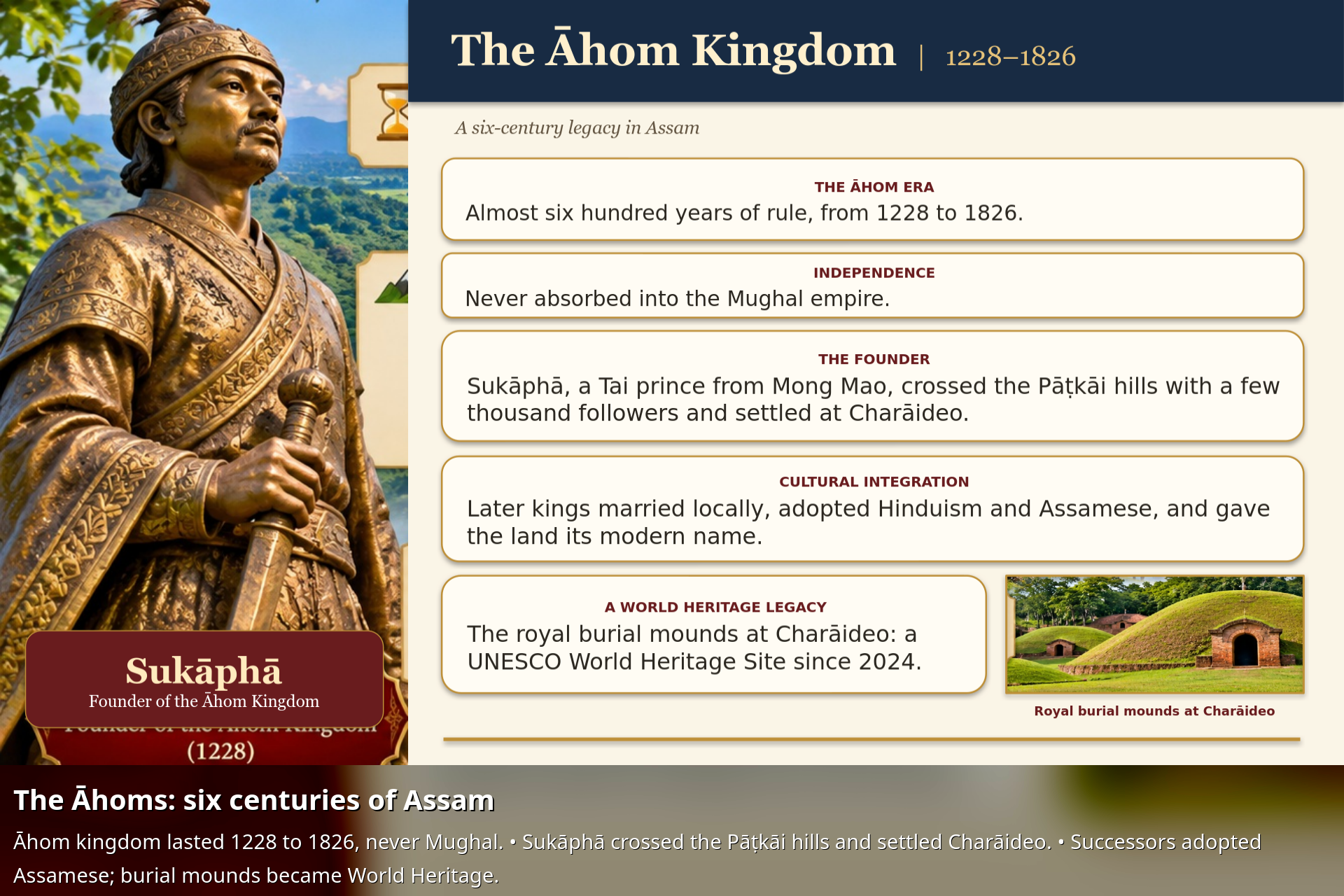
The next great chapter belongs to the Āhoms. The Āhom kingdom lasted almost six hundred years, from 1228 to 1826, and was never absorbed into the Mughal empire. Its founder, Sukāphā, was a Tai prince from Mong Mao who crossed the Pāṭkāi hills with a few thousand followers and settled at Charāideo. His successors married into local communities, adopted Hinduism and the Assamese language, and gave the land its modern name. Their royal burial mounds at Charāideo became a UNESCO World Heritage Site in 2024.
The Āhoms ran a disciplined state. Every adult male, called a pāik, owed labour and military service to the crown, which let the kings raise armies and build embankments, tanks and roads at short notice. Court chroniclers recorded events in prose histories called burañjīs, an unusual tradition of record-keeping in India. Conflict with the Mughals began in 1615 and ran for nearly seven decades. Assamese tradition counts seventeen invasions. The Āhoms won most of them by using the terrain: narrow river channels, monsoon floods, hill forts and night raids that neutralised Mughal cavalry.

Featuring:


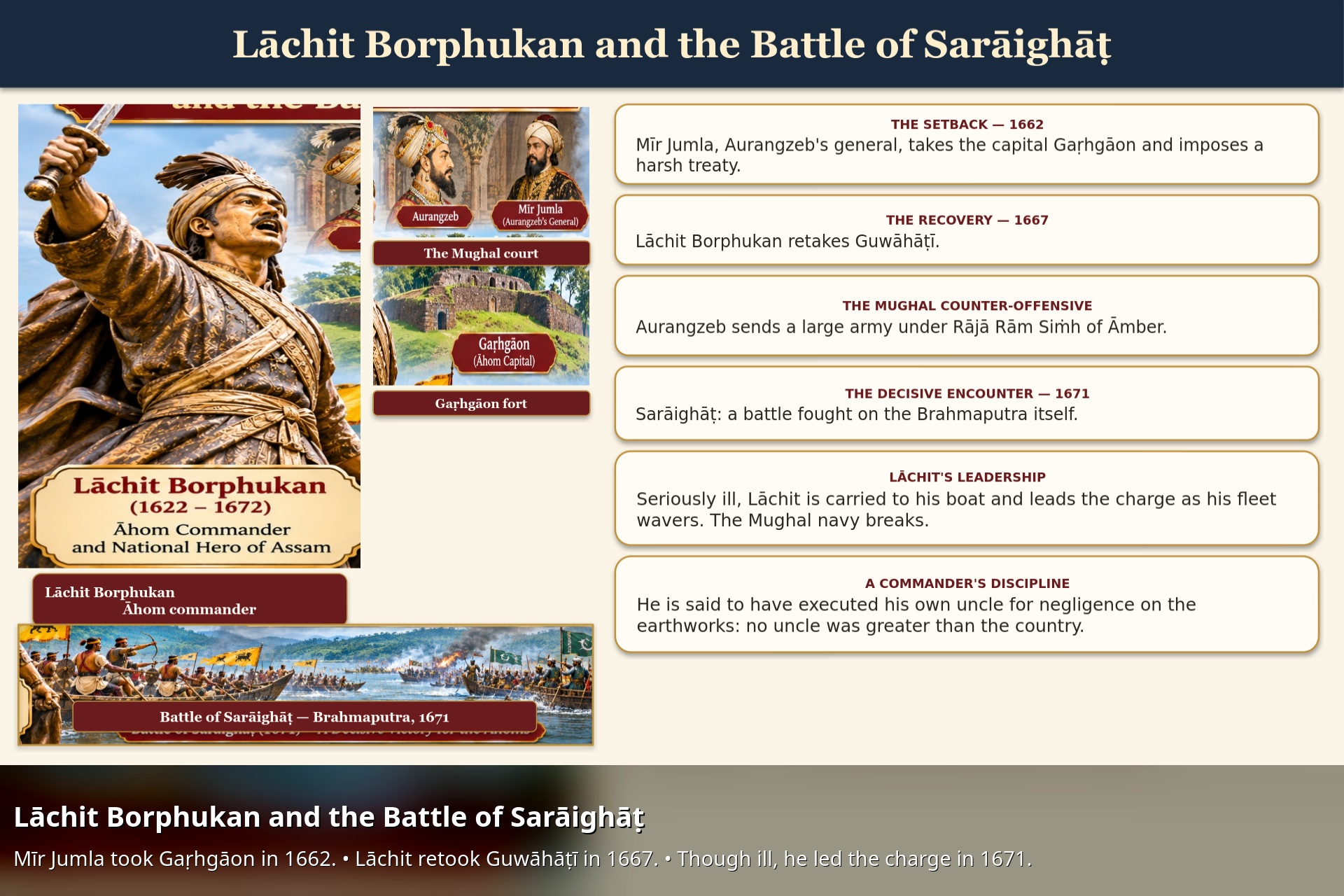
The record was not unbroken. In 1662 Aurangzeb's general Mīr Jumla took the capital, Gaṛhgāon,…
The record was not unbroken. In 1662 Aurangzeb's general Mīr Jumla took the capital, Gaṛhgāon, and forced a harsh treaty. The recovery is what Assam remembers. In 1667 the commander Lāchit Borphukan retook Guwāhāṭī. Aurangzeb sent a large army under Rājā Rām Siṁh of Āmber to win it back. The decisive encounter came at Sarāighāṭ in 1671, fought on the Brahmaputra itself. Lāchit, seriously ill, had himself carried to his boat and led the charge when his fleet began to fall back. The Mughal navy broke. Lāchit is said to have earlier executed his own uncle for negligence on the earthworks, with the words that his uncle was not greater than his country.
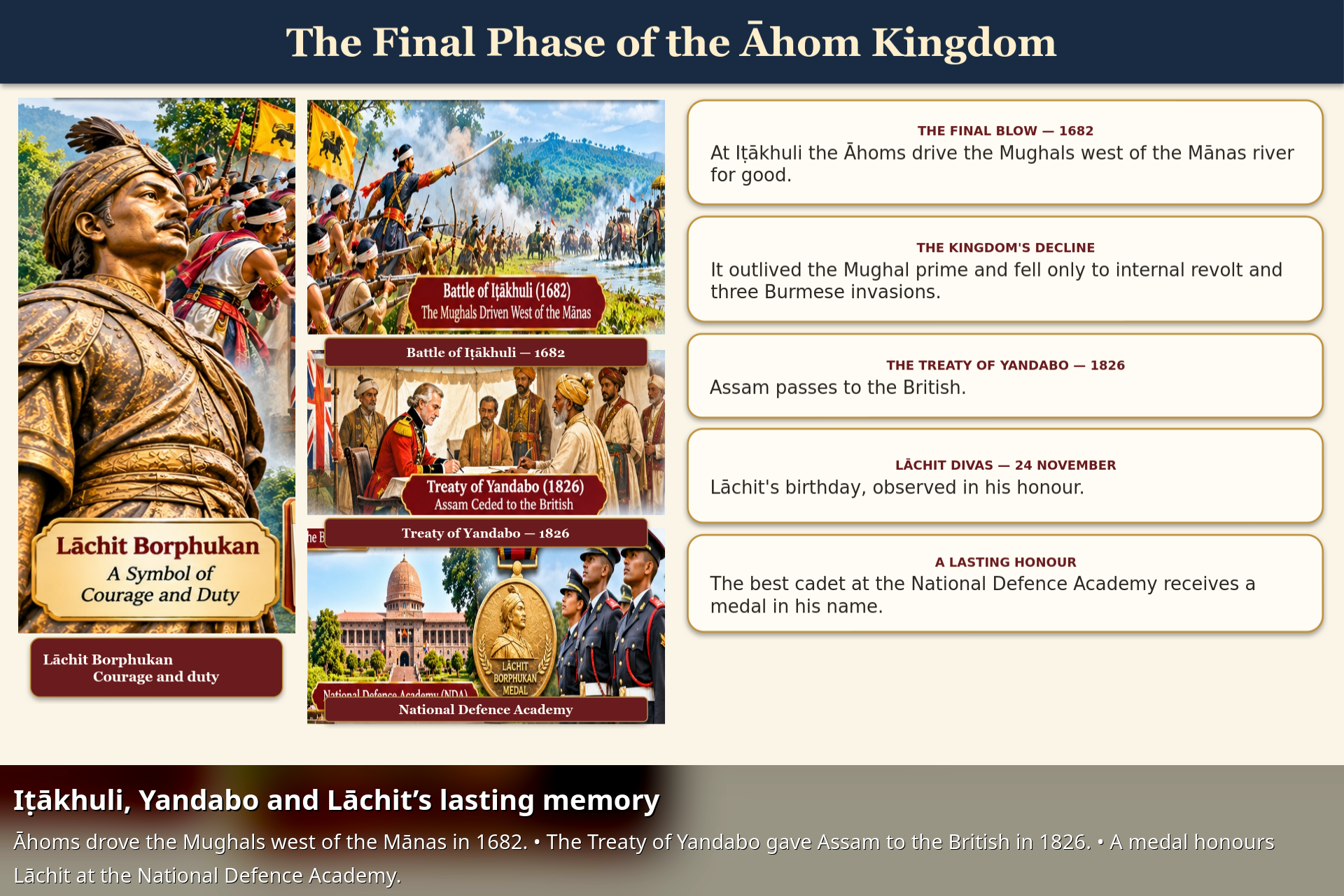
The final blow fell at Iṭākhuli in 1682, when the Āhoms drove the Mughals west of the Mānas river for good. The kingdom outlived the Mughal empire's prime and fell only after internal revolt and three Burmese invasions. The Treaty of Yandabo in 1826 handed Assam to the British. Lāchit's birthday, the twenty-fourth of November, is observed as Lāchit Divas, and the best cadet at the National Defence Academy receives a medal in his name.
Turn now to the land itself. Assam is a river valley ringed by hills. The…
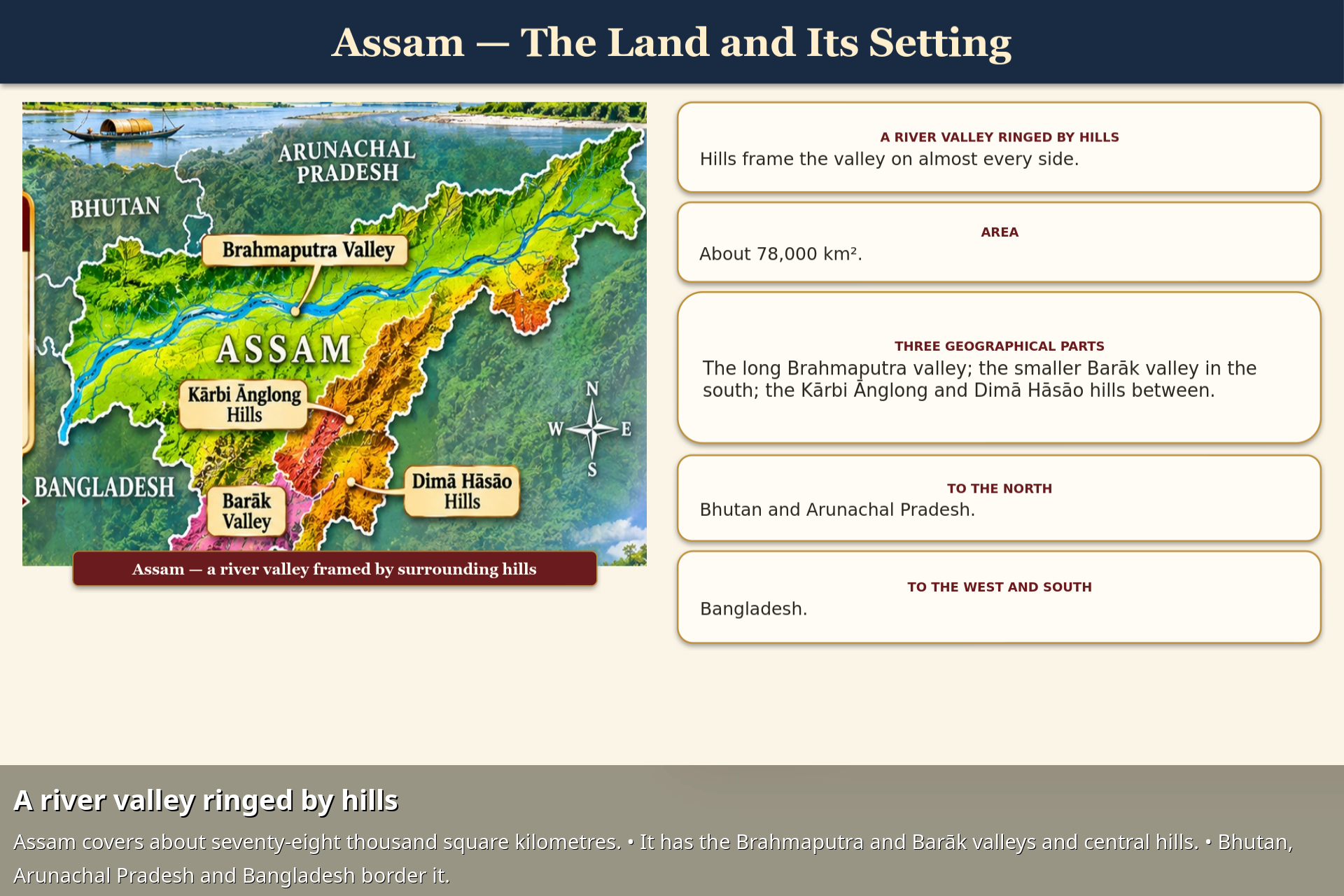
Turn now to the land itself. Assam is a river valley ringed by hills. The state covers about seventy-eight thousand square kilometres and falls into three parts: the long Brahmaputra valley, the smaller Barāk valley in the south, and the Kārbi Ānglong and Dimā Hāsāo hills between them. Bhutan and Arunachal Pradesh lie to the north, and Bangladesh touches the state in the west and south.
Featuring:

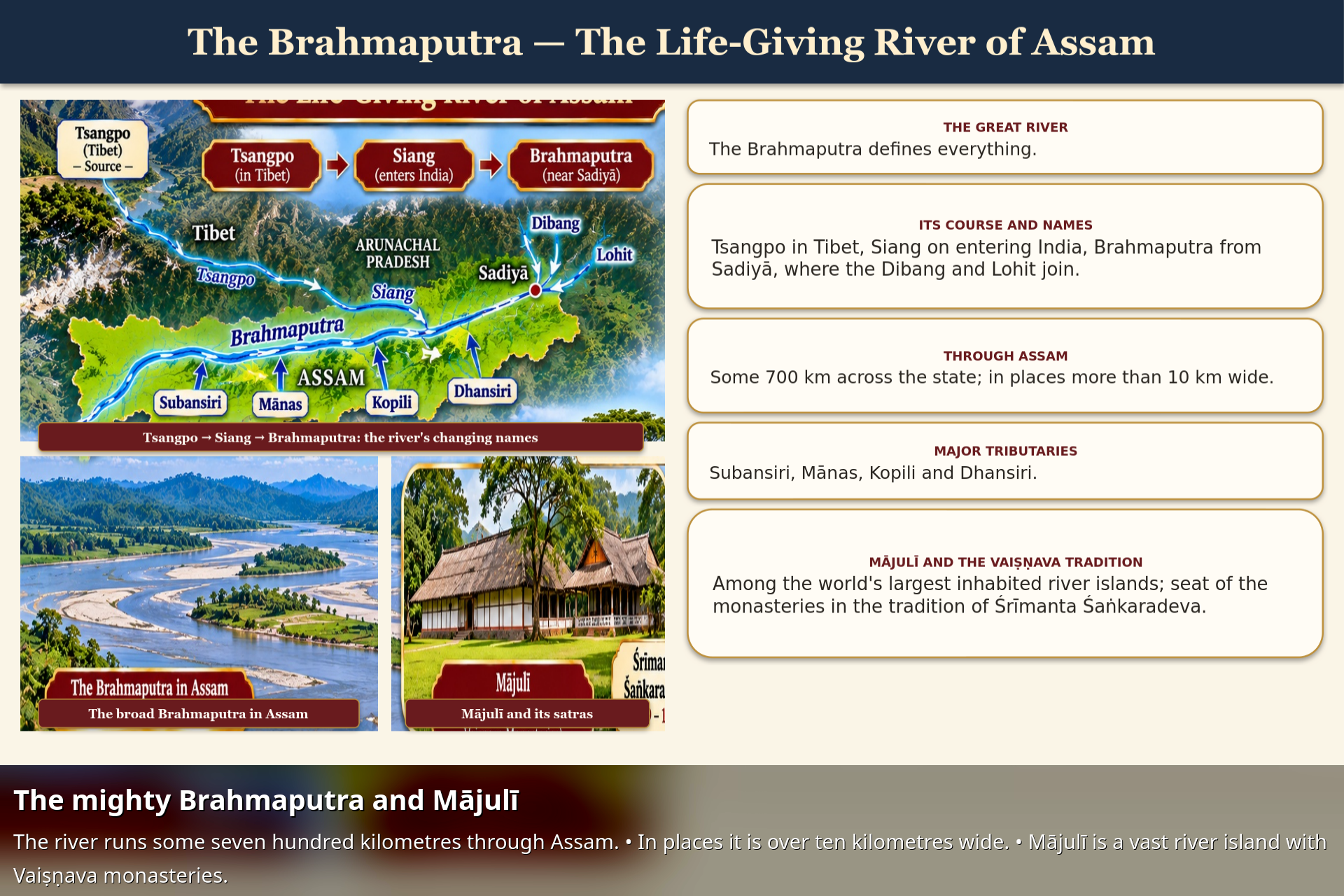
The Brahmaputra defines everything. It begins as the Tsangpo in Tibet, enters India as the Siang, and takes its famous name near Sadiyā where the Dibang and Lohit join it. It then runs some seven hundred kilometres through Assam, in places more than ten kilometres wide, fed by the Subansiri, Mānas, Kopili and Dhansiri. It holds Mājulī, among the world's largest inhabited river islands and the seat of the Vaiṣṇava monasteries founded in the tradition of Śrīmanta Śaṅkaradeva.
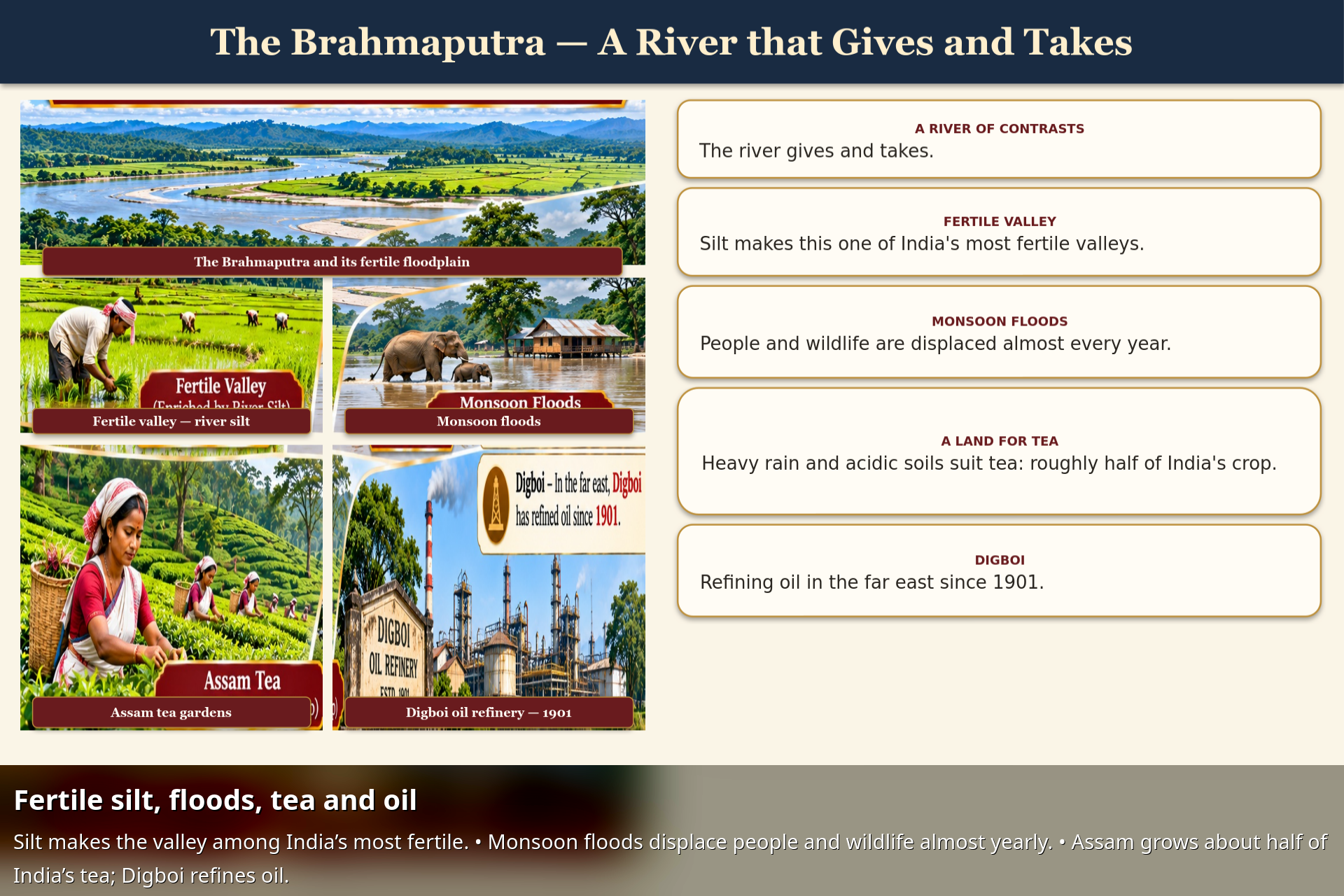
The river gives and takes. Its silt makes the valley one of India's most fertile,…
The river gives and takes. Its silt makes the valley one of India's most fertile, and its monsoon floods displace people and wildlife almost every year. Heavy rain and acidic soils on the valley edges suit tea, and Assam grows roughly half of India's crop. Digboi, in the far east, has refined oil since 1901.
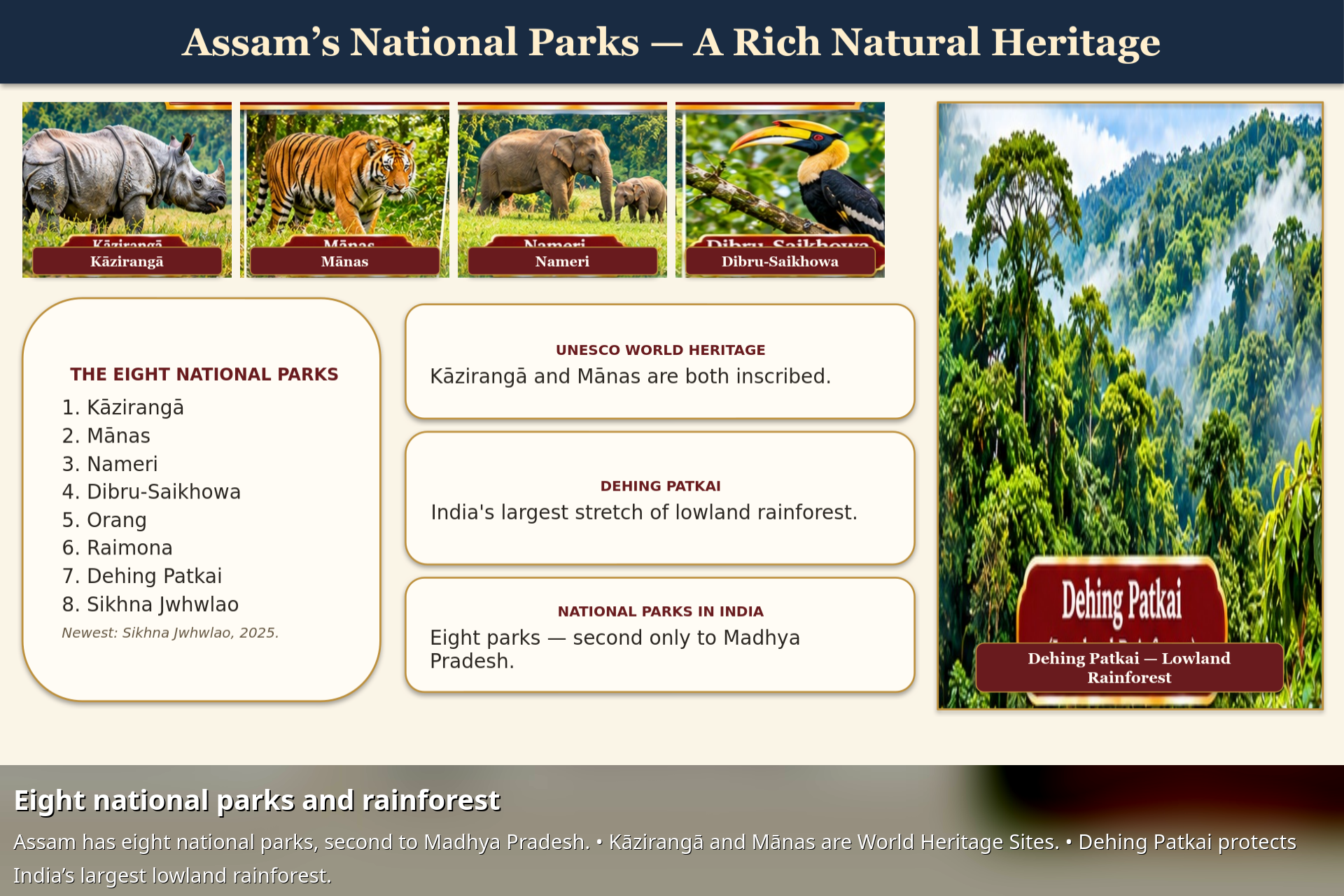
Assam has eight national parks, second only to Madhya Pradesh. They are Kāzirangā, Mānas, Nameri, Dibru-Saikhowa, Orang, Raimona, Dehing Patkai and Sikhna Jwhwlao, the last notified in 2025. Kāzirangā and Mānas are both UNESCO World Heritage Sites. Dehing Patkai protects the largest stretch of lowland rainforest in India.
Featuring:

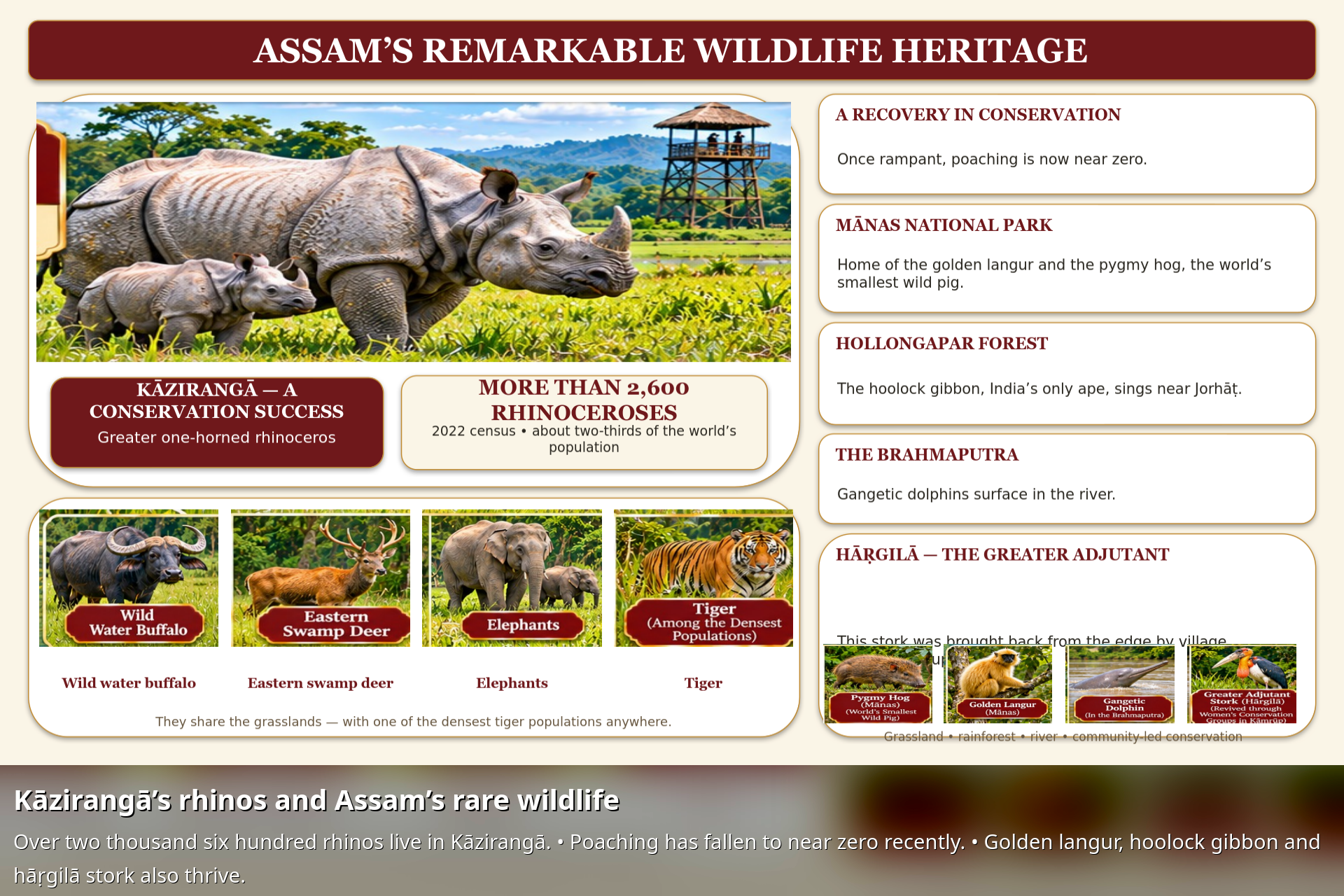
Kāzirangā is the great success. The 2022 census counted more than two thousand six hundred…
Kāzirangā is the great success. The 2022 census counted more than two thousand six hundred greater one-horned rhinoceroses there, up from a few dozen a century ago, and the park holds about two-thirds of the world's population. Poaching, once rampant, has fallen to near zero in recent years. The same grasslands carry wild water buffalo, eastern swamp deer, elephants and one of the densest tiger populations anywhere. The list of rare animals is long. Mānas shelters the golden langur and the pygmy hog, the world's smallest wild pig. The hoolock gibbon, India's only ape, sings in the Hollongapar forest near Jorhāṭ. The Gangetic dolphin surfaces in the Brahmaputra, and the greater adjutant stork, known locally as the hāṛgilā, has been brought back from the edge by village women's conservation groups in Kāmrūp.
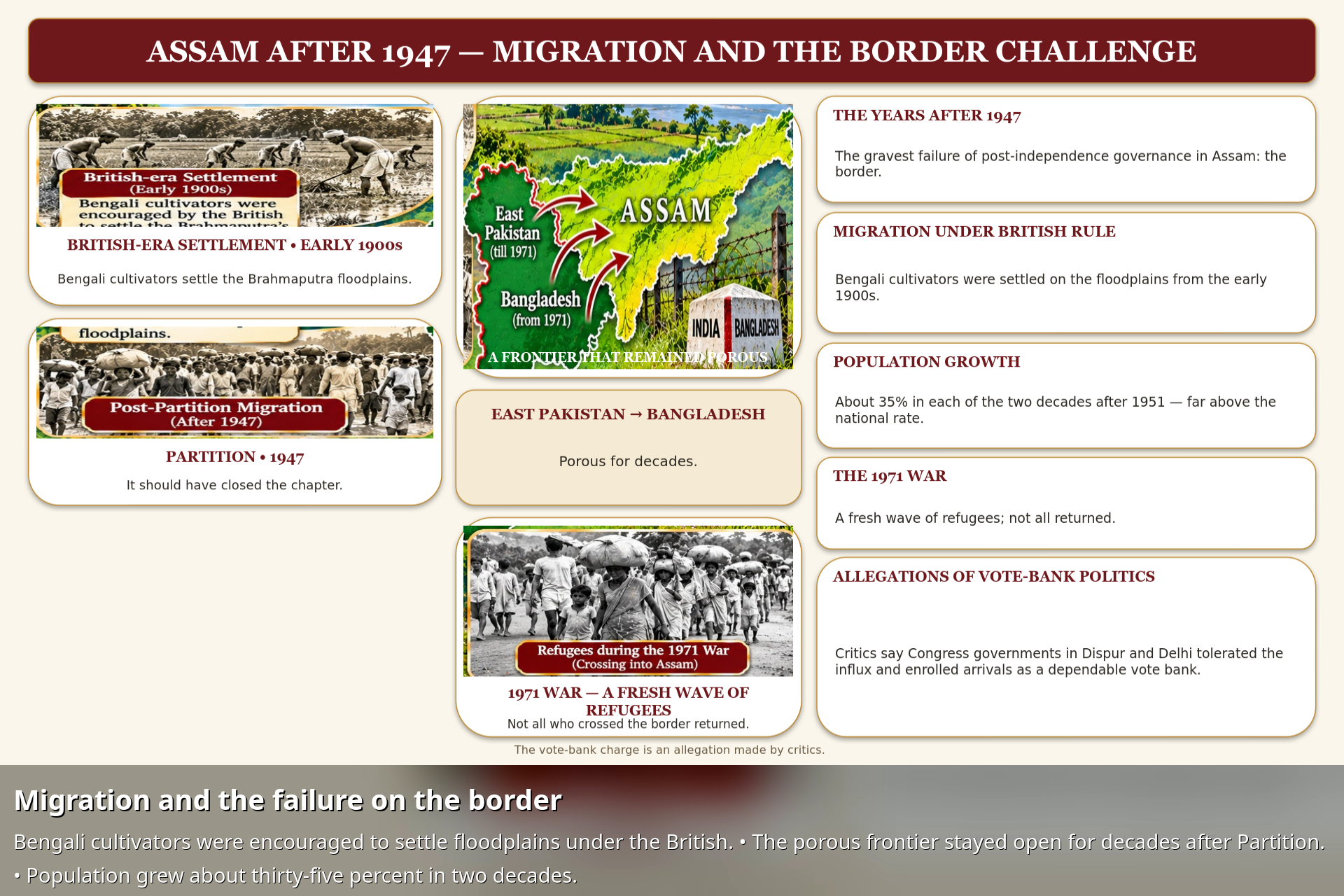
The years after 1947 were harder. The gravest failure of post-independence governance in Assam was the border. Migration from East Bengal had begun under the British, who encouraged Bengali cultivators to settle the Brahmaputra's floodplains from the early nineteen hundreds. Partition should have closed that chapter. Instead the frontier with East Pakistan, later Bangladesh, stayed porous for decades. The numbers alarmed Assam early. The state's population grew by about thirty-five percent in each of the two decades after 1951, far above the national rate. The 1971 war sent a fresh wave of refugees across the border, and not all returned. Critics accused successive Congress governments, in Dispur and Delhi, of tolerating the influx and enrolling new arrivals as voters because they were a dependable vote bank.
The anger broke in 1979, when a revision of the electoral roll in Mangaldoi turned…
The anger broke in 1979, when a revision of the electoral roll in Mangaldoi turned up tens of thousands of doubtful names. The All Assam Students' Union launched a six-year agitation demanding detection, deletion and deportation of foreigners. More than eight hundred and fifty agitators died. The movement's darkest day was at Nellie in February 1983, when around two thousand Bengali-origin Muslims were massacred during a forced election. Delhi's response that year deepened the grievance. The Illegal Migrants Determination by Tribunals Act applied only to Assam and put the burden of proof on the accuser rather than the accused. It produced barely fifteen hundred expulsions in two decades. The Supreme Court struck it down in 2005 on a petition by Sarbananda Sonowal, calling the law the main obstacle to identifying illegal migrants and likening the influx to external aggression.

Featuring:


The Assam Accord of 1985 ended the agitation and fixed the twenty-fourth of March 1971 as the cut-off for citizenship. Implementation lagged for thirty years. Much of the promised border fence remained unbuilt, and detection crawled. How many came is still disputed. Ministers have cited figures in the millions in Parliament, and the Muslim share of the population rose from about twenty-five percent in 1951 to thirty-four percent in 2011. Yet the National Register of Citizens, prepared under Supreme Court supervision and published in 2019, excluded one point nine million of thirty-three million applicants, many of them Bengali Hindus. The state government rejected that count as too low. Other scholars argue that colonial-era settlement and higher birth rates explain much of the change, and Congress disputes the vote-bank charge, noting that it signed the Accord and began the update of the register.

As for who governed, and when: Congress ruled Assam for roughly fifty-five of the first…
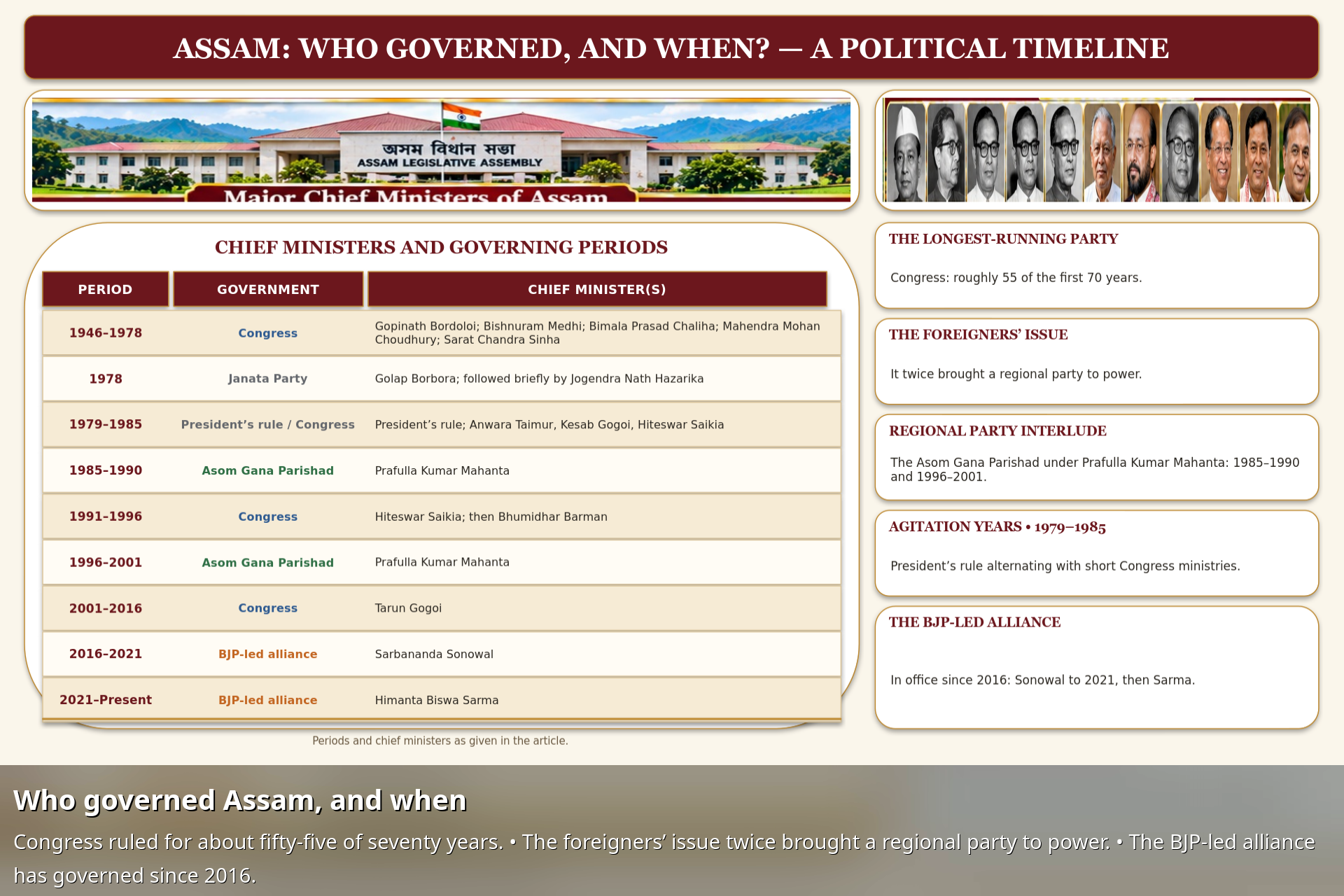
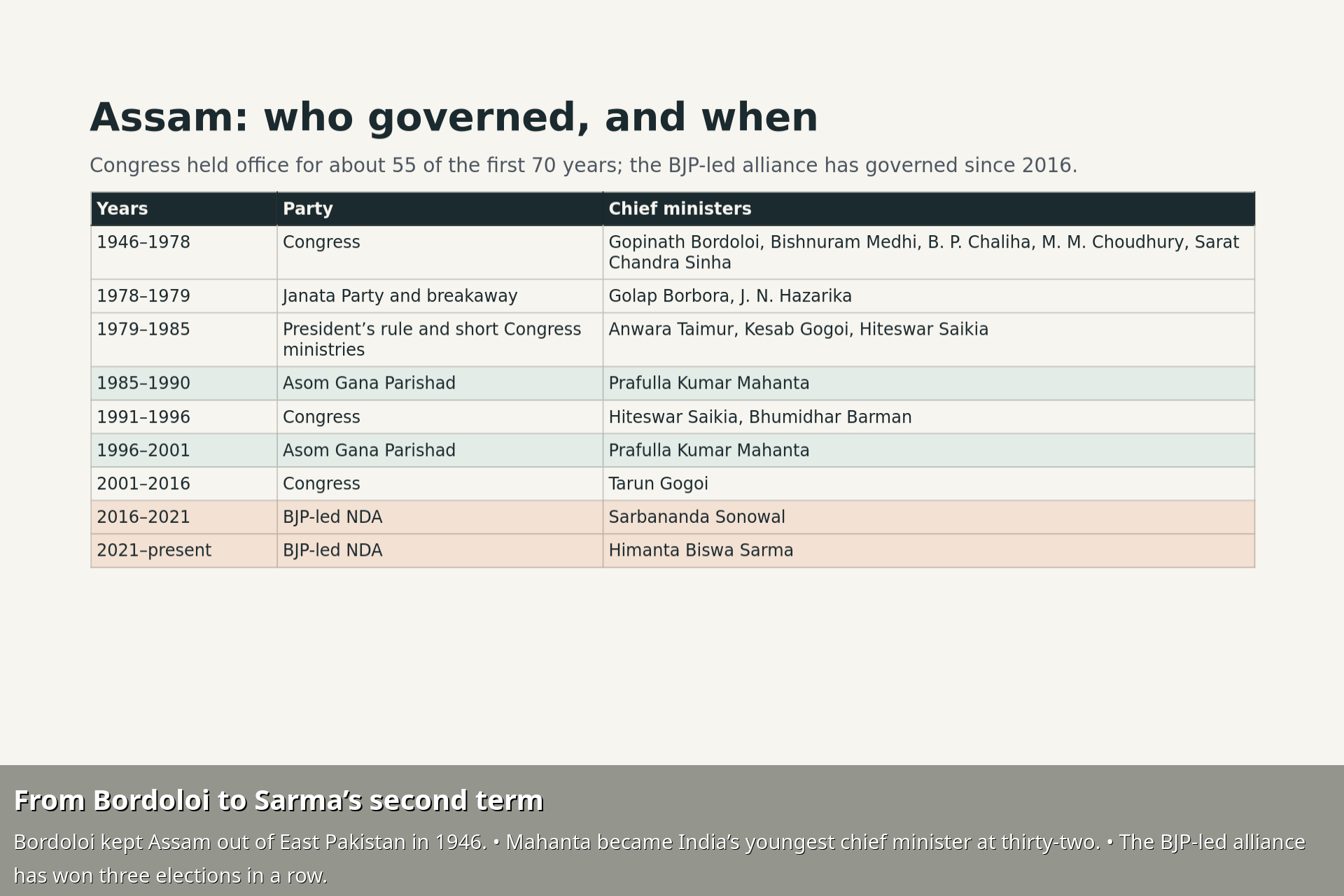
As for who governed, and when: Congress ruled Assam for roughly fifty-five of the first seventy years after independence, and the alliance led by the Bharatiya Janata Party, the BJP, has governed since 2016. The pattern in between was set by the foreigners' issue, which twice brought a regional party to power. From 1946 to 1978 Congress held office without a break, under Gopinath Bordoloi, Bishnuram Medhi, Bimala Prasad Chaliha, Mahendra Mohan Choudhury and Sarat Chandra Sinha. In 1978 the Janata Party formed the first non-Congress government under Golap Borbora, followed briefly by Jogendra Nath Hazarika. The agitation years from 1979 to 1985 saw spells of President's rule and short Congress ministries under Anwara Taimur, Kesab Gogoi and Hiteswar Saikia. The Asom Gana Parishad governed from 1985 to 1990 under Prafulla Kumar Mahanta. Congress returned from 1991 to 1996 under Hiteswar Saikia and then Bhumidhar Barman. Mahanta and the Asom Gana Parishad came back from 1996 to 2001. Congress then governed for fifteen years, from 2001 to 2016, under Tarun Gogoi. The BJP-led alliance took over in 2016 with Sarbananda Sonowal as chief minister, and Himanta Biswa Sarma has led it since 2021.
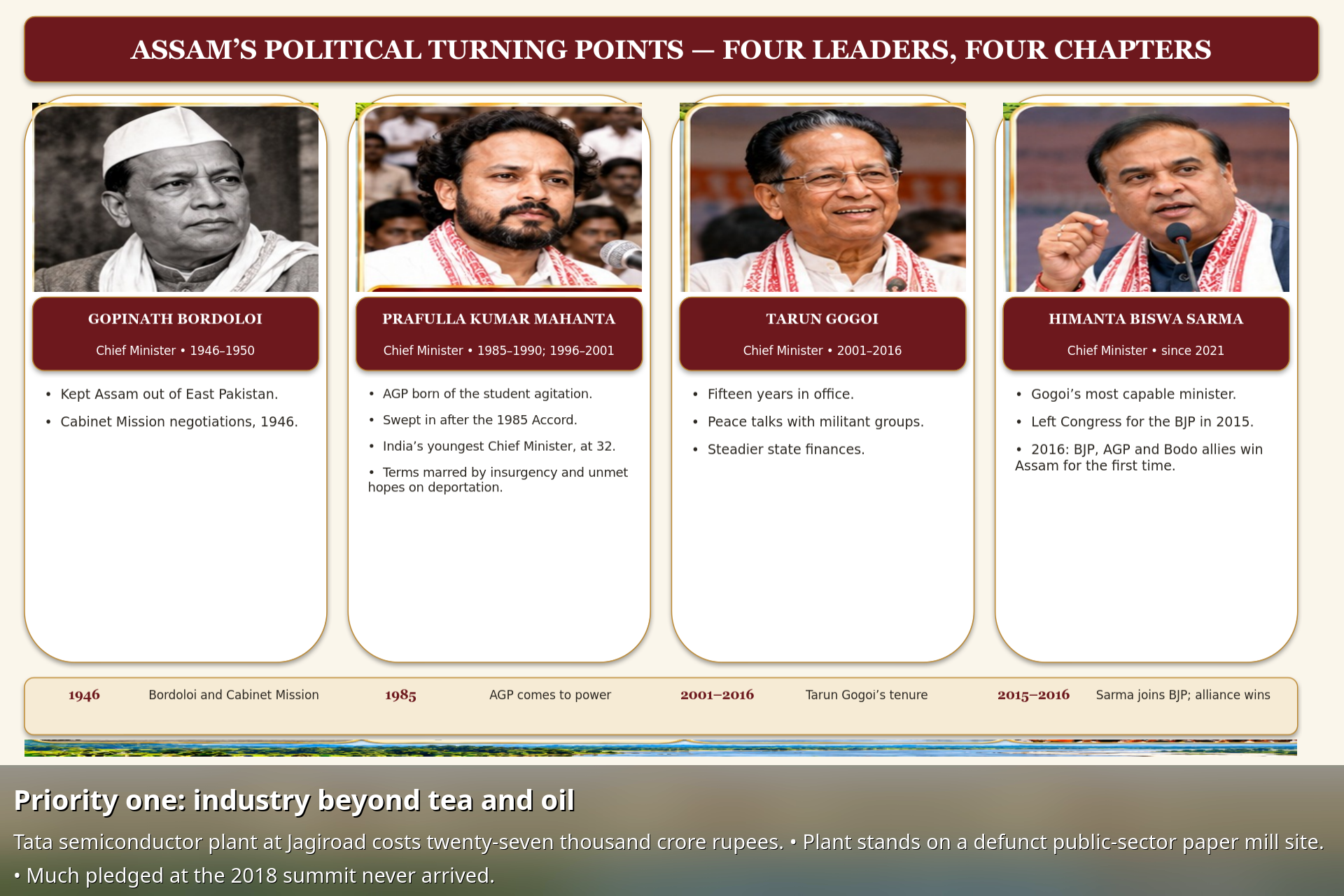
Gopinath Bordoloi is remembered for keeping Assam out of East Pakistan during the Cabinet Mission negotiations of 1946. The Asom Gana Parishad, born from the student agitation, swept in after the Accord in 1985 with Mahanta, then thirty-two, as India's youngest chief minister. Its two terms were marred by insurgency and disappointed hopes on deportation. Tarun Gogoi's fifteen years brought peace talks with militant groups and steadier finances. His most capable minister, Himanta Biswa Sarma, left for the BJP in 2015. A year later the BJP, allied with the Asom Gana Parishad and Bodo parties, won Assam for the first time. The alliance has now won three elections in a row. In the April 2026 poll it took one hundred and two of one hundred and twenty-six seats, with the BJP alone winning eighty-two and Congress reduced to nineteen. Sarma was sworn in for a second term on the twelfth of May 2026.
Featuring:

Himanta Biswa Sarma, chief minister since May 2021, has built his government around four priorities:…
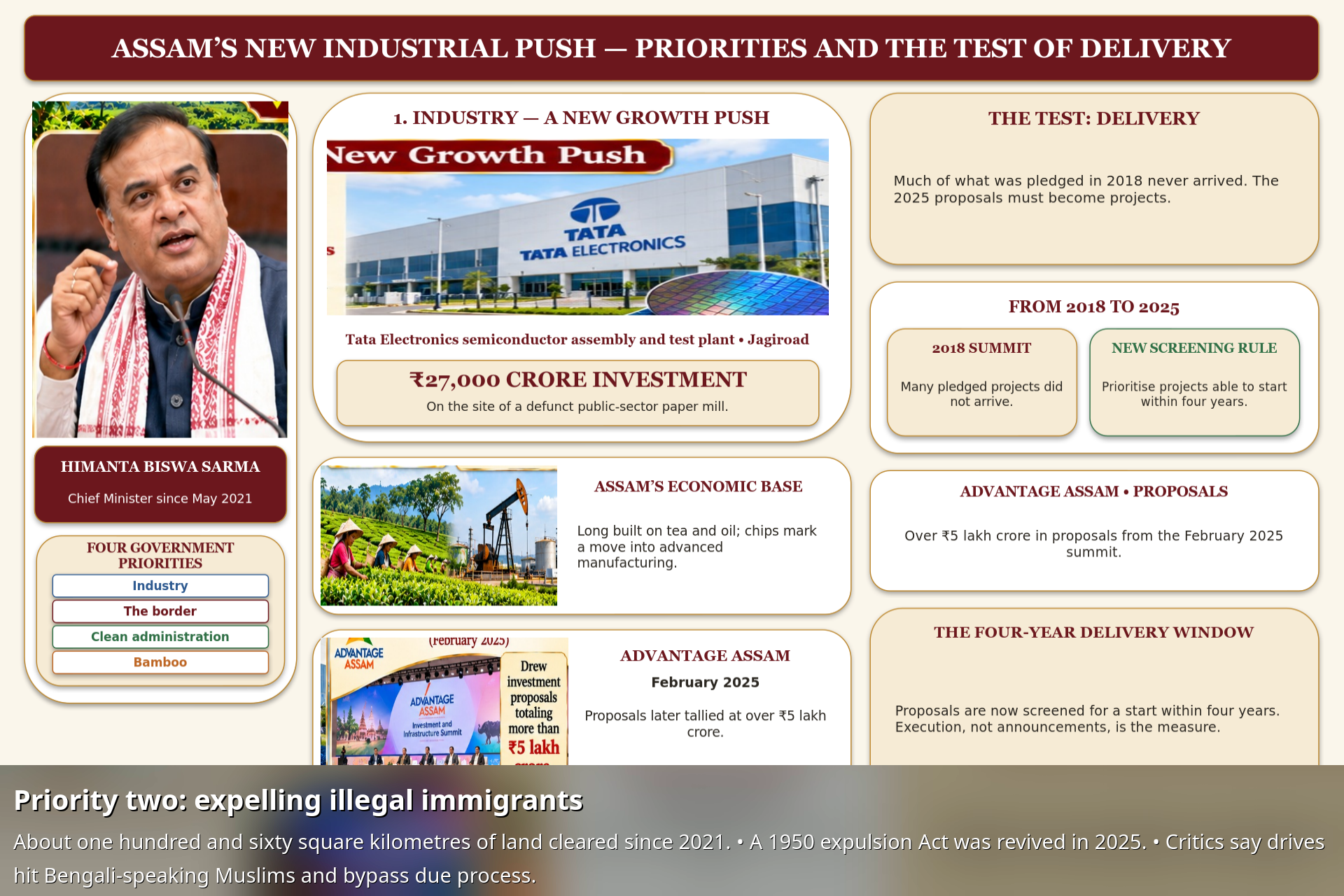
Himanta Biswa Sarma, chief minister since May 2021, has built his government around four priorities: industry, the border, clean administration and bamboo. First, industry. Assam's economy long rested on tea and oil. The flagship of the new push is the Tata Electronics semiconductor assembly and test plant at Jagiroad, an investment of twenty-seven thousand crore rupees on the site of a defunct public-sector paper mill. The Advantage Assam summit of February 2025 drew investment proposals later tallied at more than five lakh crore rupees. The test is delivery, since much of what was pledged at the 2018 summit never arrived, and the state says it now screens proposals for projects that can start within four years.
Second, illegal immigration. The government has cleared about one point two lakh bighas, or one hundred and sixty square kilometres, of encroached forest and government land since 2021, by its own count. In 2025 it revived the Immigrants Expulsion from Assam Act of 1950, which lets district commissioners order suspected foreigners out without a tribunal hearing, and began pushing people back across the border. Supporters see the first serious enforcement of the Assam Accord in forty years. Opposition parties and rights groups say the drives fall overwhelmingly on Bengali-speaking Muslims, including Indian citizens, and bypass due process. Petitions are before the Gauhati High Court.
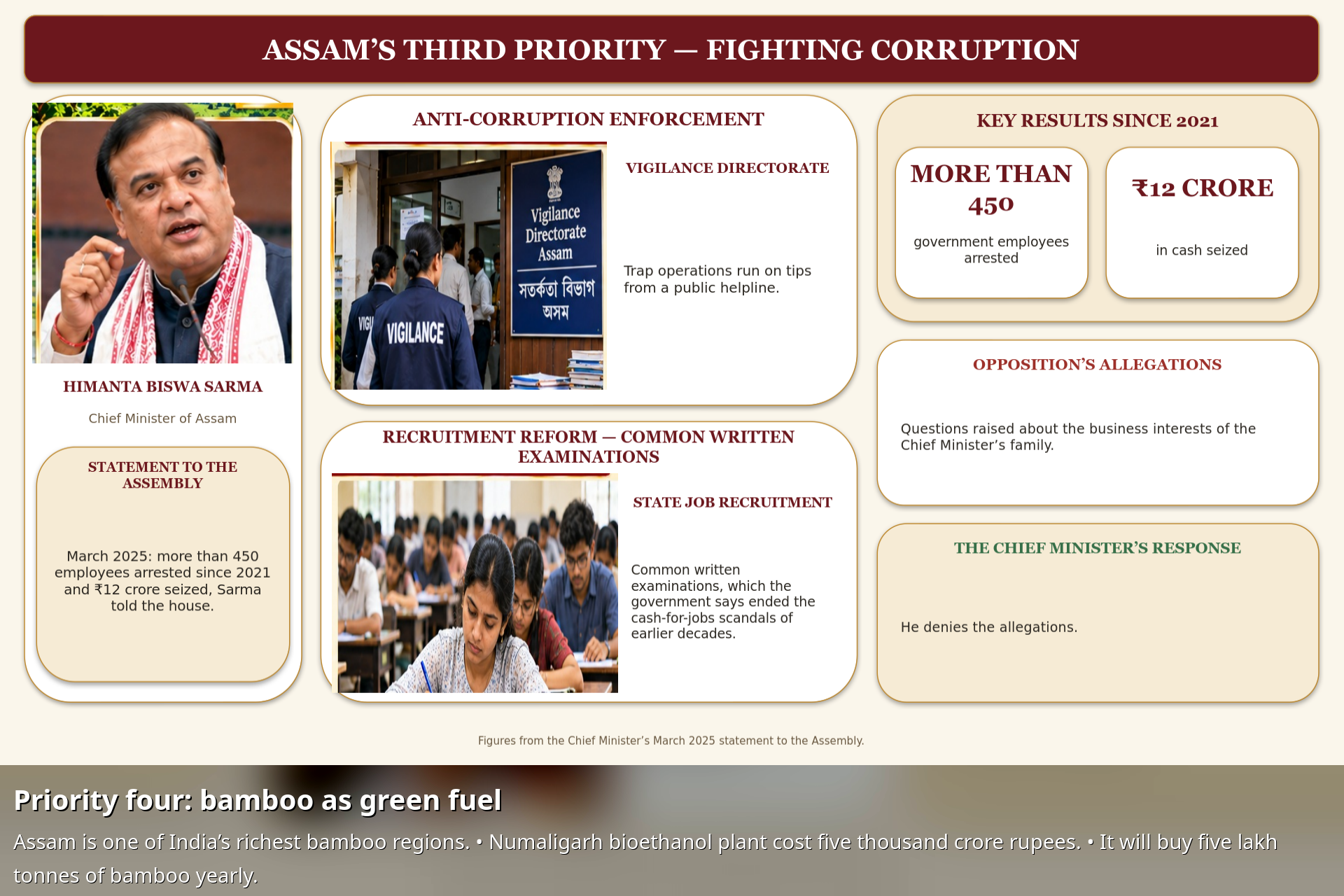
Third, corruption. The vigilance directorate runs trap operations on tips from a public helpline. Sarma…
Third, corruption. The vigilance directorate runs trap operations on tips from a public helpline. Sarma told the assembly in March 2025 that more than four hundred and fifty government employees had been arrested since 2021 and twelve crore rupees in cash seized. Recruitment for state jobs has moved to common written examinations, which the government says has ended the cash-for-jobs scandals of earlier decades. The opposition has made allegations of its own about the business interests of the chief minister's family, which he denies.

Featuring:

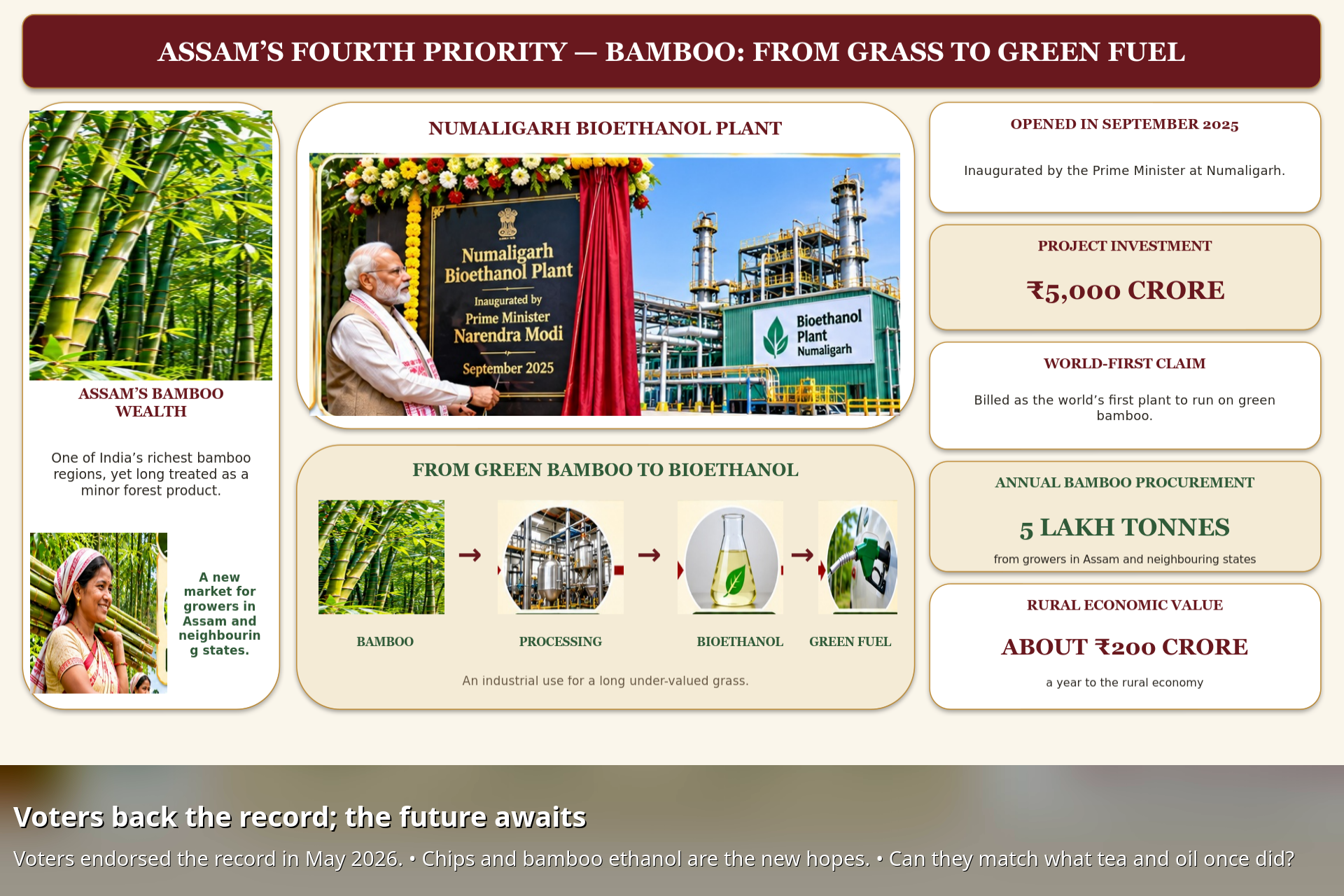
Fourth, bamboo. Assam is one of India's richest bamboo regions, and the grass was long treated as a minor forest product. In September 2025 the Prime Minister opened a bioethanol plant at Numaligarh, built for five thousand crore rupees and billed as the first in the world to run on green bamboo. It will buy five lakh tonnes a year from growers in Assam and neighbouring states, worth about two hundred crore rupees to the rural economy.
Voters endorsed the record in May 2026. Whether chips and bamboo ethanol can do for…
Voters endorsed the record in May 2026. Whether chips and bamboo ethanol can do for the valley what tea and oil once did will decide how this chapter is remembered.