



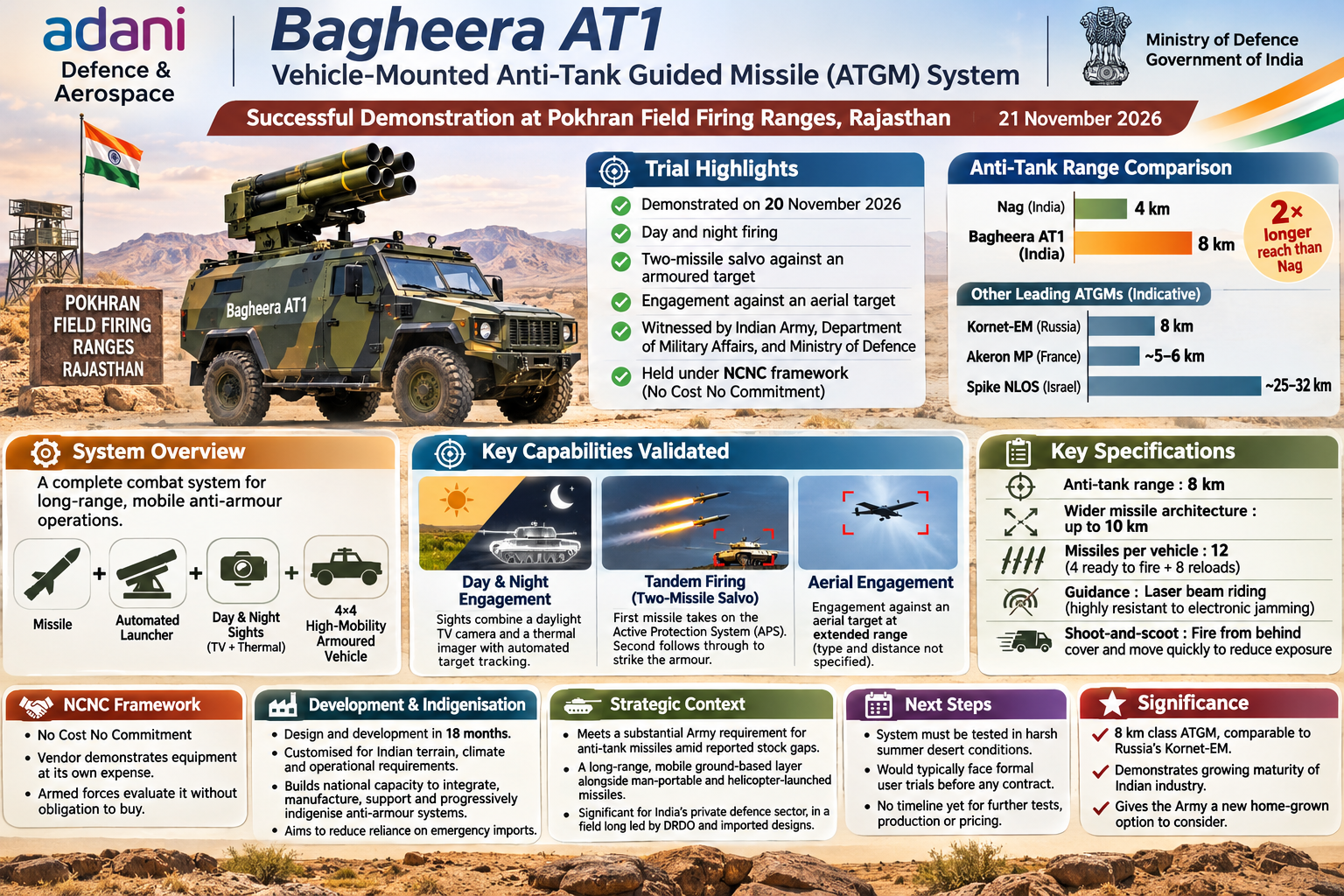
Adani Defence & Aerospace announced on November 21, 2026, that it had successfully demonstrated its Bagheera AT1 vehicle-mounted anti-tank guided missile, or ATGM, system at the Pokhran Field Firing Ranges in Rajasthan a day earlier. The trials covered day and night firing, a two-missile salvo against an armoured target, and an engagement against an aerial target. Senior representatives of the Indian Army, the Department of Military Affairs, and the Ministry of Defence watched the firings. The trial was held under the No Cost No Commitment, or NCNC, framework. Under it, a vendor demonstrates equipment at its own expense, and the armed forces evaluate it without any obligation to buy. The company says Bagheera AT1 can hit tanks at up to 8 km. That is about twice the range of the existing land-based anti-tank missile systems used by the Army, according to Business Standard.
Adani Defence fired four missiles over the course of the programme and validated three capabilities. The first was engagement by day and by night. The system's sights combine a daylight television camera with a thermal imager, and both feed an automated target tracker. The second was tandem firing. Two missiles were launched in quick succession along a single laser beam at a target representing an armoured vehicle. The tactic is aimed at modern tanks fitted with an Active Protection System, or APS, which detects and intercepts incoming rounds. The first missile is meant to take on the APS. The second follows through to strike the armour. The third was an aerial engagement at what the company called extended range. Neither the type of target nor the distance was specified. If confirmed, such a capability could give units some flexibility against low-flying threats, though the system's main job remains destroying armour.
Featuring:





Bagheera AT1 is more than a missile. Adani Defence describes it as a complete combat…
Bagheera AT1 is more than a missile. Adani Defence describes it as a complete combat system with four parts: the missile, an automated launcher, day and night sights, and a 4x4 high-mobility armoured vehicle designed in-house. Each vehicle carries 12 missiles. Four sit ready to fire on the launcher, and eight reloads are stowed on board. The crew can fire from behind cover and then move quickly, which reduces exposure to return fire. Tanks are increasingly exposed to precision-guided weapons and loitering munitions, and stopping an enemy tank before it gets within striking distance can decide an engagement.
The guidance method is the system's most distinctive feature. The missile rides a laser beam pointed at the target instead of taking commands over a radio link. With no radio signal to disrupt, the company says, the weapon is highly resistant to electronic jamming. The anti-tank engagement range is 8 km, and the company says the wider missile architecture could support guided engagements out to 10 km.
Featuring:



The test comes as the Army looks to modernise its anti-armour inventory. In its statement,…
The test comes as the Army looks to modernise its anti-armour inventory. In its statement, Adani Defence said India's requirement for anti-tank missiles is substantial and pointed to reported gaps in the existing stock. The company also said design and development took 18 months, and that the system was customised for Indian terrain, climate, and operational requirements.
The company is pitching Bagheera AT1 as a long-range, mobile ground-based layer. It would sit alongside the man-portable and helicopter-launched missiles already in service. It also frames the programme as an industrial one. The firm said the project builds national capacity to integrate, manufacture, support, and progressively indigenise anti-armour systems, cutting reliance on emergency imports.
Featuring:



Ravi Kumar Gupta, a former director of public interface at the Defence Research and Development…
Ravi Kumar Gupta, a former director of public interface at the Defence Research and Development Organisation, or DRDO, told Business Standard that building both an ATGM and its launcher is a significant achievement and a sign of Indian industry's growing maturity. Recent wars have shown how fast munitions are consumed, he said, and sustained fighting needs domestic production capacity.
Among foreign systems, the 8 km anti-tank range puts Bagheera AT1 in the class of Russia's Kornet-EM. Israel's Spike NLOS reaches much further and uses electro-optical guidance, while France's Akeron MP uses imaging sensors and can be fired in fire-and-forget mode or with the operator in the loop.
Featuring:


Defence experts quoted by Business Standard say the system must still be tested and validated…
Defence experts quoted by Business Standard say the system must still be tested and validated in the harsh summer conditions of the desert. The November trial took place in Rajasthan's mild winter. Any path to induction would normally run through formal user trials before a contract. No timeline for further tests, production, or pricing has been reported.
For now, the Pokhran firing gives the Army a new home-grown option to consider. It also gives India's private defence sector a notable entry in a field long led by DRDO and imported designs.
Featuring:


Sources: The Pioneer; Business Standard; Deccan Herald; The Morning Voice; The Defense News
Sources: The Pioneer; Business Standard; Deccan Herald; The Morning Voice; The Defense News