




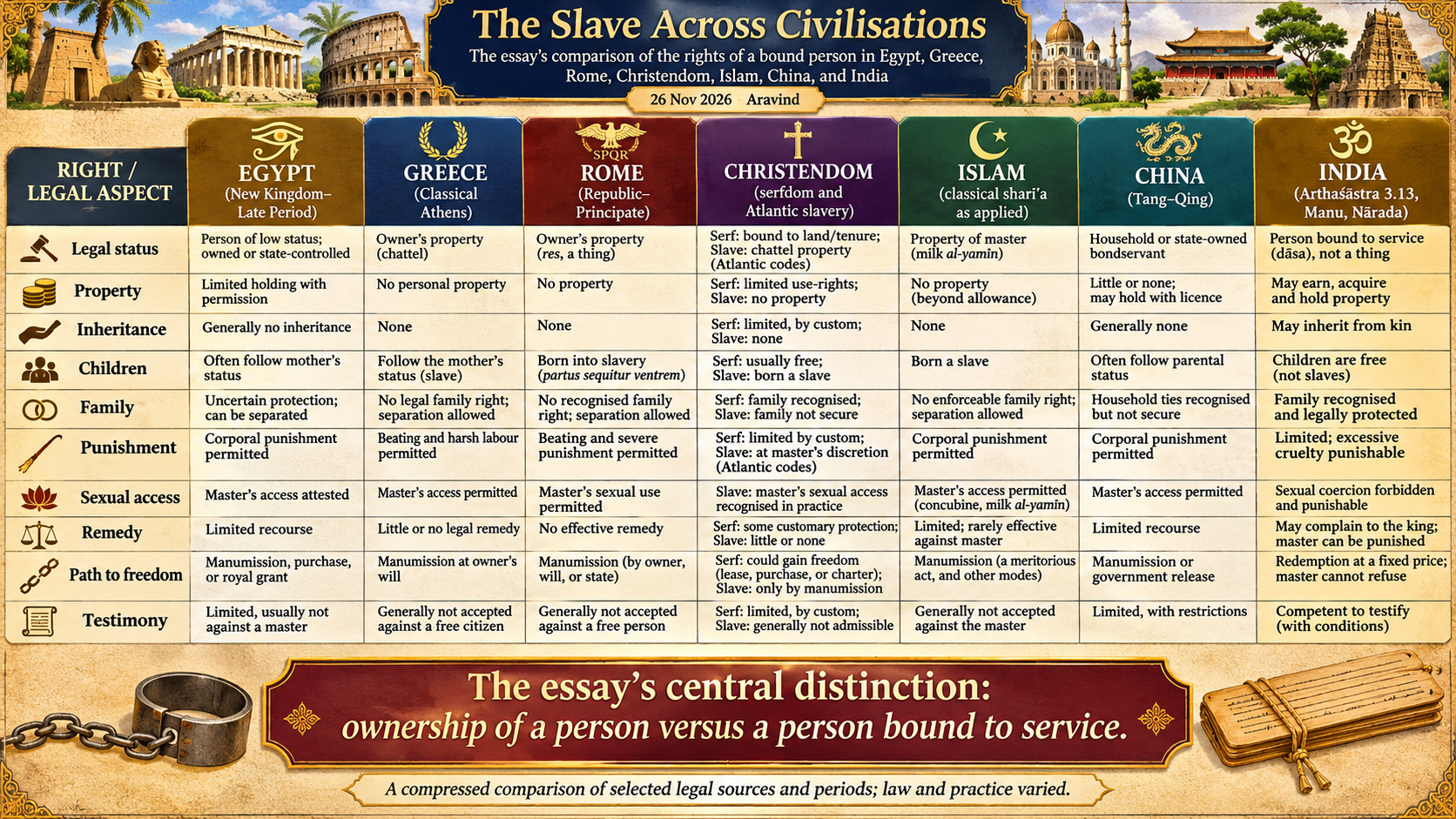
This is a companion to the essay Did the Arthaśāstra Say There Were Slaves in India?. That essay argues from the sūtras of Arthaśāstra 3.13 that the dāsa was a bound person and not an owned one, and that "serf" is the nearer English word. This document supplies the comparison the argument rests on. It sets the rights of a bound person side by side across the societies that had one, so that the reader can see what the English word "slave" carries with it, and judge for himself whether it fits the dāsa.
"Slave" is a Western construct with a definite legal content. In Roman law the slave is a res, a thing, under the dominica potestas of his owner. In the Atlantic codes he is movable property. From that status everything else follows. He owns nothing, because a thing cannot own. He is heir to nothing and leaves nothing, because a thing has no kin at law. His children are born into his condition, because the offspring of property is property. He has no family the master need respect, no remedy against the master that he can bring in his own name, and no way out except his owner's grace. He may be beaten at his master's discretion and used sexually at his master's pleasure. These are the marks of chattel slavery as Patterson and Finley define it, and they are the rows of the table below.
Featuring:





The columns are the eight traditions. Each column is a simplification of a long history,…
The columns are the eight traditions. Each column is a simplification of a long history, and the period relied on is named in the heading. For Christendom and Islam the cells state the law as it was actually enforced, not the pieties of the texts, because in both the gap between the two was wide. The Code Noir of 1685 and the American slave codes on the one hand, and the rulings of the four schools on the other, are the documents. The trades they governed carried something like twelve million Africans across the Atlantic and, over a longer period, a comparable number across the Sahara and the Indian Ocean, with Europeans taken by the Barbary states and Christian boys by the devşirme besides. The Hindu column cites the sūtra for every cell. The bracketed codes in the cells refer to the legend of sources at the end.
Three cautions. First, the table compares law, and law is not practice. Where practice is known to have departed from the law, the cell says so, but the reader should assume that every system was harsher on the ground than on the page. Second, the table compares the bound person at his most unfree in each tradition. Egypt had free labourers, Rome had freedmen who became citizens, and India had hired labourers under the same chapter as the dāsa. The comparison is of the bottom of each ladder. Third, a table flattens. The notes under each source in the legend are where the detail lives, and the reader who doubts a cell should go there first.
Featuring:




The comparative tableThe table is set out one right at a time. Under each, the…
The comparative table
The table is set out one right at a time. Under each, the seven traditions are given in the same order, with the Hindu column last. The periods relied on are: Egypt, New Kingdom to Late Period; Greece, classical Athens; Rome, Republic and Principate; Christendom, serfdom, and Atlantic slavery under the Code Noir 1685 and the American codes; Islam, classical sharīʿa, as applied; China, Tang to Qing codes; Hindu, Arthaśāstra 3.13, Manu, and Nārada.
Can a free subject be reduced to the status? Egypt. Yes. Self-sale and sale of…
Can a free subject be reduced to the status?
- Egypt. Yes. Self-sale and sale of children for debt attested [E1, E3]
- Greece. Not a citizen after Solon (594 BCE). Foreigners freely [G2]
- Rome. Not a citizen at home after 326 BCE, save penal slaves. Captives and foreigners freely [R2, R4]
- Christendom. For the serf, free peasants bound by tenure [C6]. For the slave, Christians not enslaved by Christians after c. 1000 [C6]. Papal bulls of 1452 and 1455 licensed perpetual enslavement of "Saracens, pagans, and other enemies of Christ" [C2]. Africans as chattel thereafter [C1, C4]
- Islam. In theory a Muslim can never be enslaved, and a non-Muslim only by capture in jihād [I2, I3]. In practice that meant raiding across the Sahara, the Indian Ocean coasts, the Caucasus, and the Mediterranean [I6, I7]. The rule protected only those the enslaver agreed were Muslims. Takfīr, the declaration that they were not, opened it. Ottoman fatwas of the 16th century declared the Shia Qizilbash infidels and their capture lawful. The Bukhara and Khiva markets were stocked with Persian Shia into the 1870s. Aḥmad Bābā of Timbuktu wrote in 1615 against the sale of Muslim Africans as pagans [I8]. In 2014 ISIS declared the Yazidis pagans and the Shia apostates. It then enslaved the Yazidi women and children of Sinjar, citing the classical rules in its own journal [I9]
- China. Yes. Sale of children, debt, confiscation of a criminal's family into penal slavery [Ch1, Ch3]
- Hindu. Forbidden. Fine on seller, buyer, and witnesses, in the words na tv evāryasya dāsabhāvaḥ (3.13.1–4) [H1]. Bond by debt or pledge permitted, and temporary [H1, H3]
What the person is at law
- Egypt. A servant (ḥm) with limited rights. Could be sold [E1]
- Greece. Property, an "animate tool" [G1]
- Rome. A res. No persona [R1, R4]
- Christendom. For the serf, a person bound to the land [C6]. For the slave, movable property (Code Noir art. 44) [C1]. In the American codes a chattel, "to all intents, constructions and purposes whatsoever" [C4]
- Islam. Property (mamlūk, raqīq) [I2]. A free man who kills a slave owes the owner the slave's value and, in three of the four schools, suffers no retaliation (qiṣāṣ) [I4]
- China. A person of "base" status (jian), saleable [Ch4]
- Hindu. A person who owes service. Never called property [H1]
Owns property
- Egypt. Yes, attested [E1, E2]
- Greece. No at law. A peculium by grace [G3]
- Rome. A peculium at the master's pleasure [R1, R4]
- Christendom. For the serf, his holding [C6]. For the slave, nothing (Code Noir art. 28) [C1]. American codes the same [C4]
- Islam. No. Whatever he holds is the master's [I2, I3]
- China. Informally, and unprotected [Ch3, Ch4]
- Hindu. Yes. His earnings and his father's estate (3.13.14) [H1]
Whose heirs take his estate
- Egypt. His own [E1]
- Greece. The master [G3]
- Rome. The master [R4]
- Christendom. For the serf, his heirs, with a death-duty [C6]. For the slave, the master [C1]
- Islam. The master. A slave neither inherits nor bequeaths [I2]
- China. The master [Ch4]
- Hindu. His kinsmen. The master only if none (3.13.22) [H1]
Status of his children
- Egypt. Generally servile [E1]
- Greece. Slaves [G3]
- Rome. Slaves. They follow the mother [R5]
- Christendom. For the serf, serfs [C6]. For the slave, slaves, partus sequitur ventrem (Virginia 1662 and Code Noir art. 13) [C1, C3], so that the master's own children by a slave were his slaves
- Islam. Slaves if both parents slaves. A master's child by his slave is free [I2, I5]
- China. Hereditary base status [Ch4]
- Hindu. Born free (3.13.13, 3.13.23) [H1]
Marriage and family
- Egypt. Yes. Could marry the free [E2]
- Greece. No lawful marriage [G3]
- Rome. Contubernium only. Families separable by sale [R4, R5]
- Christendom. For the serf, yes [C6]. For the slave, marriage at the master's consent (Code Noir art. 10–11) [C1], none at law in most American states [C4, C7]. Families sold apart as a matter of course [C7]
- Islam. With the master's permission. A master may annul it. Separating mother and young child disapproved but the sale of either lawful [I2, I3]
- China. Only within the base class [Ch4]
- Hindu. Yes. Kin are his heirs. A dāsī who bears the master's child is free with the child (3.13.23) [H1]
Corporal punishment by the master
- Egypt. Beating attested, with some state limit [E1]
- Greece. At the master's will. Flogging routine [G3]
- Rome. Unlimited. Flogging, branding, crucifixion reserved for slaves [R4]
- Christendom. For the serf, fines and stocks in the lord's court [C6]. For the slave, chaining and beating with rods lawful (Code Noir art. 42). Ears cut, branded, and hamstrung for flight (art. 38) [C1]. A master who killed a slave "in correction" committed no felony (Virginia 1669, 1705) [C3]. Whipping without legal limit in the American South [C7]
- Islam. Discipline (taʾdīb) at the master's discretion, short of killing or mutilation [I2, I3]. The slave's ḥadd penalties are half the free man's (Qurʾān 4.25) because his person is worth half [I1]. Castration forbidden by the jurists and practised on a large scale by the trade that supplied them [I6]
- China. Beating at will. Killing an innocent slave drew a year's servitude (Tang Code art. 322) [Ch1]
- Hindu. Limited and penalised. A rope or split bamboo on the back only, never the head (Manu 8.299–300) [H2]. To beat, strip, or set to filth or corpses forfeits the price or frees him (3.13.9) [H1]
Sexual access to the enslaved
- Egypt. Concubinage attested [E1]
- Greece. Unrestricted, both sexes [G3]
- Rome. Unrestricted. The children slaves [R4, R5]
- Christendom. For the slave, the master's access unrestricted in practice. Rape of an enslaved woman was no crime (State v. Celia, Missouri 1855) [C5]. The Code Noir fined concubinage but left the children slaves (art. 9) [C1]
- Islam. Lawful by right of ownership, without the woman's consent (mā malakat aymānukum, Qurʾān 4.3, 23.5–6, 70.29–30) [I1]. The female slave is a concubine by law [I2, I3] and the one restraint is that a child she bears is free and she becomes umm walad, unsaleable and freed at his death [I5]
- China. Purchase of concubines lawful [Ch4]
- Hindu. An offence. Forced intercourse with a dāsī forfeits the price and draws a fine (3.13.9–12). A nurse, cook or servant-woman so used is freed. The mother of a master's child is free with the child (3.13.23) [H1]
Remedy against the master
- Egypt. Some. The state punished killing [E1]
- Greece. None in the slave's own right. Refuge in a sanctuary [G3]
- Rome. None until Hadrian and Antoninus Pius (2nd c. CE) [R3]
- Christendom. For the slave, no testimony against any free person, so the Code Noir's few protections were unenforceable [C1 art. 30–31, C4]
- Islam. Complaint to the qāḍī, who may order sale. The slave's testimony is not accepted, so the complaint depends on free witnesses [I2, I3]
- China. Accusing the master is itself a crime [Ch1, Ch2]
- Hindu. Abuse ends the bond (3.13.9). A master who refuses ransom is fined and detained (3.13.21) [H1]
Route to freedom
- Egypt. Manumission at will [E1, E2]
- Greece. Manumission at will. The freedman a metic, never a citizen [G3]
- Rome. Manumission at will. The freedman a citizen [R1]
- Christendom. For the serf, by grant or flight to a town [C6]. For the slave, rare, restricted (Code Noir art. 55) [C1] and later forbidden outright in several American states [C7]
- Islam. Mukātaba self-purchase if the master agrees to the contract (Qurʾān 24.33) [I1, I3], tadbīr, expiation, umm walad [I2, I5]. Meritorious, and at the master's will [I2]
- China. Redemption, manumission, amnesties [Ch3, Ch4]
- Hindu. By the price, which the master cannot refuse (3.13.21). Captives by labour or half the price (3.13.18–19). Once freed, never rebound (3.13.25) [H1]
Capacity to testify
- Egypt. Could witness [E1]
- Greece. Only under torture [G3, G4]
- Rome. Only under torture. Cannot sue [R4]
- Christendom. For the slave, none against the free [C1 art. 30, C4]
- Islam. Not accepted [I2, I4]
- China. None against the master [Ch1, Ch2]
- Hindu. Competent witness in default of others, listed with the hired servant (Manu 8.70) [H2]
Reading across the rows
Read across the rows, the Greek, Roman, Atlantic, and Islamic columns agree on every point that matters. The slave is property, owns nothing, is heir to nothing, breeds slaves, has no family the master need respect, may be beaten at his master's discretion, used sexually at his master's pleasure, has no remedy he can prove without free witnesses, and no exit except his owner's grace. The two religious systems differ from the pagan ones only in surrounding the same ownership with exhortations to kindness, and the records of the plantations and the slave markets show what the exhortations were worth. The Egyptian and Chinese columns are harsher or milder in detail but keep the person on the property side of the line.
Featuring:




The Hindu column is on the other side of the line on every row. The dāsa cannot be made from a free subject. He is a person, not a thing. He owns, inherits, and is inherited from by his own kin. His children are free. His family is at law. A blow on the head or a hand on his wife or daughter is an offence that ends the bond. If the master abuses a woman in his service, she is freed and he is fined. He leaves the bond at a price the master cannot refuse, and if the master refuses, he is confined until he complies.
The table also shows where the dāsa stands relative to the one Western status that…
The table also shows where the dāsa stands relative to the one Western status that was bound and not owned, the medieval serf. The serf's column is the nearest to the Hindu one, and the companion essay sets the two side by side in detail. The short form is that the serf was bound to the land for life and his children with him, while the dāsa was bound to a sum for a term and his children were free. "Serf" is therefore the nearest English word, and still not an exact one.
Featuring:


Two rows deserve a separate word, because they are the ones where the Western construct and the Indian institution are furthest apart. The first is the status of children. In every slave system the child of a slave was a slave, and in the Atlantic system the rule was written so that the master's own children by an enslaved woman were his property. In the Arthaśāstra the child of a self-sold man is free, the child of the master by his dāsī is free together with its mother, and her mother, brother, and sister are freed with her. The second is sexual access. The Roman master's use of his slave was no wrong. The American courts held that the rape of an enslaved woman was no crime. The Islamic jurists made the master's access a right of ownership. The Arthaśāstra makes the same act, by the same master, a sāhasa or crime of violence, fines him in the scale reserved for assault and robbery, and frees the woman. A reader who takes nothing else from the table should take those two rows.
Legend of sources Egypt E1 A. M. Bakir, Slavery in Pharaonic Egypt, Cairo, 1952 (Supplément…
Legend of sources
Egypt
- E1 A. M. Bakir, Slavery in Pharaonic Egypt, Cairo, 1952 (Supplément aux Annales du Service des Antiquités 18).
- E2 The Adoption Papyrus (Ashmolean 1945.96, c. 1100 BCE), ed. A. H. Gardiner, JEA 26 (1940), on servants freed and married into the free family.
- E3 E. Cruz-Uribe, "Slavery in Egypt during the Saite and Persian Periods", Revue internationale des droits de l'antiquité 29 (1982), on the Demotic self-sale and servitude contracts.
Greece
- G1 Aristotle, Politics 1.4–6 (1253b–1255b), on the slave as empsychon organon, a living tool.
- G2 Aristotle, Athenaion Politeia 6, and Plutarch, Solon 15, on the seisachtheia and the ban on loans on the person.
- G3 A. R. W. Harrison, The Law of Athens, vol. 1, Oxford, 1968, ch. 6 (slaves), on status, property, marriage, punishment, and manumission.
- G4 Antiphon 5 (On the Murder of Herodes) 30–40, and Demosthenes 22.55, on the evidence of slaves taken under basanos.
Rome
- R1 Gaius, Institutes 1.9–17, 1.52, and Digest 1.5.4–5, on the slave as res under dominica potestas, and on manumission and citizenship.
- R2 Livy 8.28, on the Lex Poetelia Papiria (326 BCE) ending nexum.
- R3 Gaius, Institutes 1.53, and Digest 1.6.1–2, on the rescripts of Hadrian and Antoninus Pius on killing and cruelty.
- R4 W. W. Buckland, The Roman Law of Slavery, Cambridge, 1908, on peculium, punishment, quaestio (Digest 48.18), and incapacity to sue.
- R5 Gaius, Institutes 1.82, and Digest 1.5.5.1, on the child following the mother, and on contubernium.
Christendom
- C1 Le Code Noir, Edict of Louis XIV, March 1685, art. 9 (concubinage), 10–13 (marriage, children), 28 (no property), 30–31 (no testimony against the free), 38 (punishment for flight), 42 (chaining and rods), 44 (movable property), 55 (manumission).
- C2 Nicholas V, Dum Diversas (18 June 1452) and Romanus Pontifex (8 January 1455).
- C3 Virginia, Act XII of December 1662 (partus sequitur ventrem). Act I of October 1669, "An act about the casuall killing of slaves". Act of 1705, "An act concerning Servants and Slaves", ch. 49 § 34.
- C4 South Carolina, "An Act for the better Ordering and Governing of Negroes and other Slaves" (the Negro Act), 1740, § 1.
- C5 State of Missouri v. Celia, a Slave, Callaway County Circuit Court, 1855. M. A. McLaurin, Celia, a Slave, Athens GA, 1991.
- C6 Marc Bloch, Feudal Society, tr. L. A. Manyon, London, 1961, part 4 (serfdom). Hadrian IV, decretal Dignum est (1155), Decretals X 4.9.1 (slave marriage). D. B. Davis, The Problem of Slavery in Western Culture, Ithaca, 1966, ch. 3.
- C7 T. D. Morris, Southern Slavery and the Law, 1619–1860, Chapel Hill, 1996 (chattel status, punishment, marriage, the manumission bans of South Carolina 1820, Mississippi 1822, Alabama 1834, and Arkansas 1858).
Islam
- I1 Qurʾān 4.3, 4.25, 23.5–6, 24.33, 70.29–30.
- I2 R. Brunschvig, "ʿAbd", Encyclopaedia of Islam, 2nd ed., vol. 1, Leiden, 1960, the standard survey of the schools' rulings on status, property, testimony, marriage, discipline, and manumission.
- I3 al-Marghīnānī, al-Hidāya, Kitāb al-ʿitq, Kitāb al-mukātab, Kitāb al-nikāḥ (Ḥanafī). Mālik, al-Muwaṭṭaʾ, Kitāb al-ʿitq wa-l-walāʾ (Mālikī).
- I4 Ibn Rushd, Bidāyat al-mujtahid, Kitāb al-qiṣāṣ and Kitāb al-shahādāt, on the disagreement of the schools on retaliation for a slave and on the slave's testimony.
- I5 Ibn Rushd, Bidāyat al-mujtahid, Kitāb ummahāt al-awlād, on the umm walad.
- I6 B. Lewis, Race and Slavery in the Middle East, New York, 1990. R. Segal, Islam's Black Slaves, New York, 2001. P. E. Lovejoy, Transformations in Slavery, 3rd ed., Cambridge, 2012 (the Saharan and Indian Ocean trades and their numbers, and the eunuch trade).
- I7 R. C. Davis, Christian Slaves, Muslim Masters. White Slavery in the Mediterranean, the Barbary Coast and Italy, 1500–1800, Basingstoke, 2003.
- I8 Ebussuud Efendi's fatwas on the Qizilbash, in C. Imber, Ebu's-su'ud. The Islamic Legal Tradition, Edinburgh, 1997, ch. 4. A. Burnes, Travels into Bokhara, London, 1834, and E. Schuyler, Turkistan, London, 1876, on the Persian Shia in the Bukhara and Khiva markets. Aḥmad Bābā al-Tinbuktī, Miʿrāj al-ṣuʿūd (1615), ed. and tr. J. Hunwick and F. Harrak, Rabat, 2000.
- I9 Dabiq 4 (October 2014), "The Revival of Slavery before the Hour". UN Human Rights Council, Independent International Commission of Inquiry on Syria, "They Came to Destroy". ISIS Crimes against the Yazidis, A/HRC/32/CRP.2, 15 June 2016.
China
- Ch1 The T'ang Code, tr. W. Johnson, vol. 2, Princeton, 1997, arts. 321–322 (killing a slave), 348–349 (slaves accusing or striking masters).
- Ch2 The Great Qing Code, tr. W. C. Jones, Oxford, 1994, arts. 313–314, 336.
- Ch3 C. M. Wilbur, Slavery in China during the Former Han Dynasty, Chicago, 1943. E. G. Pulleyblank, "The Origins and Nature of Chattel Slavery in China", JESHO 1 (1958).
- Ch4 Ch'ü T'ung-tsu, Law and Society in Traditional China, Paris, 1961, ch. 4 (the base classes, jian).
Hindu
- H1 Kauṭilya, Arthaśāstra 3.13, sūtras 1–4, 9–15, 18–23, 25, in R. P. Kangle, The Kauṭilīya Arthaśāstra, Bombay, 1960–65. Sanskrit from the SARIT corpus.
- H2 Manusmṛti 8.70, 8.299–300, 8.415–417, in P. Olivelle, Manu's Code of Law, Oxford, 2005.
- H3 Nāradasmṛti 5.26–43, in R. W. Lariviere, The Nāradasmṛti, Philadelphia, 1989.
- H4 Mahābhārata, Śānti Parva 67.15–17.
- H5 Megasthenes, in Arrian, Indica 10, Strabo 15.1.54, and Diodorus Siculus 2.39.
General
- Gen O. Patterson, Slavery and Social Death, Cambridge MA, 1982, and M. I. Finley, Ancient Slavery and Modern Ideology, London, 1980, for the definition of chattel slavery used in the row headings.
- Companion essay, Did the Arthaśāstra Say There Were Slaves in India? On reading dāsa as 'slave'.